

Tenzin Nyidon
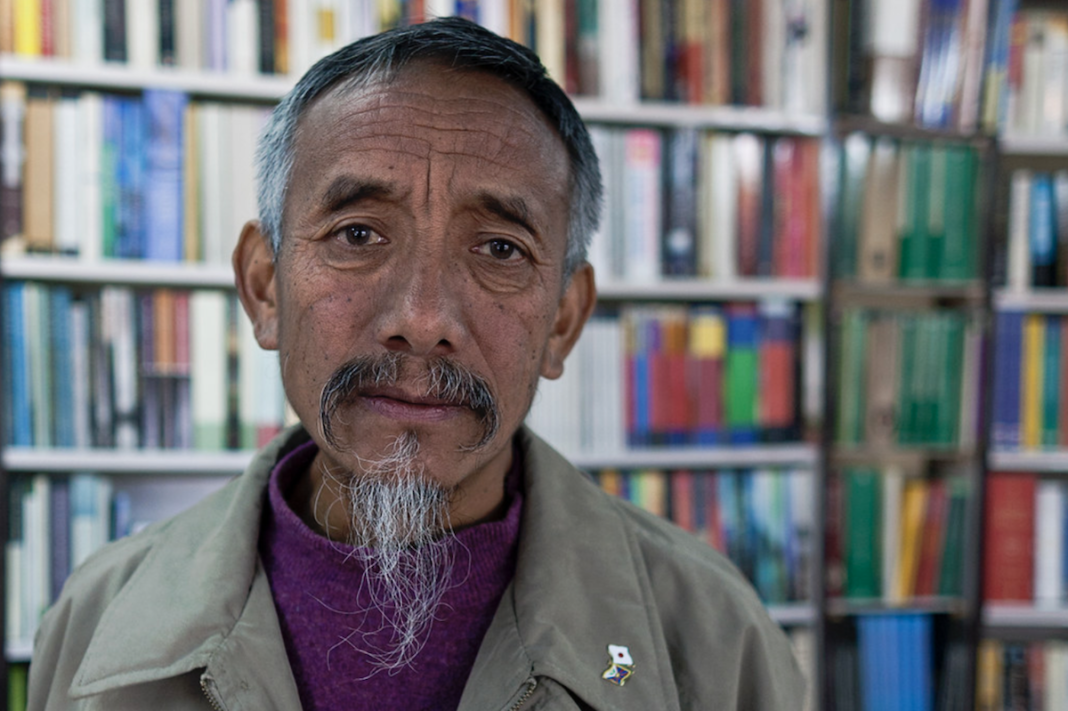
DHARAMSHALA, June 12: Veteran Tibetan independence activist, writer, and poet Lhasang Tsering passed away at the age of 74 at Jampa Ling Old Age Home in Dharamshala, India at 2:22 p.m. on Thursday. His mortal remains are currently being kept at his residence, Exile House.
Born in Tibet in 1952, Lhasang Tsering fled into exile in India with his parents and two elder brothers following China’s colonial occupation of Tibet. In 1962, he enrolled at the Central School for Tibetans (CST) in Mussoorie and later continued his studies at Wynberg Allen School in Dehradun. In 1972, he was offered an opportunity to study medicine at Johns Hopkins University in the United States. However, he chose to forgo the scholarship and instead joined the Tibetan resistance movement based in Mustang, Nepal.
Following the closure of the Mustang resistance camp in 1974, he returned to Dharamshala and went on to become one of the founding members of the Tibetan Research Centre. From 1976 to 1982, he served as principal of the Tibetan Children’s Village school in Upper Dharamshala, assuming the role at the age of 24.
In 1983, under the guidance of the Tibetan spiritual leader, His Holiness the Dalai Lama, Lhasang Tsering joined the Information Office of the Tibetan Government-in-Exile, now known as the Department of Information and International Relations (DIIR) of the Central Tibetan Administration (CTA). During his tenure, he helped expand the operations of Narthang Press and contributed to the development of its computer section.
From 1986 to 1990, he served two consecutive terms as president of the Tibetan Youth Congress (TYC), the largest Tibetan pro-independence organization in exile. He also briefly served as acting editor of Tibetan Review, overseeing the publication from May to December 1986.
Lhasang Tsering was among the founding members of the Amnye Machen Institute, established in 1992 to promote Tibetan cultural and intellectual studies. He remained actively involved with the institute until 1999. He also founded Bookworm, a bookstore in McLeod Ganj that became a gathering place for readers, scholars, and visitors interested in Tibet and its struggle for freedom.
After leaving the Amnye Machen Institute, he dedicated much of his life to writing, research, and educating students, journalists, and visitors about Tibet and the Tibetan freedom movement. His published works include Tomorrow & Other Poems (2003, Rupa & Co., New Delhi), Ocean of Melody: Songs of the Sixth Dalai Lama (translated by Lhasang Tsering, 2009, Rupa & Co., New Delhi), Hold On (2012, TibetWrites), Three Nevers (2012, TibetWrites), Wondering (2012, TibetWrites), and Random: Ideas & Opinions of a Rebel (2014, Blackneck Books, Dharamshala). Beyond poetry, he authored numerous essays and articles on Tibetan history, culture, and politics. He also completed a book titled No, Your Holiness, No!, which remains unpublished.
Throughout his life, Lhasang Tsering remained an outspoken and ardent advocate for Tibetan independence and a passionate lover of literature. He devoted his life to advancing the Tibetan cause through activism, scholarship, and literature, leaving behind a lasting legacy in both the political and cultural spheres of the Tibetan community.


Lhasang Tsering was a man of conviction. He was a man who believed in himself and his own propensity! My earliest recollection is playing football with him at the cricket ground of the National Academy of Administration ground in Mussoorie. He often hit the ball hard in close range to give what we called then ཤ་བག་ལེབ་ It was a way of messaging the opponent to be beware of his own power! He was good at it to show that he was the strong man! He was not that well known among the Tibetan children from Wynberg Allen School while he was a student there. Wynberg Allen School is in Mussorie. He became prominent after he finished school especially during his stewardship of the Tibetan Youth Congress. During this time, he played a pivotal role in shaping the course of the TYC and its image as a powerful organisation that dared to challenge the Chinese occupation of Tibet. He openly talked about a military campaign to launch “pinpointed attacks” on Chinese infrastructure and military targets including bridges. He was both feared and respected by the public for his temper and dedication to the cause. He did give hope to the young Tibetans that the independence of Tibet was the mission of the Tibetan Youth Congress and it was not in any way daunted by the Chinese military might. Communist china was itself caught up in a myriad of troubles and it had little appetite to confront the vociferous damnation by the TYC leader. The Tibet issue was high on the agenda of the international conflicts and Lhasang Tsering was able to ride the surging interest in Tibet thanks to the popularity of the Dalai Lama who soon became an international icon! When the Sera monks demonstrated in the streets of Lhasa in 1987, Tibetan monks from Sera in south India went to New Delhi to show their solidarity with the monks in occupied Tibet. Lhasang Tsering was in New Delhi as thousands of Tibetans gathered to show their solidarity for the protests in occupied Tibet by first the Drepung monks and then the Sera monks!
Lhasang told the gathering, “I cannot thank you for coming to New Delhi to protest because it is a duty befallen upon each one of us”. The Sera monks numbering about sixty demonstrated at the entrance of Mahatma Gandhi Memorial Gardens where tourists constantly visited the site. When a Chinese convoy arrived at the site, they parked the car and went to see the memorial site. Lhasang Tsering was there and he said, “let’s over turn the car and set it ablaze”. We started to push the car to over turn it but the driver or whoever it was alerted the police and we were stopped! We were able to spit through the windows but after that the protesting monks were thrown out of the venue for good! He was driven by sheer animosity of the Chinese enemy and cared little about consequences. He was not afraid of consequences! His commitment to Tibetan independence set him at loggerheads with the Dalai Lama but he was not afraid! He was man driven by conviction and not by devotion. He refused to be a sycophant unlike most Tibetans. He and Jamyang Norbu were the inspiration of a generation of young English speaking Tibetans through their writings and speeches. However, they found themselves estranged owing to the political dynamics of the Tibetan exiles. Tibetan independence Movement will only grow louder as the situation inside occupied Tibet deteriorates and there is no solution insight. Nationalism is surging across the world with liberation movements getting more shrill even in democratic countries such as UK, Canada and Spain. Lhasang Tsering will be remembered for his courage, dedication and devotion to the liberation of Tibet from colonial Chinese occupation. All his works, be it poetry or prose must be published as a tribute to his life long dedication to the cause of Tibetan independence!