
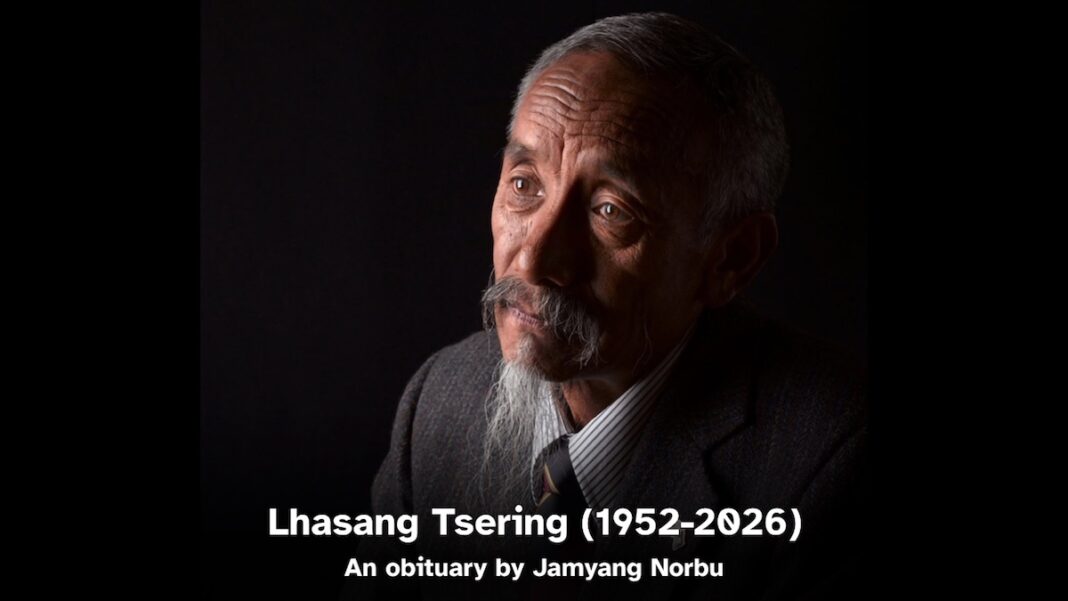

By Jamyang Norbu
Lhasang Tsering was born in Tradun, in Western Tibet, in the Water Dragon year (1952). His father was a Nyingma ngakpa, or tantric master, from the Taklung Kagyu monastery in Riwoche near Chamdo. On his way to Mount Kailash, the ngakpa stopped at Gyangtse, where he took a young maid, Jhanjup, from the Tara aristocrat family as his spiritual consort. One account mentions that he may have successfully treated a member of the Tara family for a severe ailment, though this is not certain. On their long pilgrimage west, this spiritual couple had three sons — Ugyen, Karma Choephel, and Phurba Lhasung (later changed to Lhasang Tsering at Mussoorie school) — all born on the immense and wild Changtang plateau. Lhasang once told me of his fleeting memories of life there: of living in a banak, the black yak-hair tent of the nomads, and of eating dresel, sweet rice with butter — a very special treat, which is why he remembered it.
After the 1959 Uprising, the family escaped to Nepal through Mustang. Lhasang and his older brother Karma Choephel were enrolled in the Central School for Tibetans in Mussoorie, while Ugyen joined the Special Frontier Force at Chakrata. Lhasang was later selected to study at the English-language Wynberg Allen School in the same town. He graduated (ISC first division) from school in 1972, and received an offer (from his missionary sponsor) to study medicine in the United States, but he declined this opportunity and instead joined the Tibetan resistance force based in Mustang, on the Nepal–Tibet border. He joined the force together with his Wynberg schoolmate Tashi Tsering, and Gyalpo Tsering from Dr. Graham’s Homes School in Kalimpong.
I had earlier joined the Mustang force myself and had been trained in intelligence work by the French SDECE. With the support of the Security Department of the exile government and of our commander, Gyato Wangdu, Lhasang, Gyalpo, and I worked on creating a training program in intelligence work for young Tibetan volunteers at Mustang. Unfortunately, with the arrest of our chief of operations Lhamo Tsering by the Nepalese police and the death of commander Wangdu, the program was terminated.
When the Mustang base was closed in 1974, Lhasang worked with me in Dharamshala at the Tibetan Office of Research and Analysis (TORA), headed by Lodi Gyari. Lhasang handled the Russian desk, while I handled the China desk. When TORA was eventually closed by the exile government, Jetsun Pema, the director of the Tibetan Children’s Villages, asked Lhasang to help her develop the TCV elementary school into a proper high school and to serve as its principal, which he did with great success from 1976 to 1982. During those years he was also instrumental in starting the TCV schools at Ladakh and Bylakuppe, and he developed the TCV School in Lower Dharamshala into a regular school for children with parents in exile — which in turn made it possible for children escaping from Tibet to be accepted into the main TCV School. He also lived in Japan for a year in 1978–79, and in 1980 he travelled inside Tibet for some three months.
On the instructions of His Holiness the Dalai Lama, Lhasang joined the Information Office of the exile government in March 1983. Among his achievements there, he developed the Narthang Publications Project and the present Narthang Building, which today houses the Department of Information and International Relations (DIIR). Planning for the computerization of the Tibetan language, he also developed a new font for printing Tibetan.
In 1986 he was elected President of the Tibetan Youth Congress. When the widely publicized protests for independence took place in Lhasa at the end of 1988, and again in March 1989, he responded by organizing demonstrations and hunger strikes in New Delhi and other parts of India. He also travelled widely across India, as well as to the United States, Canada, Europe, Thailand, and Australia, and successfully publicized the issue of Chinese repression in Tibet.
Lhasang was one of the first Tibetans to publicly oppose the Middle Way Policy of His Holiness the Dalai Lama — the policy of setting aside the struggle for independence to seek “genuine autonomy for Tibet within the People’s Republic of China” through peaceful negotiations. In 1989 he was re-elected President of the Tibetan Youth Congress, but because of the difficulties arising from his opposition to the Middle Way Policy, he resigned at the end of 1990.
He then started the first bookstore in McLeod Ganj, the Bookworm — not only to support his family but also to promote a reading culture in the exile capital. His wife and partner, Dorje Lhamo, was instrumental in helping him carry out this remarkable venture, by which many visitors to Dharamshala still remember him. Dorje Lhamo la, who predeceased him, will always be remembered by all of Lhasang la’s friends for her warm-hearted hospitality and generosity to all of them.
In 1992, along with Tashi Tsering, Pema Bhum, and myself, Lhasang became one of the founders of the Amnye Machen Institute (AMI) (Tibetan Centre for Advanced Studies), established to promote an international and secular culture within traditional Tibetan society. From 1992 until 1999 he set aside his personal affairs and rendered full-time voluntary service to the Institute, helping with fundraising, general administration, translation, and editing, among much else. Lhasang’s fundraising and outreach ability was such that he managed to invite the financier George Soros to MacLeod Ganj to meet the directors of AMI specifically to discuss our major project to set up The University of Tibet, in Dharamshala. When Soros’s private plane landed at Kangra airport, we requested the Private Office of His Holiness to lend us their Mercedes car to bring him up to McLeod Ganj, which the Private Office generously did.
Lhasang la resigned from AMI in 1999. In the years that followed, while helping his wife run the Bookworm, he devoted himself to writing, and he never stopped speaking to students, researchers, and journalists about Tibet. His first book, Tomorrow and Other Poems, was published in 2003. His second, Ocean of Melody, a translation of the songs of the Sixth Dalai Lama, appeared in 2009, and his third, Hold On, and Other Verses, in 2010. His last book, No, Your Holiness, remains unpublished. I must mention the many evenings that Lhasang la, myself, and other friends spent in long discussions on history, literature and poetry; and also, the singing of folk songs, which I accompanied on my guitar. Lhasang la and I adapted the famous Woody Guthrie anthem into Tibetan as “Bhod di Khay-gi Ray,” which we sang with other friends, for the enthusiastic pleasure of the children of TCV. The chorus verse and its translation:
Bhöd di khay-gi ray, Bhöd di ngae-gi ray, Shar Dhartsedo nay, Tö Ngari-kor-sum
Jhang tso-ngonpo nay, Lho Kongpoe shingnak, Phayul di ngantso tsangmae ray.
Tibet is your land, Tibet is my land, From Dhartsedo in the East to the “Three Circuits of Ngari” in the West,
From the Great Blue Sea in the North to Kongpo’s forests in the South,
This homeland belongs to you and me.
Incidentally, I am told that Lhasang la wrote a number of lyrics for the Dharamshala rock band JJI.
After a long decline in his health, Lhasang Tsering passed away on 11 June 2026. He is survived by his daughter Norkyi, son Legdup, brothers Ugyen, Tsering Lhundup, and Lobsang Gawa and their respective families.
With Lhasang la’s passing goes one of the clearest and most uncompromising voices of the Tibetan struggle — and, for those of us who knew him, a beloved friend.
The author is a widely respected Novelist, Writer, Historian, Tibetan Independence activist and a Podcaster. He is a Co-founder of Amnye Machen Institute and the Founder of New York based High Asia, a center dedicated to researching and advancing the history, culture, literature and struggle for freedom and dignity of Tibetans. His novel The Mandala of Sherlock Holmes won the Crossword Book Award (“India’s Booker”) in 2000, and has been translated into eleven languages.

