
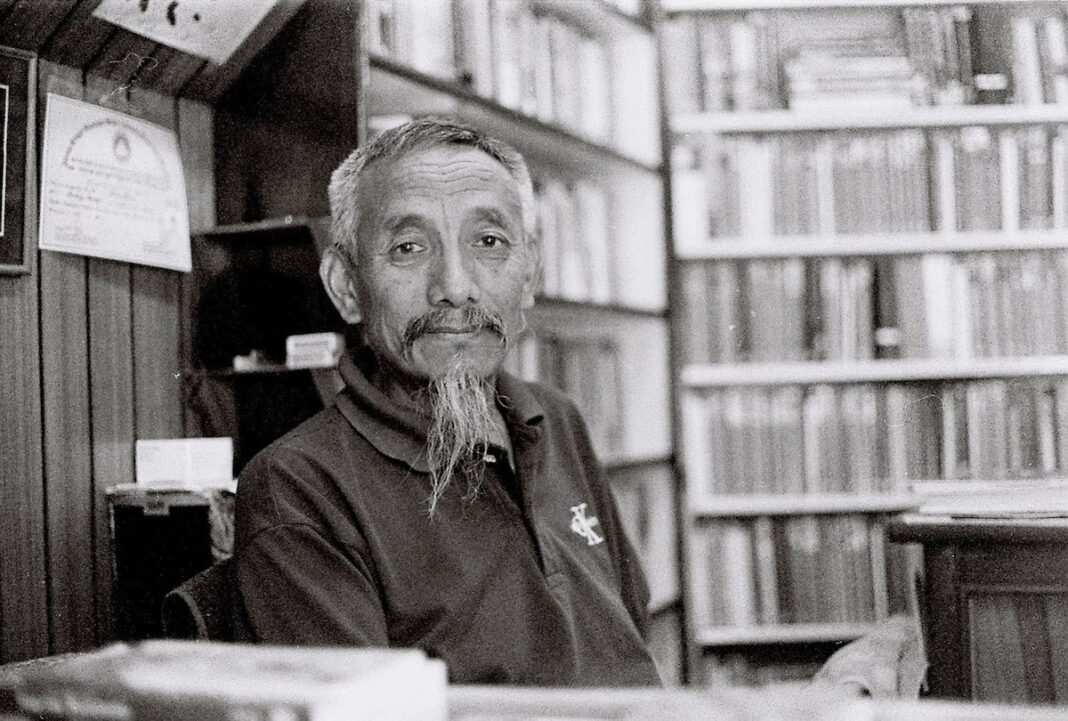

By Christophe Besuchet
I first met Lhasang Tsering in October 1987, while I was on my way to Tibet — or so I thought. The Chinese authorities had just closed the country after the pro-independence demonstrations that had shaken the Tibetan capital a few days earlier. I had planned to stop first in Dharamshala and, as was common in those days, I was carrying letters and parcels that friends abroad wished to send to India. One of them was for Lhasang-la.
The previous year, Lhasang had been elected President of the Tibetan Youth Congress on a clear Rangzen platform, and I was to meet him at the Centrex office in McLeod Ganj. I had been warned that he could be unpredictable, especially with foreigners who opposed Tibetan independence. Although I was already convinced of the need for an independent Tibet, my legs were trembling as I climbed the few steps leading to his office. I was twenty-one, and I had not yet met a figure of such stature and intensity.
Years later, I told Lhasang how afraid I had been before that first meeting. He smiled, and with that smile made me understand that he had known it all along. I had not looked as brave as I had hoped. Yet he had received me with a warmth, respect, and empathy that I have never forgotten. At the time, I had not yet imagined that I would become actively involved in the Tibetan struggle. Perhaps he had sensed something before I did.
In 1994, after he had commissioned me to design a book cover, after I had met him on several occasions and hosted him in my flat in Geneva, I joined the Amnye Machen Institute as a graphic designer. For the following five years, he became one of my directors and a deep source of inspiration. He taught me common sense, integrity, moral responsibility, and dignity.
Lhasang will be remembered for many reasons, not all of them comfortable. He could be difficult, demanding, and at times impossible to appease. The passing years did not make this easier. But no tribute to Lhasang can be complete without honouring Dorjee Lhamo, his wife, who sustained him in ways that were financial, social, emotional, and far beyond any simple description. She was a woman of extraordinary generosity — present, steady, and quietly indispensable to all who came within their orbit. She passed away in 2021.
If Lhasang was unpredictable, his qualities were countless and his devotion boundless. And if he was able to give so much of himself to Tibet, it was also because Dorjee Lhamo stood beside him.
I remember his mood swings and the way he would bang his fist on the table. “I was asked not to bang my fist on the table — well, that’s exactly what I’m doing!” he once roared, striking the table during a debate organised by the Tibetan government on the different paths to be taken for the future of Tibet. But although his temper could be formidable, it did not come from vanity or from a taste for power. It came from a life given tirelessly and entirely to the cause of Tibet. Indifference, apathy, and wishful thinking — especially within Tibetan society itself — wounded him deeply and could send him into fury.
I remember the long nights we spent with Jamyang Norbu and Tashi Tsering, finishing the layout of Mangtso newspaper, while Dorjee Lhamo brought us tea and food as the sun was finally rising. Lhasang was tireless. Yet he would not join us the next day when we went for lunch at Kyran restaurant, in lower Dharamshala, to celebrate the paper’s delivery. He refused any advantage that might come with his position. For him, the cost of a lunch was better saved for the good of the office. He never accepted a salary from the Institute.
I remember the texts of Kahlil Gibran and other poems he would read to me, lying on the bed of his tiny flat in the Nyamlekhang, while Dorjee Lhamo was busy at the stove preparing thukpa. As he read, his whole face and his eyes would light up, like those of a child discovering for the first time the beauty and wisdom of words. He was a voracious reader with a prodigious memory, able to quote entire passages from books to support an argument, or simply for the beauty of the prose. He loved literature, and he loved opening its world to others. To be welcomed into it in such quiet, private moments was a rare privilege.
I remember his stories about the Indian type designer, a hard-working man from Mumbai, who would go home twice a day to change into immaculate white clothes. They had worked together to produce the metal type characters for the new Narthang printing press. In that task, Lhasang had shown extraordinary vision. Since metal was expensive, he devised a method to calculate the frequency of each Tibetan letter, based on different kinds of literature, including children’s books, in order to determine the right quantity of each character to produce. As Lhasang often lamented, this work might even have served as the basis for a native Tibetan keyboard, had the Tibetan establishment of the time not been so resistant to change and personal initiative.
It is no surprise that he became a strong supporter of what we then called “desktop publishing” in the early days of computers. Nor was he hesitant to spend money on a proper Apple workstation — something almost unknown in Dharamshala at the time — when it was needed for the production of our publications.
I also remember him telling me how Jetsun Pema, the younger sister of the Dalai Lama and then Director of the Tibetan Children’s Village, was astonished to meet him unexpectedly on the road to Chamdo during her tour with the third fact-finding mission in 1980. Lhasang had not been invited and was supposed to be at his post as Principal there. But he wanted to judge for himself the real situation in Tibet. He had secretly entered the country and travelled to Kham for that purpose.
He was fearless, and never afraid to take risks in order to see the truth for himself.
Lhasang Tsering, together with his comrade-in-arms Jamyang Norbu, had an immense impact on Tibetan society and politics — an impact that will probably never be fully measured or understood. Much of what later became part of Tibetan political consciousness was shaped, directly or indirectly, by their commitment, farsightedness, and intellectual integrity. They inspired countless Tibetan men and women to stand up and keep faith in a brighter future.
Lhasang walked the talk. He sacrificed comfort, security, recognition, and ease, even when this brought ostracism, marginalisation, and criticism from the very society he sought to awaken.
I had known for some time that Lhasang was unwell. I kept postponing a trip to Dhasa for reasons that, in the end, were not reasons at all. Now that Lhasang Tsering is no more, I cannot forgive myself for not having gone to see him while I still could.
His was a life given to Tibet. May it never be forgotten.
The author is a long-time observer of Tibetan affairs. He is the former publisher of Lungta magazine, co-founder of the Swiss Tibet Support Group, and the author of several maps of Tibet and Lhasa. From 1994 to 1999, he worked as a graphic designer at the Amnye Machen Institute in Dharamshala, India.

