

Tenzin Nyidon
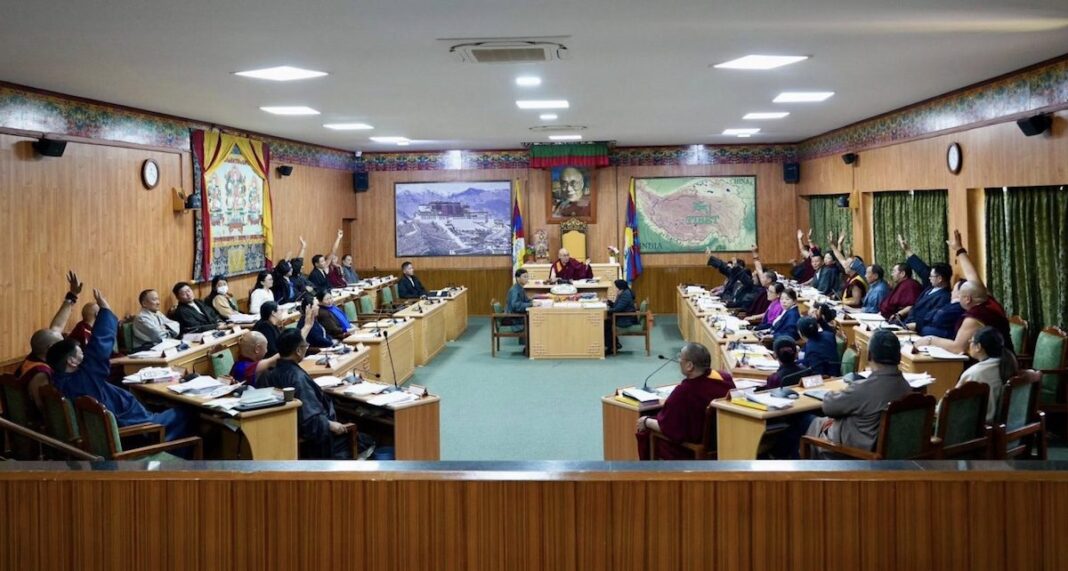
DHARAMSHALA, March 26: Lawmakers of the Tibetan Parliament-in-Exile, during the ongoing budget session on Thursday, formally adopted a comprehensive set of rules regulating the use of the Tibetan national flag, emblem, and national anthem. The legislation, titled “Rules and Regulations for the Use of the Tibetan National Flag, Emblem, and Anthem,” was passed following its second reading after extensive deliberations and is set to come into force on May 25, 2026.
The bill, introduced by Central Tibetan Administration President Penpa Tsering and supported by Security Minister Gyari Dolma, incorporated a several amendments. These amendments addressed multiple provisions, including Articles 2, 3, 8 (clauses i, iv, v, viii, xii, and xiii), 9 (clauses ii(d), iii, iv(a), (b), and (c)), 17 (clauses vi and vii), 22 (clauses i, ii, iii, and iv), and 23, refining the scope and enforcement of the regulations.
The newly adopted framework establishes clear guidelines to prevent misuse of the national symbols. It explicitly prohibits commercial exploitation, improper display, and any form of desecration of the Tibetan national flag, emphasizing that it must be treated with utmost respect and dignity. The rules also set out detailed protocols for official flag hoisting, ceremonial standards, and provisions governing the lowering of the flag to half-mast during periods of mourning or national significance.
Under the regulations, the Tibetan national flag is not to be used as a covering, drapery, or decorative material on podiums, buildings, or objects. Its use on items such as clothing below the waist, cushions, towels, shoes, socks, or napkins is strictly forbidden. Additionally, the flag must not be displayed on the same pole alongside other flags, nor may it bear any inscriptions or markings.
The act also defines desecration, stating that no Tibetan national shall publicly burn, deface, soil, trample upon, or otherwise disrespect the flag or any part of it. Violations of the regulations may result in warnings and corrective measures, while serious or repeated misuse, including acts of desecration, may result in stricter penalties such as fines, suspension of voting and electoral rights, or other disciplinary actions, with desecration specifically punishable by a five-year loss of voting rights.
Guidelines for official flag hoisting specify key occasions, including Losar (Tibetan New Year), Tibetan Uprising Day, the birthday of His Holiness the Dalai Lama, Tibetan Democracy Day, and the anniversary of the Nobel Peace Prize conferred on the Dalai Lama. The flag may also be displayed alongside the host nation’s flag during significant national events.
Provisions on half-masting outline that the flag shall be lowered upon the death of senior officials such as the Chief Tibetan Justice Commissioner, the Speaker of Parliament, and the President. The Cabinet may also direct half-masting in special circumstances, including to honour individuals who have made exceptional contributions to Tibet, world peace, or humanity, as well as during natural disasters or national calamities.
The regulations further impose strict controls on the use of the national emblem, prohibiting its use without authorization from the CTA Cabinet and banning any commercial or trademark-related usage.
Regarding the national anthem, the rules mandate that individuals must stand upright with composure and attentiveness when it is sung, refraining from movement and participating respectfully.
In addition, lawmakers passed amendments to Article 4 concerning the historical account of the Tibetan national flag, proposed by Parliamentarian Geshe Atong Rinchen Gyaltsen and supported by Geshe Lharampa Gowo Lobsang Phende.
Another amendment to Article 7, addressing the flag’s color specifications, was introduced by Parliamentarian Tsering Lhamo and supported by Geshe Lharampa Atuk Tseten. The revised provision noted that the flag must not be used in any manner inconsistent with its prescribed colors, design, or form.


The most important thing for Tibetans is to respect Tibetan independence! That is the inviolable fact of Tibet’s nationhood and statehood. Anyone who feels for their country, they invariably think of the country with whom they identify with. You can often see athletes standing on the podium shedding tears of joy and be honoured to represent their country. Tibetan independence is the most sacred national pride of the Tibetan people. It goes to demonstrate a sense of belonging to a state they identify with as their sacred nation. It is the most sacred national pride of every Tibetan. However, as bad luck would have it, today among the Tibetan exiles, it has become a dirty word! This alone demonstrate the shocking loss of national pride and love for one’s country. As the Tibetan saying goes, མི་ལ་བསོད་ནམས་མེད་ན་ གསེར་ཡང་བྱེས་མར་གྱུར་ (when luck runs out even gold turns into dust), this is exactly what happened to the Tibetan exiles! They have forfeited independence for foreign domination. Even the few die hard independence advocates are vilified, disparaged and denigrated with malicious intent! The flag is just a symbol of Tibetan nationhood. If you have forfeited independence, there is nothing for the flag to represent. It is only a hollow symbol signifying nothing! Therefore, instead of tampering with the flag and make rules that are irrelevant, RESPECT TIBETAN INDEPENDENCE AND ITS ADVOCATES! THEY ARE THE ONES WHO ARE VINDICATING TIBETAN NATIONHOOD AND VALIDATE THE FLAG AS THE TIBETAN NATIONAL SYMBOL!