

By Kaydor Aukatsang
A Law That Closes a Door
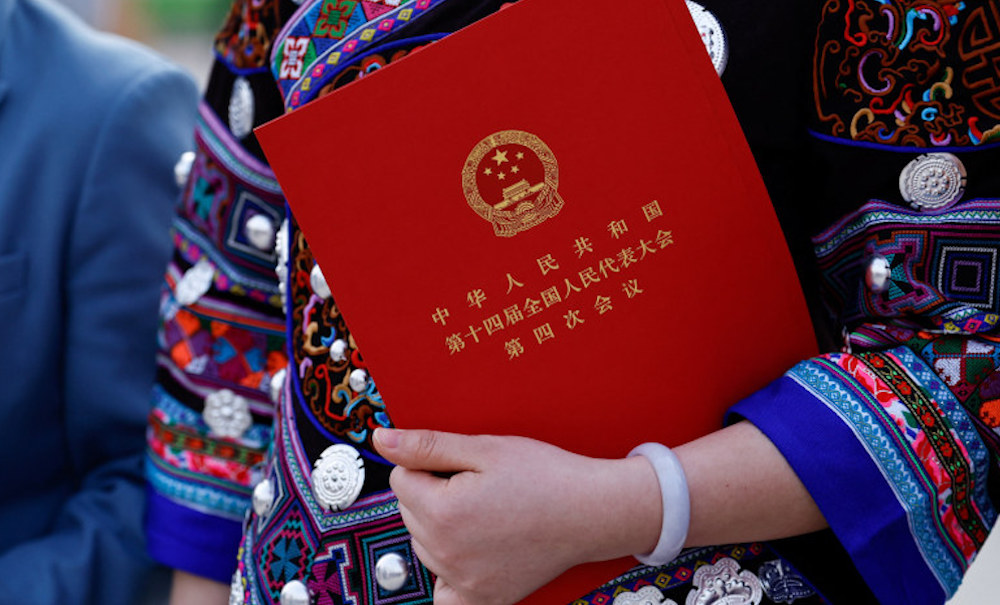
On March 12, 2026, the National People’s Congress — widely regarded as a rubber-stamp legislature whose primary function is to formalize decisions made by the Chinese Communist Party’s Politburo Standing Committee — adopted the Law on the Promotion of Ethnic Unity and Progress. Set to take effect on July 1, 2026, the law represents a culmination — the legal codification of a policy of assimilation that has been building steadily since Xi Jinping became the President of China.
For Tibetans, Uyghurs, Southern Mongolians, and other “minority” communities across China, the law’s significance lies precisely in what it forecloses. Even as space for cultural survival and limited self-governance narrowed under Xi Jinping, it retained a theoretical existence — space that could be appealed to, negotiated over, or incrementally expanded. The 2026 law eliminates that ambiguity. It establishes a permanent legal foundation for the systematic assimilation of minority cultures, languages, and identities into a single, Han-centered Chinese national identity.
For the Tibetan leadership in exile, the implications are profound. Nearly five decades of diplomacy, dialogue, and calibrated compromise have been anchored in a single proposition: that meaningful autonomy within China remained possible. The 2026 law does not engage with that proposition — it forecloses, one by one, the very possibilities that proposition was designed to secure.
The Intellectual Roots of Assimilation
The 2026 law did not emerge in isolation. Its intellectual foundations were laid years before Xi Jinping came to power, in debates within China’s policy and academic establishment about the long-term viability of its approach to ethnic minorities.
As early as the 2000s, Ma Rong, a professor at Peking University, argued that China’s existing ethnic policies were entrenching divisions rather than building cohesion. He called for “de-ethnicization” — a deliberate shift away from institutionalized ethnic distinctions toward a unified national identity. These arguments were amplified by Hu Angang and Hu Lianhe of Tsinghua University, who in 2011 explicitly called for a “second-generation ethnic policy“ to replace regional autonomy with deep integration: the deliberate absorption of minority nationalities into a single Chinese identity.
This intellectual current found its political home under Xi Jinping. Since consolidating power in 2013, Xi moved China decisively away from even the limited cultural accommodation that had characterized earlier decades. In Tibet, this has meant expanding mass surveillance, restricting the Tibetan language in schools, closing private Tibetan educational institutions, and placing large numbers of Tibetan children in state-run boarding schools where instruction emphasizes Mandarin, Chinese culture, and loyalty to the Party. Religious institutions have come under intensified state oversight and China has been accused of Sinicization of religion.
For those watching Tibet closely, the 2026 law contains few surprises. Its significance lies not in what it introduces but in what it permanently forecloses.
The Middle Way and the Memorandum
To understand what the 2026 law forecloses, it is necessary to understand what Dharamsala, the seat of the Tibetan Government-in-Exile, spent decades building.
Each morning at around 4 a.m., the 14th Dalai Lama begins his day with tonglen (གཏོང་ལེན་) — a Tibetan meditation and mind training practice in which the practitioner absorbs others’ suffering and returns compassion in its place. In this practice, the 90-year-old Tibetan spiritual leader symbolically absorbs the hostility of the Chinese government and responds with compassion and a commitment to dialogue with his adversaries in Beijing. This ethic is not merely spiritual; it has shaped the political strategy of the Tibetan freedom movement for nearly half a century.
In the late 1970s, the Dalai Lama made a decision that would define the Tibetan freedom movement for generations: he renounced the demand for full independence. In its place, he advanced the Middle Way Approach (MWA) — a principled, non-violent path between the two extremes of outright independence and complete assimilation.. What Dharamsala sought was genuine autonomy and self-governance within China: Tibetan control over language, culture, religion, education, environmental protection, population migration, and local governance.
This position was shaped by two forces. The first was the Dalai Lama’s identity as a Buddhist monk, for whom non-violence and dialogue are not tactical choices but moral imperatives. The second was hard information from the ground — including reports from four fact-finding delegations sent to Tibet between 1979 and 1985. He also drew encouragement from Deng Xiaoping’s reported 1979 statement that “apart from independence, all issues can be discussed,” and from the relative openness of the early reform period in Tibet (1978-1987).
Even as that opening closed — most sharply with the crackdowns following the Lhasa protests of 1987–1989 — the Dalai Lama did not waver. International recognition and support, including the Nobel Peace Prize in 1989, did not lead him to escalate his demands. He continued to seek only genuine autonomy and self-governance.
Back-channel contacts, often facilitated by his elder brother Gyalo Thondup, eventually led to the resumption of formal talks in 2002. Between September 2002 and January 2010, representatives of the Dalai Lama and Chinese government officials held nine rounds of dialogue. The fullest expression of the Tibetan position came during the eighth round, in October 2008, with the presentation of the Memorandum on Genuine Autonomy for the Tibetan People.
The Memorandum outlined eleven areas for meaningful self-governance: language, culture, religion, education, environmental protection, natural resource management, economic development and trade, public health, public security, population migration, and international cultural and religious exchanges. Each reflected Tibetan aspirations to preserve a civilization with its own language, a distinct spiritual tradition, and a continuous history stretching back more than a millennium.
The Memorandum made no appeal to international law or the right to self-determination. It was framed entirely within China’s own constitutional and legal framework — including the Law on Regional National Autonomy — presenting genuine Tibetan autonomy not as a challenge to Chinese sovereignty, but as a call for existing legal provisions to be genuinely honored. Beijing rejected it as “independence in disguised form.”
What the Law Forecloses
The incompatibility between the 2026 Ethnic Unity Law and the Memorandum on Genuine Autonomy is not a matter of emphasis or degree. It is structural and total. The two frameworks move in opposite directions. Where the Memorandum seeks space, the law closes it. Where the Memorandum appeals to Chinese law, the new law rewrites what Chinese law means in practice.
- Language. The Memorandum demands Tibetan as the primary language in education and public life, as provided for in China’s own constitution. The new law establishes Mandarin as the dominant medium of instruction and governance, with Tibetan reduced to a marginal, secondary role.
- Religion. The Memorandum envisions Tibetans managing their own religious institutions and practices. The law reinforces state oversight and requires Tibetan Buddhism to be adapted to serve the interests of the state and Party.
- Education. The Memorandum advocates for local control over curriculum and language of instruction. The law mandates centralized ideological education built around Party loyalty and a unified national identity.
- Security. The Memorandum emphasizes local control over internal security. The law consolidates all coercive authority in Beijing.
- Migration. The Memorandum reserves Tibetans’ right to regulate demographic change within their homeland — a provision of existential importance given the scale of Han migration into Tibetan areas. The law actively promotes population mobility, inter-ethnic marriage, and ethnic “intermingling” policies that in practice accelerate the dilution of the Tibetan demographic presence in Tibet.
- External relations. The Memorandum insists on freedom to maintain international cultural and religious exchanges — connections that sustain Tibetan identity and keep Tibet visible to the world. The law subjects all external contacts to central control and frames minority communities’ international ties as potential threats to national unity.
On key areas that matter, the law moves in the precise opposite direction from the Memorandum. It does not narrow the distance between Beijing and Dharamsala. It eliminates the ground on which any convergence could stand.
A Strategic Crossroads
For nearly five decades, the Middle Way Approach has rested on a core conviction: that Beijing could be persuaded — through dialogue and compromise — to honor its own legal framework and accommodate Tibetan aspirations within it. The Memorandum remains the most comprehensive and legally grounded articulation of that conviction.
The 2026 law calls that conviction into question.
The Middle Way Approach remains a valid moral and political philosophy. Its commitment to non-violence, dialogue, and coexistence retains enduring relevance and commands broad respect and support — among majority of Tibetans and many in the international community including many in the Chinese community. But its principal operational instrument — the Memorandum — now confronts a Chinese legal order that explicitly forecloses the outcome it seeks. The prospect of genuine autonomy and meaningful self-governance has been formally and legally denied. China has now committed itself, in law, to precisely the outcome the Middle Way was designed to prevent: complete assimilation.
The implications are immediate and difficult:
- Can the Memorandum continue to serve as a basis for engagement when the legal ground it stood on has been legislated away?
- How can autonomy be negotiated when assimilation is codified as state policy?
- What does dialogue mean — and how can it be meaningfully pursued — with an adversary whose new law requires, in effect, that Tibetans cease to be Tibetan?
These are not questions that challenge the values underlying the Middle Way Approach. They are questions about how those values can find effective expression in a landscape that has changed dramatically and perhaps permanently. The Memorandum was an act of faith — that dialogue was possible, that compromise was achievable, that Beijing’s own laws meant what they said. The 2026 law quietly extinguishes each of those assumptions, one by one.
What Comes Next
The 2026 law does not merely constrain Dharamsala’s options — it demands strategic reassessment.
A constructive next step would be for the Central Tibetan Administration (CTA) to convene a Special General Meeting — bringing together Tibetan representatives from across the diaspora to deliberate collectively on the implications of the 2026 law and chart a future course. The last such gathering, held in Dharamsala in October 2019, brought together nearly 350 delegates to discuss the long-term vision for the Tibetan freedom movement and the relationship between the lineage of the Dalai Lama and the Tibetan people. The challenges posed by the 2026 law are no less consequential — and they demand the same seriousness of collective reflection, and perhaps greater urgency.
The Middle Way Approach was conceived as a path between two extremes: independence on one end, assimilation on the other. China has now formally and legally committed itself to the latter. As a result, the foundational assumption underpinning five decades of Tibetan strategy — that genuine autonomy remains negotiable — appears increasingly untenable.
What Dharamsala does next may be the most consequential decision the Tibetan leadership has faced since the Dalai Lama first chose the path of dialogue and compromise over independence, nearly half a century ago.
(Views expressed are his own)
The author is a former Representative of His Holiness the Dalai Lama to North America and has served the Central Tibetan Administration as the Chief Resilience Officer and Director of SARD under the Department of Finance.


The whole idea of the so called “ethnic unity law” is essentially a law to legalise ethnic cleansing! It is to scrub the people of occupied territories such as Tibetans and Uyghurs, Mongols and other groups to be absorbed into Han population by erasing their language, culture, religion and identity! It is said, the Chinese saw the disintegration of the fifteen Soviet Republics as the USSR was dissolved in the aftermath of its collapse in 1991. The Chinese communists are feeling that history will be repeated if Tibetans and other ethnic groups that have been forcibly conquered and their land forcibly occupied are allowed to retain their unique features in terms of language and culture. They are fearful that the danger for them to go their separate ways is always present! After all, no people want to be enslaved by a totalitarian dictatorship like communist China! Therefore, they have decided to supplant the ethnicity of all its conquered territories to be created into a monolithic Han centred entity in order to ensure to built a Chinese empire that cannot fall apart! This is an illusion! Any forced unity may seem superficially stable but it is only retained by force and oppression. It will last as long as the centrifugal power dynamic is strong but once the centre of power weakens, it will fall apart! We have seen this in the USSR and Yugoslavia. In fact all empires fall apart in the end. Even so, this is a grave danger to the survival of the unique and very precious language, religion and culture of the Tibetan people. IT IS MURDER OF TIBET AND ITS CIVILISATION! In modern political lexicon, IT IS ETHNIC CLEANSING PURE AND SIMPLE! Therefore, there is no other option than fight for Tibet’s historical right to independence! Tibet was an independent nation from 127 CE until the Chinese occupation and the Dalai Lama’s flight into exile on 17th of March 1959. Tibetans should know that there are many liberation movements across the world. It’s not only us who are fighting for independence. India itself achieved independence from Britain after almost three centuries. We must not think we are alone in our struggle either. According to Prof Dawa Norbu, “the strategic importance of Tibet is lost neither to China nor India. The apparent lack of interest that New Delhi now shows in the Tibetan question should not be misconstrued as lack of strategic appreciation of Tibet; it is more a diplomatic posture of accepting the Chinese reality in Tibet”. “Given the chance, and in the absence of the Chinese, to reassert its political its political power in Tibet, even Nehruvian India would have prepared to pursue essentially the same policy as that of the British did in the past”. As Nehru stated in December 1950, “FROM TIME IMMEMORIAL, THE HIMALAYAS HAVE PROVIDED US WITH MAGNIFICENT FRONTIER. WE CANNOT ALLOW THAT BARRIER TO BE PENETRATED BECAUSE IT IS ALSO THE PRINCIPAL BARRIER TO INDIA”. Dawa Norbu goes onto say,”This policy was designed to make Tibet a buffer state among the great imperial powers that surround the Himalayan piedmont-India, China and Russia”. Former diplomat and author Dilip Singh writes in his recently released book-IMPERIAL GAMES IN TIBET- The Struggle for Statehood and Sovereignty: “whether Britain ever contemplated making Tibet an independent country is hotly debated subject, especially in India, where many believe that Britain intended to use Tibet as a buffer against China, a prudent policy abandoned by independent India”. He also writes:”TIBET’S STATUS IN INTERNATIONAL RELATIONS REMAINS DISPUTED”. Owing to its strategic location in the hearts of Asia, Tibet is strategically important to India for its national security. Therefore, India will not abandon Tibet. The Dalai Lama will be instrumental in cementing Tibet’s historical relation with India and the legitimacy of the Tibetan independence Movement for the Tibetans in occupied Tibet. The most important future task at hand is to make sure the reincarnation of the present Dalai Lama is secure and gain the same level of legitimacy and international recognition as the 14th Dalai Lama Tenzin Gyatso. That is the pillar of the Tibetan independence movement. The thrust for future should be to gain recognition of the Tibetan Government in India and galvanise international support for Tibetan independence by exposing the colonial and imperialist occupation of Tibet and the sinister policy of stealth ethnic cleansing and cultural genocide perpetrated by communist China! The whole attempt by the CCP law is to ethnically cleanse the Tibetans in order to dispossess Tibet by Tibetans and claim ownership of it by communist China. In the same vein calling for the sinofication of Tibetan Buddhism is to sabotage Buddhism and destroy it completely as it directly challenges Tibetan people’s loyalty to the CCP! It is also breeding nationalist Tibetans such as the monks and nuns and so the CCP wants it to be totally eradicated! In short, TIBETAN NEVER FACED SUCH GRAVE DANGER FROM ANY ENEMY IN OUR LONG HISTORY OF 3500 YEARS. THE EVIL CCP IS AN EXISTENTIAL THREAT TO THE MARVELLOUS TIBETAN CIVILISATION THAT HAS NURTURED A PEOPLE FULL OF LOVE AND COMPASSION. THERE IS NO WAY WE CAN ALLOW THIS AND EVERY TIBETAN MUST BEAR THE RESPONSIBILITY TO SAVE OUR LANGUAGE, CULTURE, RELIGION AND OUR IDENTITY FROM TOTAL DESTRUCTION BY THE EVIL TOTALITARIAN KILLER REGIME OF CHINA!