

Tenzin Nyidon
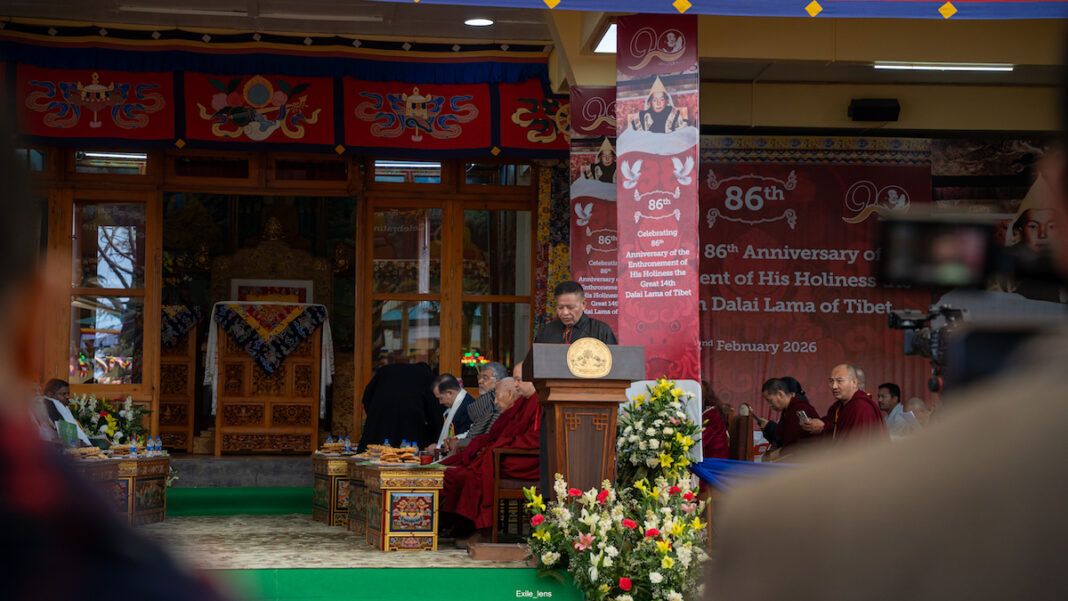
DHARAMSHALA, Feb. 22:The Central Tibetan Administration (CTA) commemorated the 86th anniversary of His Holiness the 14th Dalai Lama’s enthronement with a solemn ceremony at the Main Tibetan Temple in Dharamshala on Sunday. The event marked the historic day when His Holiness was formally enthroned on the Golden Throne at the Sishi Phuntsok Hall within the Potala Palace in Lhasa on 22 February 1940.
The ceremony was attended by Nobel Peace Laureate Kailash Satyarthi and former Kalon Tripa Samdhong Rinpoche, who graced the occasion as Chief Guest. Also in attendance was Kundeling Tatsak Rinpoche. Guests of Honour included Adrian Michael A. Amatong and Rufus B. Rodriguez from the Philippines’ House of Representatives, alongside representatives of diverse faiths and Indian communities, including Shri Ajay Kumar Sharma, Muhammad Kamil Jamie, Rev. Victor Khojee, and Sarbjeet Singh, reflecting the interfaith and intercultural solidarity expressed on the occasion.
In a statement delivered by the CTA President Penpa Tsering on behalf of the Cabinet, it emphasised the historical and political significance of the enthronement. The statement noted that the anniversary is not only an occasion to honour His Holiness’s ascension but also to recognise his lifelong dedication to compassion and non-violence.
Highlighting the historical context of the 1940 ceremony, the statement recalled that the Gaden Phodrang Government had formally granted permission to representatives of the Chinese Kuomintang Government, the British Government, and neighbouring nations, including Sikkim, Nepal, and Bhutan, to pay obeisance and present tributes at the enthronement, and received them accordingly.
Addressing what it described as persistent misinformation from Beijing, the Cabinet rejected claims propagated by the government of the People’s Republic of China. It stated that the Chinese authorities “persistently propagate the falsehood that the Kuomintang representative presided over the ceremony and that Regent Reting Rinpoche submitted a petition requesting exemption from the so-called ‘Golden Urn Lottery.’” The statement asserted that “innumerable archived documents and successive scholarly works have not only debunked these false claims but also brought the actual facts to light,” reaffirming the Tibetan administration’s position on the historical legitimacy and sovereignty reflected during the enthronement ceremony of 1940.
Guests of Honour Adrian Michael A. Amatong and Rufus B. Rodriguez, Members of the House of Representatives of the Philippines, paid heartfelt tribute to His Holiness on the anniversary of his enthronement and conveyed their solidarity with the Tibetan people. In his address, Representative Rodriguez expressed pride that the Republic of the Philippines conferred upon His Holiness the prestigious Ramon Magsaysay Award for Community Leadership in 1959, an honour that continues to be held in high esteem by the Filipino people.
Speaking with evident pride, he stated, “As a Filipino, I am proud and privileged that our country, the Republic of the Philippines, gave His Holiness the great fortune the Dalai Lama gave the most prestigious award the Philippines could ever give, and that is the Ramon Magsaysay Award in 1959. Ramon Magsaysay was one of the most beloved presidents of the Republic of the Philippines, a man of the masses, opening Malacañang Palace to all the residents and constituents of the Philippines. He died unfortunately, in a plane crash in 1957, but his memory lives on, and the memory of your 14th great Dalai Lama receiving the Ramon Magsaysay Award is still very well known and remembered by the Filipino people in the Republic of the Philippines.”
In his keynote address, Nobel Peace Laureate Kailash Satyarthi described the 86th enthronement anniversary as “a journey of 86 years that has cut through darkness and moved toward light.” He observed that since his enthronement, His Holiness has continued to carry that light forward for the benefit of humanity.
Reflecting on the early life of His Holiness the 14th Dalai Lama, Satyarthi noted that a child born into an ordinary family was placed upon the Golden Throne at the tender age of four. However, he emphasised that the greatness associated with the throne derived not from the seat itself, but from the individual who occupied it. The radiance and moral authority later witnessed by the world, he said, “did not come from the throne itself but from within him — his wisdom, spiritual strength, and inner radiance.” Indeed, he added, the throne became extraordinary because the Dalai Lama sat upon it.
Satyarthi further asserted that no government or political authority, irrespective of its power or wealth, possesses the moral legitimacy to appoint a Dalai Lama in place of His Holiness, either now or in the future. He described the institution of the Dalai Lama as a distinct and sacred spiritual tradition, maintaining that the recognition of the next Dalai Lama rests solely within the established religious process and under the guidance of His Holiness.
“Even if he lives to 110 years, the next Dalai Lama will be the one chosen according to this tradition — no one else can decide that,” Satyarthi stated, highlighting the sanctity and autonomy of the centuries-old institution.

