

Tenzin Nyidon
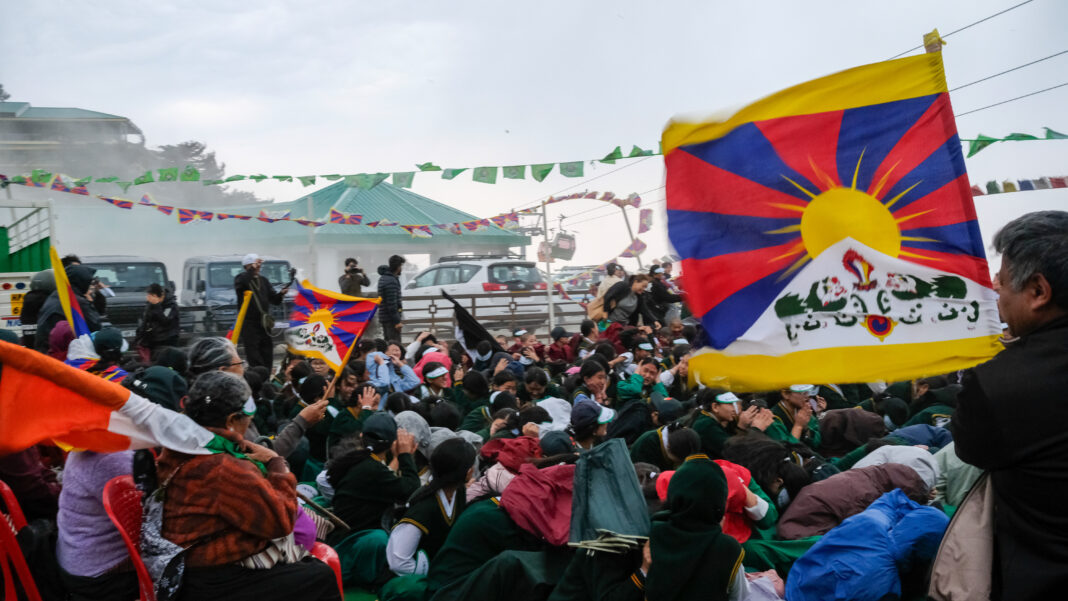
DHARAMSHALA, March 12: Members of the Tibetan Women’s Association (TWA) central and regional chapters commemorated the 67th anniversary of Tibetan Women’s Uprising Day in Dharamshala on Thursday, with Kewtsang Rinpoche attending as the chief guest of the ceremony.
The event, held to honour the historic role of Tibetan women in the Tibetan freedom movement, saw comparatively lower public participation than the annual commemoration of Tibetan National Uprising Day on March 10. The opening ceremony was briefly disrupted by a sudden thunderstorm, and the planned march rally to Kacheri was called off shortly afterward due to rain.
Attendance at the ceremony comprised schoolgirls whose participation was mandatory, a small number of nuns, around one hundred elderly and younger women, and approximately twenty men. The relatively modest turnout was lamented by TWA President Tsering Dolma, who expressed concern over the level of public engagement.
Addressing the gathering, Tsering said that organizers sometimes feel discouraged when participation in activities related to the Tibetan cause remains limited. She suggested that a lack of historical awareness, particularly among the younger generation, may be one of the key reasons behind the low turnout. “When we organize activities and give our best effort to carry them forward, and people do not participate, it is not necessarily because they lack responsibility,” she said. “Many may simply not fully understand the historical struggles and sacrifices that took place in Tibet. But when participation is low, it still leaves us with feelings of concern and worry.”
Tsering urged Tibetans in exile to take collective responsibility in supporting community initiatives and commemorations tied to the Tibetan freedom movement. She also encouraged elders to share historical knowledge with younger generations so that the events and sacrifices of the past are not forgotten.
Speaking on the historical significance of the day, she stressed that the contributions of Tibetan women to the resistance against Chinese rule were immense and should not be overlooked by either institutions or individuals. “The sacrifices made by Tibetan women are far too significant to be ignored,” she said. “Sometimes people attend these events and sometimes they do not, or they treat them casually. This is not appropriate. Both the government and individuals must recognize and honour the importance of this day.”
In his address, the chief guest Kewtsang Rinpoche, echoed similar concerns about declining awareness and participation. He stressed the importance of strengthening Tibetan institutions and community organizations to ensure unity and collective responsibility.
Reflecting on earlier decades of resistance, he recalled that in the past, large numbers of Tibetans gathered in places such as the Jokhang area and Barkhor in Lhasa to express solidarity and resistance through songs and demonstrations despite severe risks. “Many brave individuals risked their lives for the Tibetan cause. Many were arrested, and some were sentenced to fifteen or twenty years in prison,” he said. “These stories must continue to be told, because they truly happened and are part of our collective history.”
Rinpoche also spoke about the current situation inside Tibet, describing the region as heavily militarized and tightly controlled by Chinese authorities. He expressed concern over restrictions on movement, the suppression of the Tibetan language and culture, and the difficulty Tibetans face in openly displaying images of the Dalai Lama. “From the outside it may appear that systems and institutions exist, but in reality there is still no real freedom,” he said, adding that the future of Tibetan identity and language remains a serious concern as many Tibetan children are increasingly educated in Chinese-language institutions.
Many say that the exile Tibetan government, officially known as the Central Tibetan Administration (CTA), should mark March 12 with the same official prominence as March 10. March 12 has long been recognized as a significant day in the history of the Tibetan resistance. During the administration of former CTA President Lobsang Sangay, the date was rebranded as “Tibetan Women’s Day,” a move that drew strong criticism from the TWA and other supporters who argued that the original political significance of the day should not be diluted.
In 2018, then TWA President Dolma Yangchen publicly opposed the change, stating that March 12 represents a pivotal moment in Tibet’s political history and should continue to be observed as Tibetan Women’s Uprising Day. The organization also appealed to the CTA cabinet to reverse the decision. On February 5, 2022, the 16th Cabinet under President Penpa Tsering issued an internal notice to all CTA departments officially reinstating the designation of the day as Tibetan Women’s National Uprising Day.
The origins of the historic day date back to March 12, 1959, when Tibetan women led by Pamo (female martyr) Kusang organized a peaceful protest outside the Potala Palace in Lhasa against the Chinese Communist government’s invasion and occupation of Tibet. Around 15,000 Tibetan women from various regions gathered in what became the first organized women’s uprising in Tibet’s modern history.
A decade later, Kusang was executed by Chinese authorities for her role in the resistance. Many other women lost their lives in the subsequent crackdown, while countless others were imprisoned and subjected to torture without trial.


It must be Tibetan Women’s National Uprising Day because at the time in Lhasa, Tibetan women from all over the Tibet took part in the demonstration, risking their lives. Unfortunately many brave women who took part in the demonstration were executed by ruthless CCP, and many perished in prison by ruthless torture and inhuman conditions. We should never forget the courage and sacrifices of Tibetan women who took part in the demonstration on March 12, 1959 in front of the Potala place. Therefore, I am for Tibetan Women’s National Uprising Day.