

Tenzin Nyidon
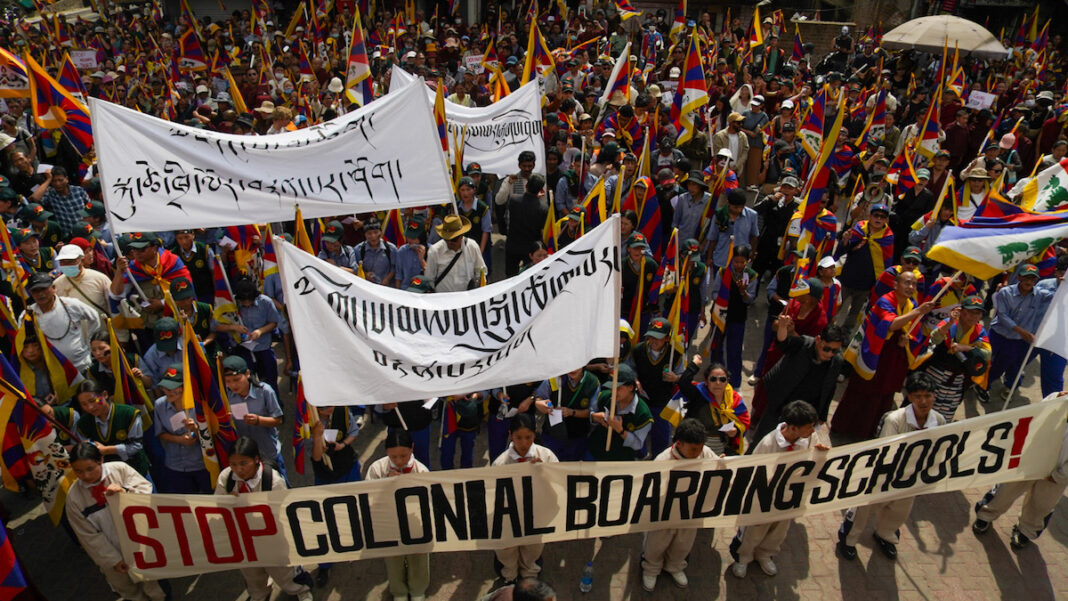
DHARAMSHALA, March 10: Thousands of Tibetans in exile took to the streets of Dharamshala on Tuesday to mark the 67th anniversary of the Tibetan National Uprising Day, commemorating the historic moment in 1959 when tens of thousands of Tibetans gathered in Lhasa to protect their revered leader His Holiness the Dalai Lama and rose in defiance against China’s illegal occupation of Tibet.
The 67th anniversary of the poignant event was marked during an official ceremony organised by the exile Tibetan government, formally known as the Central Tibetan Administration (CTA), where political delegation consisting contingents from EU, Czech Republic, Germany among others, echoed solidarity and support for Tibet and its movement.
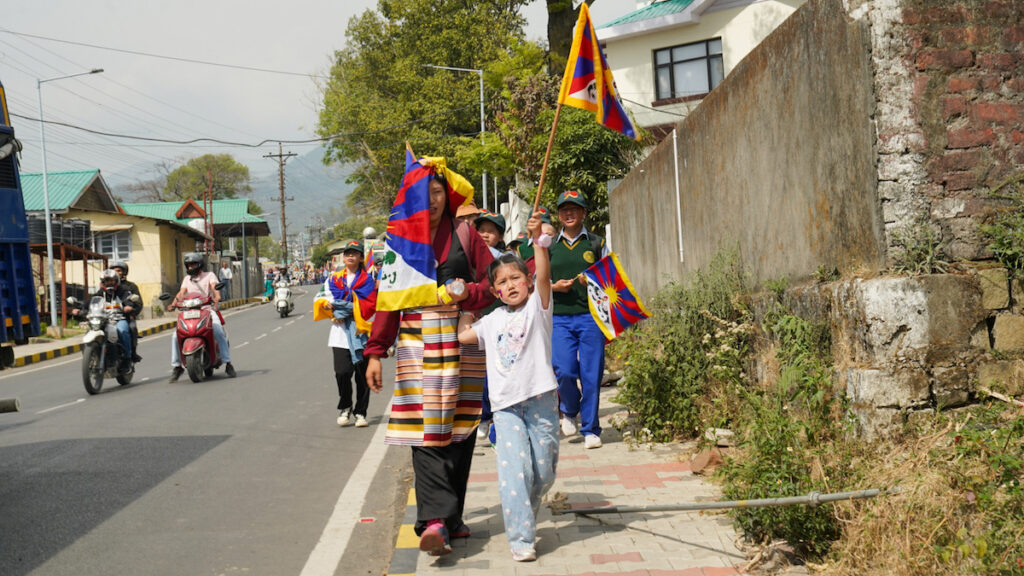
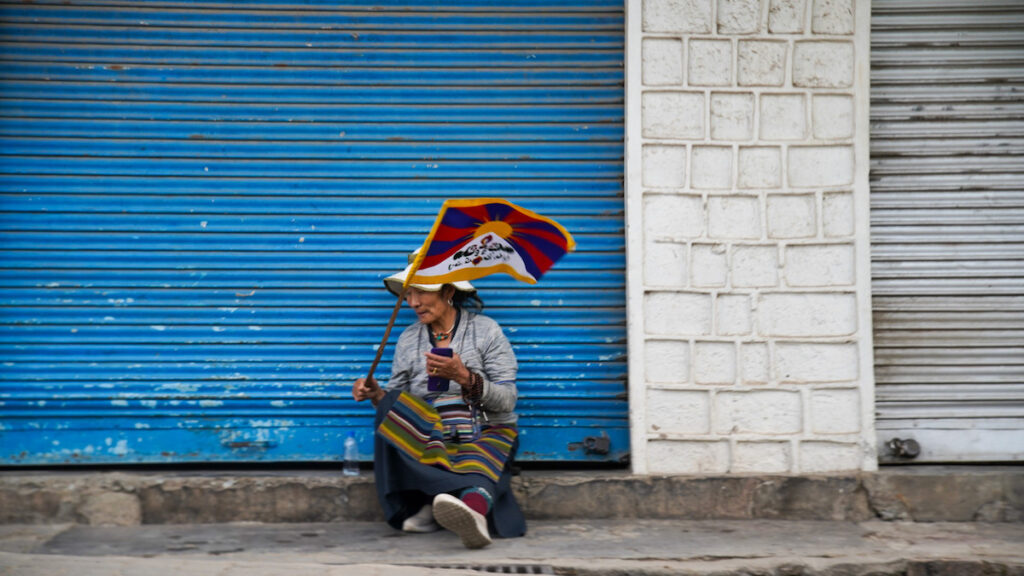
For over 6 decades, the day in exile is marked by a protest rally where Tibetans cry their heart out to protest China’s treatment of their fellow countrymen and repressive policies carried out in Tibet. In Dharamshala, participants march a trail from the temple complex to Kacheri, waving Tibetan national flags and chanting slogans of freedom and justice while carrying banners drawing attention to Tibet’s plight.
The peace rally this morning saw wide participation from across the Tibetan community, including elderly citizens, youth, families, and parents with children as young as five or six years old. However, the participation of senior exile Tibetan leadership remained limited, with many departing the venue by car soon after the official ceremony concluded.
Phayul spoke with one of the organisers of the rally and a handful of Tibetan parliamentarians who joined the public march, asking about the limited presence of exile leadership and whether CTA leaders should take on a more visible, on-ground role during public rallies like this one. Among the elected representatives who joined the rally were Members of Parliament Dorjee Tseten, Lhagyari Namgyal Dolkar, Youdon Aukatsang, Ven. Tenpa Yarphel, Serta Tsultrim, and Ven. Thubten Wangchen.
Tashi Targyal, Vice President of the Tibetan Youth Congress (TYC), one of the five major Tibetan NGOs organising the rally, said the commemoration belongs to all Tibetans and should encourage broader participation from the leadership. “Generally speaking, when we talk about the commemoration of the Tibetan National Uprising Day, it belongs to all Tibetans. Today marks the 67th anniversary and we are observing it here together,” he said.
Tashi, who has been involved in organising activism for several terms of the TYC, said the public rally is organised collectively by the five major Tibetan NGOs to mobilise grassroots participation. “Our hope is that whenever such occasions arise, Tibetans in Dharamshala from all regions and communities will come together and participate. Encouraging such participation is part of our responsibility,” he said.
He added that leaders should also be more present on the ground. “As leaders of the Central Tibetan Administration, it is extremely important that we come down to the ground and actively work among the people. Especially now, the situation inside Tibet is becoming increasingly serious. When members of parliament and representatives from organisations join, it gives encouragement and a positive feeling.”
Tashi said he could not see any apparent reason for why members of the exile leadership shunned the protest rally. “To speak frankly, there is the Middle Way Approach followed by the CTA and there are organisations advocating Tibetan independence. But if we continue arguing and creating divisions between independence and the Middle Way here in exile, it will not lead us anywhere,” he said, adding that all Tibetans ultimately share the same goal of justice for Tibet.
Member of Parliament Dorjee Tseten described March 10 as fundamentally a people’s movement. “The commemoration of the March 10 uprising is essentially a people’s uprising. Historically, it emerged when Tibetans rose up to protect the life of His Holiness the Dalai Lama and to defend Tibet’s freedom and independence,” he said.
He said it was important for leaders to join public demonstrations alongside the people. “Because this is a people’s uprising, anyone within the Tibetan community—whether leaders or ordinary citizens—should participate collectively. Through this, we can raise awareness and help others understand the significance of these actions.”
MP Lhagyari Namgyal Dolkar also emphasised the symbolic importance of the day and the responsibility of elected representatives. “March 10 is one of the most important days for the Tibetan people. It represents the unity and power of the Tibetan people raising their voice against the Chinese government,” she said.
“As representatives chosen by the people, we have a responsibility to participate. If we only attend a morning ceremony and have no real engagement afterward, it raises questions about whether that aligns with the idea of a people’s government.”
MP Youdon Aukatsang said it was both a personal and political responsibility for Tibetan leaders to join the rally. “As a Tibetan and as a parliamentarian, I believe it is my responsibility to be here. If I can, I should actually be leading protests, but if not, I must at least participate,” she said.
She added that public demonstrations were an important opportunity to highlight pressing issues inside Tibet, including the Chinese government’s assimilation policies targeting Tibetan children, environmental exploitation of Tibetan resources, and the broader sinicization of Tibetan culture and religion. “This is a great opportunity to show the world that we have not forgotten our country and that we stand in solidarity with Tibetans inside Tibet,” she said. “Leaders should lead—whether from the front or the back—but we must be proactive.”
While she acknowledged that some leaders may have been engaged in other events or advocacy work on the day, Aukatsang stressed that participation in such public commemorations remained crucial. “We all have a big responsibility to support these important occasions. March 10 is very, very important,” she said.


It’s been 67 years since the evil hordes of communist China invaded and occupied Tibet. Since then, Tibetans across the world have been observing this tragic day in every nook and corner of the world on March 10th to commemorate the catastrophic event when 87,000 Tibetans who were defending the Dalai Lama who was on the verge of being kidnapped by communist China were slaughtered! After nine years of Chinese occupation after the signing of the so called 17 Point treaty under duress, Tibetans were enraged when it was discovered that communist China was planning a decapitation of the Tibetan leadership by kidnapping the Dalai Lama! The words spread like wild fire and thousands gathered at Norbu Lingka which is the summer residence of the Dalai Lama. The Tibetan people demanded the departure of the Chinese occupation forces from Tibet declaring “TIBET IS INDEPENDENT! CHINESE GO BACK TO CHINA”! The flight of the Dalai Lama became inevitable as the danger to his life was undeniable. On 17th of March, the Dalai Lama and his entourage left Tibet into exile. The Dalai Lama declared the “17 point treaty” null and void from Tezpur on his arrival at the Indo-Tibet border. He was given sanctuary by Pandit Jawaharlal Nehru and moved to Mussoorie where he re-established the TIBETAN GOVERNMENT IN EXILE! Since then, Tibetans in exile formed their own Government, parliament, executive branch and Judiciary and ran a parallel Government in exile that is democratic in nature where the representatives of the three cholkhas, and five religious traditions are elected by the Tibetan exiles across the world! SIKYONG or Tibetan leader is elected by the people and he represents not only the Tibetan exiles but the six million Tibetans inside Chinese occupied Tibet! The Dalai Lama devolved political power to the elected leader and now the SIKYONG is the LEADER OF THE TIBETAN PEOPLE IN BOTH OCCUPIED TIBET OUTSIDE TIBET! The Chinese entity in occupied Tibet does not represent the aspirations and hope of the Tibetan people. It is in fact a puppet of the Chinese Communist to oppress and enslave the people of Tibet. Tibetans have been spearheading the Tibetan freedom movement through multifaceted avenues such as lobbying governments, especially western democratic Governments, politicians, academics, writers, authors, journalists and actors! Owing to the iconic status of the Dalai Lama, Tibet attracted thousands of admirers of the Dalai Lama and his cause in almost every country including communist countries! Credit goes to the Dalai Lama for his serene demeanour and charismatic personality! He has admirers even from communist China where he is regarded as an “enemy of the state” by the terror professing Chinese communist regime! The Dalai Lama’s campaign of non-violence against the vile Chinese regime has had similar effect like that of Mahatma Gandhi during Indian independence struggle. Tibetans on their part took part in non-violent protests for the last 67 years in every street, city, town and village across the length and breath of the world! For a long time, it remained only in India but today, as the Tibetan diaspora spread across the world, so did the protest march. There is now big protests by Tibetans in every big city from London, New York, Washington DC, Los Angeles, Toronto, Taipei, New Delhi, Bombay, Calcutta and Bangalore! The old guard who
arrived from Tibet are more or less come to an end but the ones who are borne in exile are now taking the baton to continue the freedom movement to the next stage. There are very dedicated leaders in the exile community such as Lhagyari Namgyal DOLKAR, Yudon Aukatsang, Dorje Tseten and Tibetan independence crusader Tenzin Tsondue, Thupten Chonyi, Chimme Lhamo and Sangye Kyab! These dedicated young people inspires others to do the same and thus helps to continue the struggle for Tibet’s freedom! The attack on Venezuela and Iran have sorely damaged the CCP’s attempt to project power through authoritarian companionship. However, with the damage that was inflicted on them, the CCP feels lonely and friendless in a sea of internal troubles as well as threat from outside! The PLA is in disarray and the economy growth is lowest in thirty years plus the population decline are signs of the CCP’s upward surge has halted and now it’s only downward spiral! What goes up must come down. The CCP’s promulgation of a law that forbids the use of Tibetan language is a sign that it is hellbent to destroy the ancient civilisation of Tibet in order to erase the Tibetans as a distinct people to transform them into Chinese! This clearly indicate that there is zero chance for the Tibetans to survive as Tibetans under Chinese occupation! The speeches of the SIKYONG and Speaker of the parliament were forthright in declaring the history of Tibet’s independence status. This is the first time such frank and direct assertion of historical independence is made by our leaders and it must be a message to the Chinese malevolent dictator Xi! “DON’T TEST OUR PATIENCE! DON’T INTERPRET GRACE FOR WEAKNESS”!!!