

Tenzin Nyidon
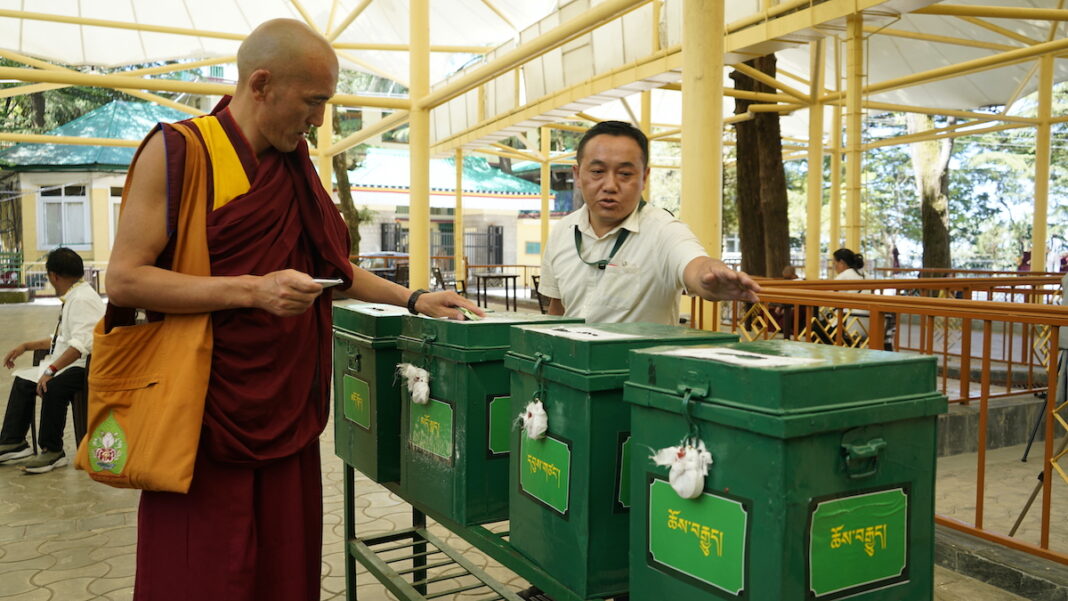
DHARAMSHALA, April 26: Exile Tibetan electorates in Dharamshala, the seat of the Tibetan Government-in-Exile, officially known as the Central Tibetan Administration (CTA) cast their ballots across 11 polling stations on Sunday in the final round of the 2026 Tibetan general election to elect for a new Tibetan Parliament in Exile.
The final phase of the 2026 parliamentary elections was conducted simultaneously across 27 countries, spanning 309 polling stations. The process was overseen by 87 Regional Election Offices and managed by a total of 1,737 election officials.
Chief Election Commissioner Lobsang Yeshi, speaking to Phayul, highlighted both the strengths and challenges of conducting a global democratic exercise. He emphasised the resilience of the Tibetan democratic system in exile, noting that elections have been conducted successfully for over six decades. He attributed this to the CTA’s institutional framework, the commitment of election officials, and the continued participation of the Tibetan public.
He also acknowledged several challenges, including logistical constraints, gaps in voter participation in some regions, and the unique difficulty of organizing elections across 27 countries, often without formal offices in each location. He said efforts are underway to expand the presence of Offices of Tibet abroad to enable more coordinated election management and improve voter turnout in future polls.
Responding to China’s criticism of the preliminary election results, the Chief Election Commissioner dismissed the remarks as part of Beijing’s long-standing rhetoric against the Tibetan leadership and His Holiness the Dalai Lama. He stated that a one-party system lacking democratic processes does not hold the legitimacy to comment on democratic practices.
He further added that China’s continued attention to exile Tibetan elections reflects its concern over the global visibility of the Tibetan cause. Despite limitations faced by the exile community, he said Tibetans remain committed to democratic values, expressing hope that the election sends a clear message to the Chinese leadership that Tibetans have not given up their struggle and will continue to uphold their democratic institutions.
Phayul raised questions to the Chief Election Commissioner regarding the Commission’s recent decision to withdraw the final round of voting in Nepal’s Choejor Tibetan Settlement. In an official communication, the Election Commission stated that it had found “serious violations” in the conduct of the preliminary polls in the Choejor settlement, including areas such as Boudha and Jorpati, and subsequently withdrew the final election for that polling station.
Referring to the decision, Phayul questioned the Commission’s reluctance to address the issue publicly and the absence of a dedicated press conference despite media expectations. In response, Lobsang Yeshi declined to comment in detail, stating that the Commission had already issued a “no comment” on the matter and emphasized that the priority remained the successful conduct of the ongoing election.
When pressed further on transparency, he said the Commission remains accountable to the public and could consider holding a press conference if deemed “necessary.” However, he reiterated that the immediate focus was on ensuring the smooth completion of the election process.
The 2026 election for the 18th Tibetan Parliament in Exile will determine representatives for the next five-year term. A total of 93 candidates are contesting the final round, having been shortlisted during the preliminary elections held on February 1.
The candidates include 20 representatives each from the three traditional provinces, as well as four candidates each from the five major religious traditions. There are also four candidates, each representing constituencies in North & South America and Europe & Africa, while two candidates will represent Australasia. In addition, the slate includes three voluntary candidates—one each from the Dotoe, North & South America, and Europe & Africa constituencies.
The incumbent CTA President Penpa Tsering secured the necessary majority of over 60% of the votes (61.025%) to secure a second term during the preliminary election. The apex electoral body earlier announced that 91,042 Tibetans have registered as voters for the 2026 general elections from across the globe.

