

Tenzin Nyidon
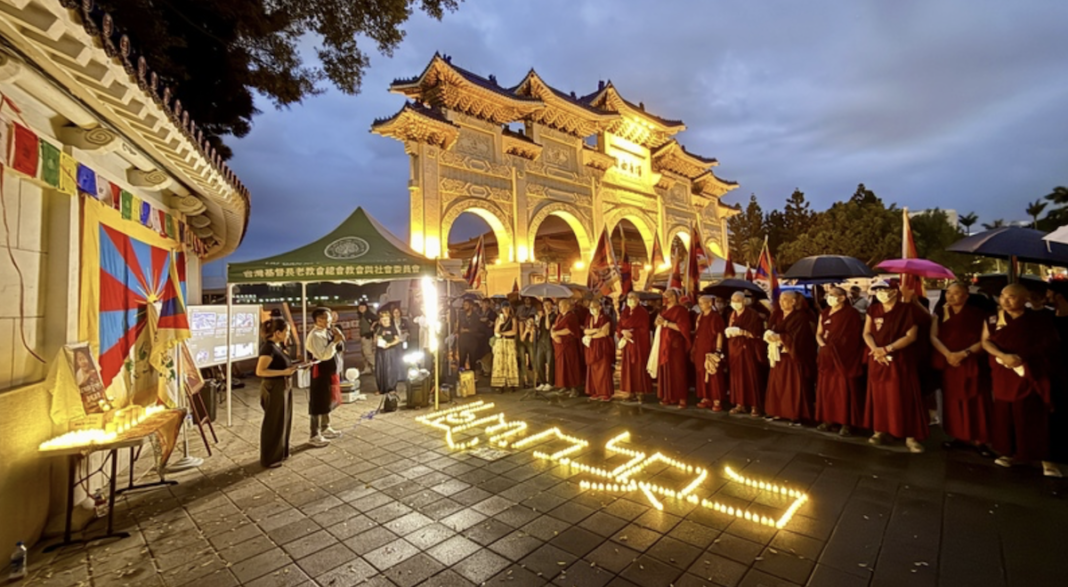
DHARAMSHALA, July 16: More than 300 Tibetans living in Taiwan, joined by human rights advocates and supporters, gathered at Taipei’s Liberty Square on Wednesday to pay tribute to the late Tibetan independence activist Lobga Rangzen and denounce China’s newly enacted Ethnic Unity Law.
The candlelight vigil and peaceful protest came two weeks after Lobga Rangzen’s self-immolation and the implementation of the controversial legislation. Participants observed a minute of silence, offered traditional white khatas, recited prayers, and symbolically tore copies of the law in a public expression of defiance.
Taiwan Vice President Hsiao Bi-khim said Lobga Rangzen’s death highlights the continuing struggle against the erosion of Tibetans’ fundamental human rights.
Kelsang Gyaltsen Bawa, chair of the Tibet Religious Foundation of His Holiness the Dalai Lama, said the gathering was intended not only to honour Lobga Rangzen’s sacrifice but also to send a clear message that Tibetans would not remain silent in the face of authoritarian rule. He described China’s Ethnic Unity Law as a mechanism for ideological control and cultural assimilation disguised as legislation.
Sky Fung, secretary-general of the Taiwan-based exile organisation Hong Kong Outlanders, warned that the law seeks to strip communities of their identity, language, and cultural heritage. Fung said Hongkongers, Tibetans, and Southern Mongolians have the right to define their own identities and urged all those who share democratic values to continue standing together in solidarity against repression.
Lobga Rangzen’s death has prompted an outpouring of grief and renewed calls for international action across the Tibetan exile community. Candlelight vigils and prayer services have been held in several countries to honour his sacrifice, while Central Tibetan Administration President Penpa Tsering described the self-immolation as the “ultimate sacrifice” for the Tibetan national cause.
The CTA President also urged governments and civil society organisations worldwide to mount a coordinated response against China’s Promoting Ethnic Unity and Progress Law, warning that the legislation threatens the identity, culture, and fundamental rights of Tibetans.
International opposition to the law has continued to gather momentum in recent weeks. Statements condemning the legislation have been issued by lawmakers and government representatives in the United States, Switzerland, the Czech Republic, Germany, the United Kingdom, Estonia, and by Italian parliamentarians, who have warned that the law institutionalises forced assimilation under the guise of national unity.
Most recently, Members of the European Parliament (MEPs) from across the political spectrum, together with senior European Union officials and national parliamentarians, strongly denounced the law as an instrument of forced assimilation. Reaffirming their solidarity with the Tibetan people, they warned that the legislation poses a grave threat to the cultural, religious, and linguistic rights of Tibetans and other communities living under Chinese rule, while calling on Beijing to respect internationally recognised human rights and protect the distinct identities of minority peoples on July 10.

