

Tenzin Nyidon
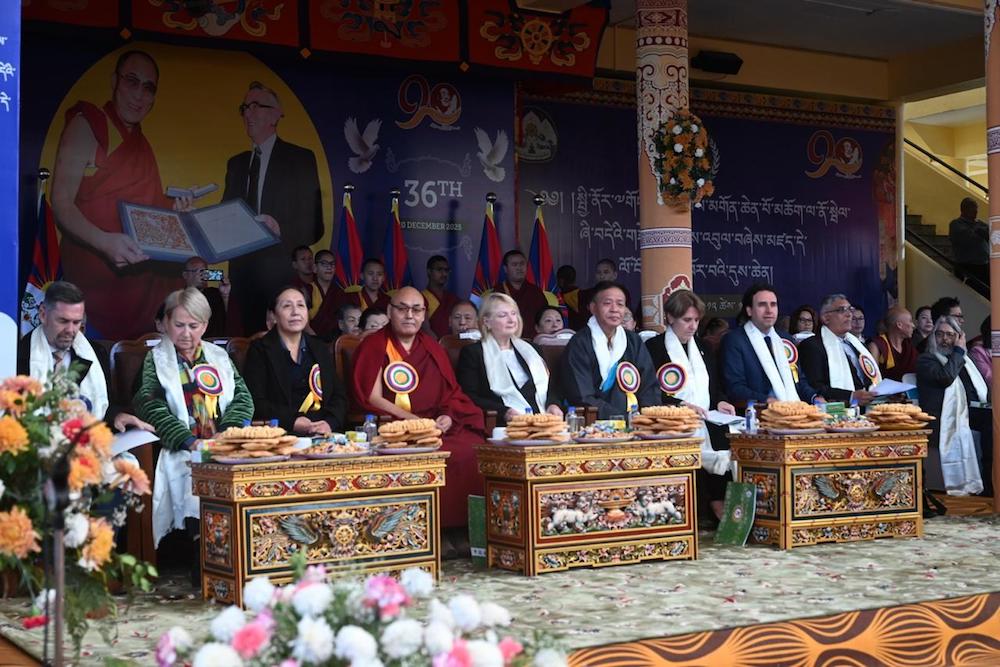
DHARAMSHALA, Dec. 10: The Central Tibetan Administration (CTA) known also as the Tibetan government in exile, along with the local Tibetan community marked the 36th anniversary of the Nobel Peace Prize being conferred on His Holiness the Dalai Lama, as well as International Human Rights Day, at the Main Temple in Dharamshala on Wednesday.
The dignitaries at the ceremony included an international parliamentary delegation from Australia, Chile, Czech Republic, Fiji, France, Italy, New Zealand and the CTA President Penpa Tsering, Speaker Khenpo Sonam Tenphel, representatives of the three pillars of the Tibetan democracy as well as members of the Tibetan Parliament in Exile and officials of the CTA.
“At a time when our world is shrouded in the darkness of conflict, hatred, and fear, His Holiness the Dalai Lama’s philosophy of peace, rooted in compassion, wisdom, and a profound sense of universal responsibility, has illuminated a viable path toward genuine and lasting peace. It needs no elaboration that the primary purpose of observing this historic occasion is to devote ourselves to the study and implementation of these timeless teachings,” the Tibetan political leader said in the Cabinet’s official statement.
“Today also marks International Human Rights Day. We express our solidarity with all those around the world who are denied their basic human rights and extend our hope that those who oppress these rights will gain a sense of right and wrong. Through the understanding of compassion, may they come to respect every human life, listen to every human voice, and honour every human aspiration.”
Dignitaries present at the event also reflected on their private audience with the nonagenarian Tibetan leader before the official function began. They spoke of His Holiness’s unwavering efforts to preserve Tibetan culture and identity despite decades of living in exile, while reaffirming their support for the Tibetan cause.
Hon. Virendra Lal, Member of Parliament from Fiji, said that His Holiness spoke about the essence of humanity and service. “We have to become good human beings. If you are a Christian, become a good Christian. If you are a Muslim, become a good Muslim. If you are a Hindu, become a good Hindu. But above all, become a good human being and follow the religion of humanity.” He added that “even as he faces the limitations of age and health, his voice remains unwavering in calling for compassion as the foundation of a peaceful world.”
Hon. Greg Fleming, Member of Parliament from New Zealand, reflected on his country’s own history, recalling the 1814 treaty between the British authorities and the Māori people. Although the agreement included a commitment to preserve Māori language and culture, the following 130 years saw the opposite as policies and decisions were made that systematically suppressed both. “Tragically, decision after decision aimed to eliminate the language and culture as much as possible,” he noted.
He added that about 50 years ago, New Zealand experienced a turning point. The tide shifted, and for the past two and a half generations, Māori language and culture have not only revived but have begun to thrive again.
“Over the brief time we have been here with you all, my mind and heart have consistently turned to what your culture and language is. It must be, and it must always continue to be. And it is in your identity, and it is why you hold so strong to it, and it is why you must, and it is why the world supports you in that because it is your language and culture that carries your identity,” he said.
The day holds profound significance for Tibetans, as the Dalai Lama’s 1989 Nobel Peace Prize remains a landmark recognition of the Tibetan people’s non-violent struggle. In his acceptance speech, His Holiness dedicated the honour to the resilience of the Tibetan people and to peace movements around the world.
“I accept the prize with profound gratitude on behalf of the oppressed everywhere and for all those who struggle for freedom and work for world peace. And, of course, I accept it on behalf of the six million Tibetan people, my brave countrymen and women inside Tibet, who have suffered and continue to suffer so much,” he had said.
He further affirmed, “The prize reaffirms our conviction that with truth, courage, and determination as our weapons, Tibet will be liberated.”

