

Tenzin Nyidon
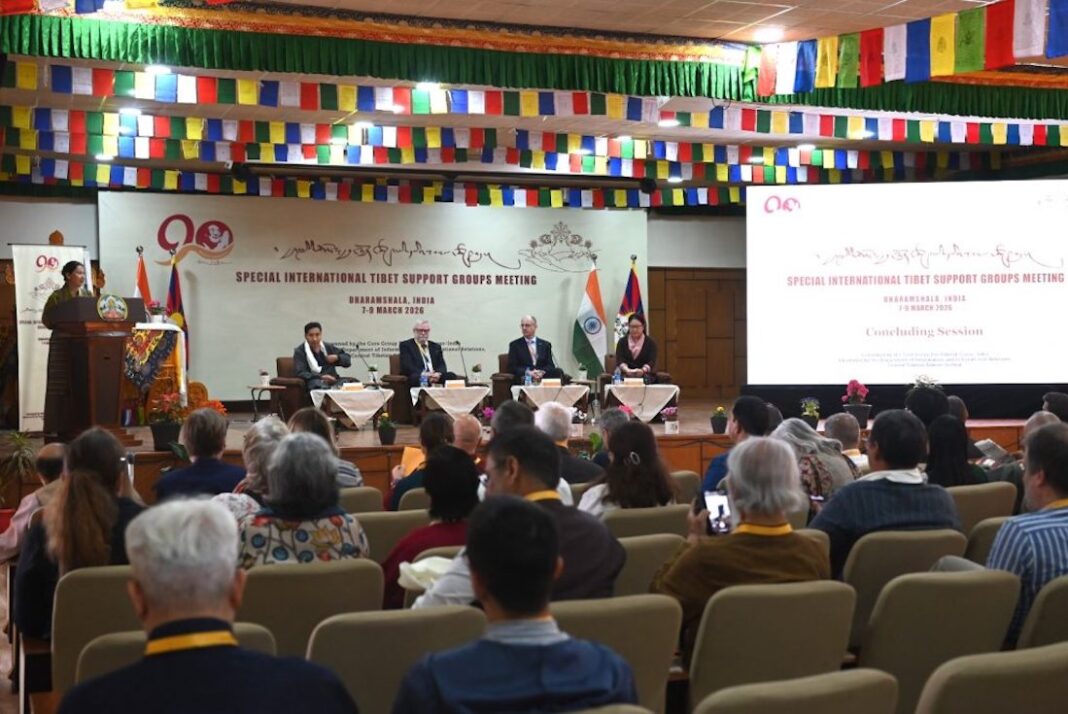
DHARAMSHALA, March 9: The Special International Tibet Support Groups Meeting concluded on Monday after three days of deliberations that brought together international dignitaries, parliamentarians, human rights advocates, scholars, and activists from across the world. The gathering ended with poignant valedictory speeches by Michael Brand, Parliamentary State Secretary at Germany’s Federal Ministry for Family Affairs and Senator Jiří Oberfalzer, Vice President of the Czech Senate.
In his remarks, Michael Brand described his participation in the meeting as both an honour and a privilege, adding that returning to Dharamshala felt “a little bit like coming home.” He commended the tireless efforts of Tibetans and their supporters around the world who continue to work for the preservation of Tibetan identity, culture, and rights.
Brand reflected on the profound global shifts taking place in the contemporary world and stressed that such uncertain times require greater attention to issues of justice and human dignity. While noting that the current period may appear brief when measured against Tibet’s millennia-old history and cultural legacy, he warned that the Tibetan people face unprecedented challenges today.
He also addressed developments within China, pointing to economic difficulties, demographic decline, and recent political tensions within the Chinese Communist Party as signs of instability. According to Brand, such internal pressures could potentially lead the Chinese government to adopt even more aggressive policies externally. In this context, he emphasized that Tibet remains highly vulnerable.
Brand called on the international community to raise greater awareness about the situation in Tibet, including policies that he said threaten the survival of Tibetan culture, language, and identity. He specifically highlighted the issue of hundreds of thousands of Tibetan children being placed in state-run boarding schools where they are separated from their families and subjected to political indoctrination.
Describing Tibet as a “litmus test” for the world’s response to authoritarianism, Brand urged democratic nations to confront what he characterized as the expansion of repressive governance models promoted by the Chinese Communist Party. He concluded his speech with a message of hope, expressing confidence that through collective efforts and unity, the Tibetan people will one day regain their rightful place in the global community.
Senator Jiří Oberfalzer echoed similar sentiments in his address, drawing parallels between Tibet’s struggle and the historical experiences of the Czech people under communist rule. As a representative of a small Central European nation that endured decades of oppression during the Soviet era, Oberfalzer said the Czech Republic deeply understands the challenges faced by Tibetans living under authoritarian control.
He recalled that shortly after the fall of communism in Czechoslovakia during the 1989 Velvet Revolution, His Holiness the 14th Dalai Lama became one of the first distinguished international guests invited by then-President Václav Havel in 1990. Oberfalzer said the visit carried a powerful message of nonviolence and moral courage for a society emerging from decades of repression.
While acknowledging that the geopolitical imbalance between Tibet and China presents significant challenges, Oberfalzer emphasized that Tibet’s cause remains widely recognized internationally, largely due to the global influence and leadership of His Holiness the Dalai Lama.
However, he also offered a candid assessment of Europe’s relationship with China, noting that economic interests often overshadow human rights concerns. Oberfalzer stated that many European nations have contributed to China’s economic rise by relying on inexpensive Chinese goods, adding that such economic dependencies have sometimes come at the expense of supporting the Tibetan cause.
Despite these challenges, he highlighted the Czech Republic’s longstanding solidarity with Tibet, citing the work of various civil society organizations such as the Czech Support for Tibet group, Pro-Tibet initiatives, and the civic group Lungta. He also mentioned the annual “Flag for Tibet” campaign, during which municipalities across the Czech Republic raise the Tibetan national flag on March 10 to express support for Tibet.
Oberfalzer further noted that Czech President Petr Pavel visited Dharamshala last year and met His Holiness the Dalai Lama, marking the first time a sitting Czech president officially held such a meeting. Reaffirming his personal commitment to the Tibetan cause, he reiterated the position that Tibet historically existed as an independent nation and called for continued international efforts to support Tibetans’ right to preserve their culture, religion, and identity.
Concluding his remarks, Oberfalzer urged the international community to demonstrate its commitment not only through words but also through meaningful actions, even if such actions require sacrificing economic convenience or profit.

