
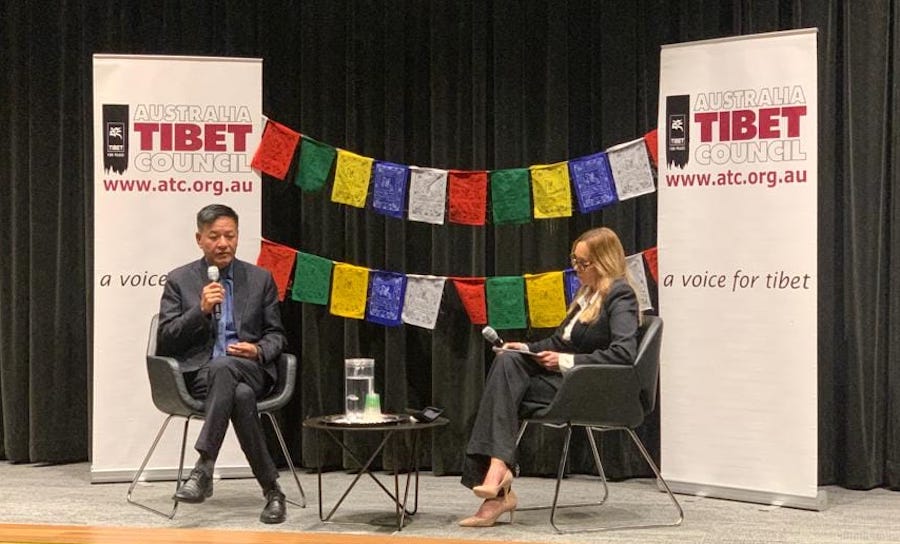

By Tsering Dhundup
DHARAMSHALA, June 20: The President of the exile Tibetan government, known officially as the Central Tibetan Administration, Penpa Tsering said that Australia’s approach to addressing human rights abuses is unjust, as it punishes countries like Iran and Russia while exempting China from similar repercussions due to their status as Australia’s largest trading partner.
In his first visit to Australia since becoming the head of Tibet’s government-in-exile, Sikyong Penpa Tsering called on Prime Minister Anthony Albanese to raise human rights concerns with Chinese President Xi Jinping during his potential visit to Beijing later this year and to impose sanctions on Chinese officials responsible for the persecution of natives in Tibet and East Turkestan (Xinjiang).
Drawing parallels between the forced separation of Tibetan children from their families and Australia’s treatment of Indigenous children during the stolen generations era, Tsering accused President Xi Jinping of seeking to annihilate Tibetan identity. Despite efforts by Chinese officials in Australia to have the event cancelled, the Tibetan leader will address the National Press Club in Canberra on Wednesday, June 21. He said that the Chinese government’s attempts to silence him have inadvertently provided publicity for the Tibetan cause.
President Tsering urged Australia to adopt a consistent standard when it comes to addressing human rights abuses by foreign governments. While the Australian government has imposed Magnitsky sanctions on officials from Russia, Iran, and Myanmar, it has resisted calls to do the same for China. Magnitsky sanctions would enable the Australian government to revoke visas, ban travel, and seize the property of individuals who might be attempting to hide assets within Australia.
He also urged PM Albanese to be forthright about human rights violations if he accepts an invitation to visit Beijing later this year, emphasizing the importance of strategic engagement rather than disengagement with China. He labelled China’s actions in Tibet and East Turkestan (Xinjiang) as “crimes against humanity,” with reports suggesting that around one million Tibetan children have been separated from their families and placed into Chinese state-run boarding schools.
During his visit to Canberra, Tsering is scheduled to meet with opposition foreign affairs spokesman Simon Birmingham, MPs from the parliamentary friends of Tibet group, and representatives from the Tibetan community. However, he has not secured a meeting with Foreign Minister Penny Wong. A spokeswoman for Wong stated that the foreign minister has consistently raised concerns about the erosion of rights and freedoms in Tibet during meetings with her Chinese counterpart, and Australia uses all available strategies to uphold human rights in alignment with its values and interests.
The Chinese embassy responded to the upcoming National Press Club address by stating that the human rights situation in Tibet is currently at its best in history. In response, Tsering challenged the Chinese government to allow foreign journalists to visit Tibet and witness the situation firsthand.


Most advanced countries separate children from families when the families refuse to integrate into host culture. It’s wrong but power speaks