

Tenzin Nyidon
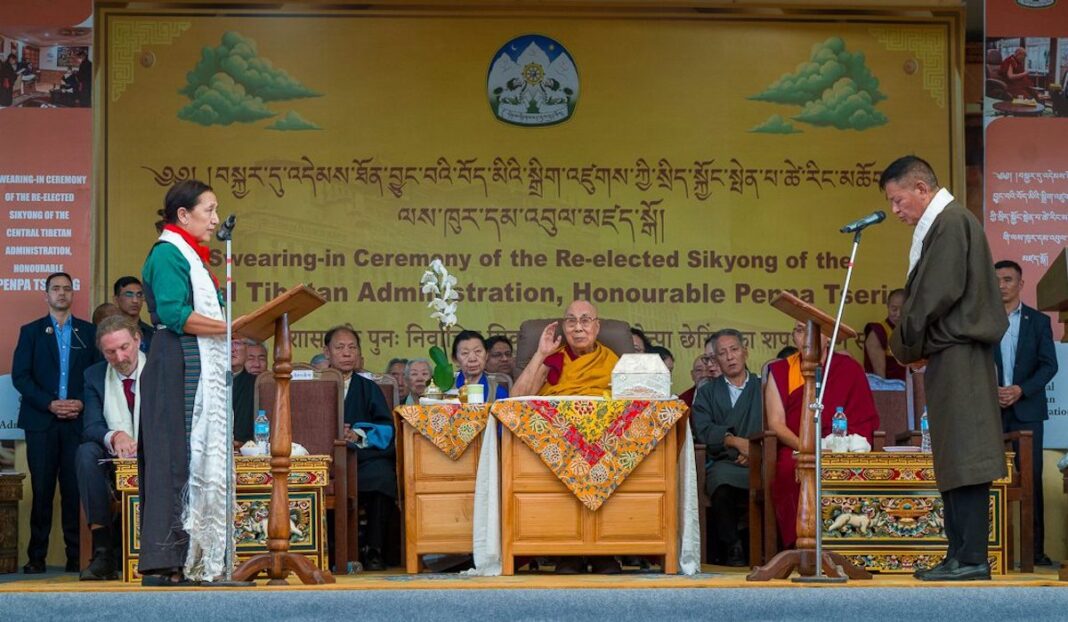
DHARAMSHALA, May 27: President Penpa Tsering took the oath of office for a new term in the highest office of the Tibetan exile polity on Wednesday at the Main Tibetan Temple, in the presence of His Holiness the Dalai Lama. The swearing-in ceremony was led by Chief Justice Commissioner Yeshi Wangmo, who administered the oath of office.
Tsering secured a decisive mandate in the preliminary election of the Central Tibetan Administration, widely known as the Tibetan Government in Exile, garnering 31,325 votes, or 61.025% of the total vote share, to secure his second term in office.
In his inaugural address, the CTA President recalled that when he contested the presidential election in 2021, he had pledged not to engage in any campaign that could create divisions within the Tibetan community. “Remaining true to that commitment, I did not campaign at all during this election. Nevertheless, with a majority mandate from the public, I was re-elected as the Sikyong for a second term. For this, I extend my heartfelt gratitude to everyone who participated in the electoral process,” he said.
The Tibetan political leader reaffirmed the incoming 17th Cabinet’s commitment to the “Middle Way Policy,” stating that the Chinese government’s present approach toward nationalities leaves little room for formal negotiations. “Until a resolution is achieved, we will continue backchannel communications with the Chinese government cautiously and steadily, while simultaneously strengthening international recognition and support for the Middle Way Policy,” he stated.
He further said that the 17th Cabinet would uphold justice grounded in rules and regulations, mobilise collective effort through principled governance, and work toward common goals. “The Kashag (Cabinet) will pursue political and social welfare initiatives with the primary objective of ensuring the long-term sustainability of the Tibetan struggle until a just resolution of the Tibet-China conflict is achieved,” he added.
Referring to the principles outlined during his 2021 campaign, Tsering said his administration would continue to be guided by “transparency, equity, efficiency, and sustainability.” He noted that the cabinet would focus on social welfare programmes, including completion and management of public infrastructure projects, youth skill development, school consolidation for greater efficiency, and improved healthcare and preventive services, with particular attention to vulnerable sections of the community.
“At the same time, advancing self-sufficiency within the Central Tibetan Administration and the exile Tibetan community remains critical to sustaining the Tibetan cause,” he said, expressing gratitude to organisations and individuals who have contributed toward that effort while calling for continued collective participation.
Speaking on the e-governance initiative launched under the 16th Cabinet, Tsering said the next cabinet would further expand the programme by strengthening personnel capacity, technology, infrastructure, and institutional systems. He added that enhanced data management and database systems, along with the use of information technology and artificial intelligence, would improve advocacy efforts, administrative efficiency, public service delivery, and communication with Tibetans living in exile around the world.
The address also pledged to ensure that official responsibilities are carried out smoothly so that the Tibetan spiritual leader is “not unduly disturbed by the trivial matters” of the community, while continuing efforts to retain the trust of Tibetans inside Tibet.
Highlighting what he described as China’s systematic attempts to erode Tibetan national identity, Tsering asserted that Beijing could not weaken the Tibetan people’s enduring connection to their homeland. He urged Tibetans inside Tibet to preserve Tibetan identity at the household level by instilling in children a strong foundation in Tibetan language, religion, and culture.
The swearing-in ceremony was attended by several international dignitaries and lawmakers, including Chris Law, Alicia Kearns, Kerry McCarthy, Wera Hobhouse, Jose Francisco Lira Alvarado, Luis Mala Valenzuela, Tapir Gao, and Sujeet Kumar.

