

Tenzin Nyidon
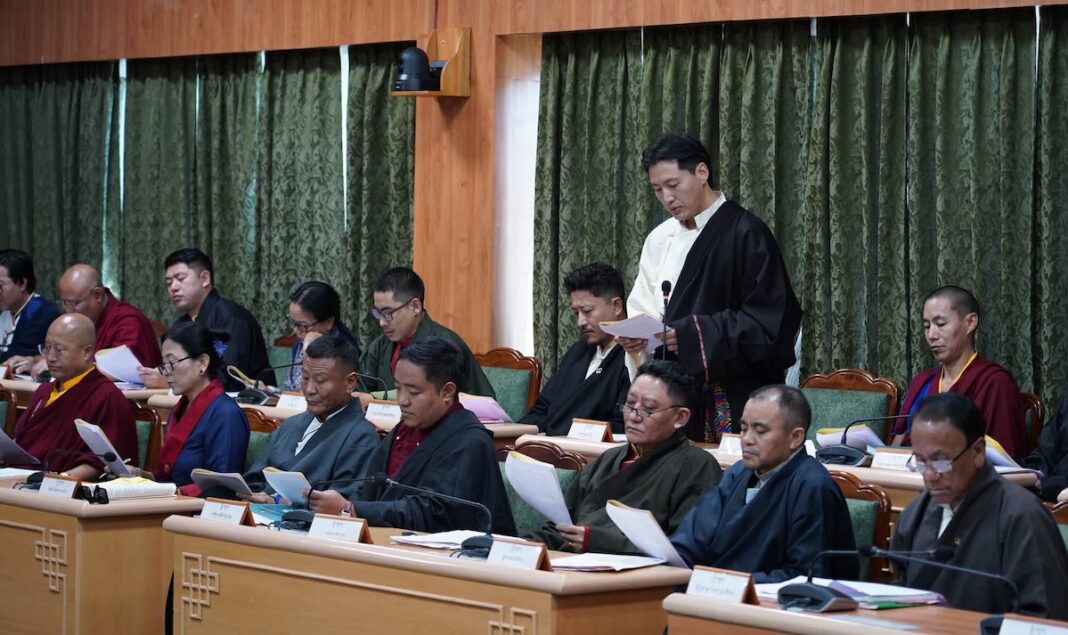
DHARAMSHALA, Sept. 18: A private member’s resolution seeking the adoption of a policy supporting Tibetan independence failed to secure the majority number after securing 15 votes in favour and 23 against, on Friday, during the second session of the 18th Tibetan Parliament-in-Exile, The resolution was subsequently dropped from further discussion.
The resolution, tabled by Parliamentarian Sangye Dorjee and supported by Gyaltsen Choekye Gagya, sought to establish Tibetan independence as a policy position, calling for the restoration of Tibet’s sovereignty and the continuation of the independence struggle until Tibetans inside and outside Tibet are reunited.
The motion faced a series of points of order from parliamentarians during the proceedings, with Central Tibetan Administration President Penpa Tsering repeatedly questioning whether a private member’s motion could be used to alter the Administration’s established policy position.
While tabling the resolution, MP Sangye Dorjee argued that since 1959, following what the resolution describes as the illegal occupation of the entire territory of Tibet by Communist China, Tibet’s environment, religious institutions, language, and cultural identity have faced sustained destruction and assimilation.
The resolution alleged that hundreds of thousands of Tibetans had been killed, imprisoned, or subjected to torture, while Tibetan children had been placed in residential schools and access to monasteries restricted for those under 18. It further cited the removal of Tibetan-language instruction from schools and what it described as efforts to assimilate Tibetan customs, traditions, culture, and language.
According to the resolution, these policies amount to an attempt to erase Tibet’s national identity and eliminate the Tibetan people as a distinct nation. It argued that, so long as Tibetans remain, the struggle for freedom must continue and efforts must be made to restore Tibet’s sovereignty as a historically independent nation.
The resolution also paid tribute to Tibetans who had sacrificed their lives for the Tibetan nation and people, pledging to fulfil their aspirations. It called for the independence struggle to continue “even at the cost of one’s life” until Tibet is restored with freedom, religious prosperity, well-being, and the reunification of Tibetans inside and outside Tibet.
The CTA President raised a procedural concern over the proposed resolution, arguing that because it could alter the Central Tibetan Administration’s existing policy, it should not be treated as an ordinary private motion. Citing Article 56 of the Charter in Exile, he said major policy changes concerning Tibet and Tibetans are subject to specific approval thresholds and, where applicable, a public referendum.
He cautioned that allowing an individual parliamentarian to change the Administration’s policy through a private motion could set a precedent for altering major policy positions too readily in the future. “It cannot simply be introduced in this manner and then immediately taken up for discussion,” the CTA President said, stressing that the matter should either follow the relevant parliamentary procedure or be brought before the House under another appropriate agenda item.
Speaking again during the proceedings, the CTA President urged the Speaker to review the procedural basis of the proposed private motion submitted by an individual member, arguing that if it could lead to a change in the Central Tibetan Administration’s official policy, Article 56 of the Charter may apply.
He reiterated that his intervention was not a position for or against the independence proposal, saying, “I do not know whether I support or oppose it. My concern is solely with the procedure.” He argued that if the resolution were allowed to proceed and ultimately resulted in a change to the CTA’s policy, it would constitute a policy change of significant importance, making the application and interpretation of Article 56 particularly relevant.
He warned that failing to properly observe parliamentary rules could create difficulties not only in future proceedings but also in how substantive issues are introduced, debated, and interpreted within the Tibetan Parliament-in-Exile.
Despite the procedural objections, the House ultimately rejected the motion at the threshold stage, with 15 members voting to allow discussion and 23 voting against, bringing the proposed independence policy resolution to an end without a substantive debate on its contents.

