

Tenzin Nyidon
DHARAMSHALA, Sept. 18: The Tibetan Parliament in Exile on Friday adopted a resolution mandating leaders, officials, and staff of the exile Tibetan government officially known as the Central Tibetan Administration (CTA), to use Tibetan in their official duties without unnecessarily mixing it with other languages.
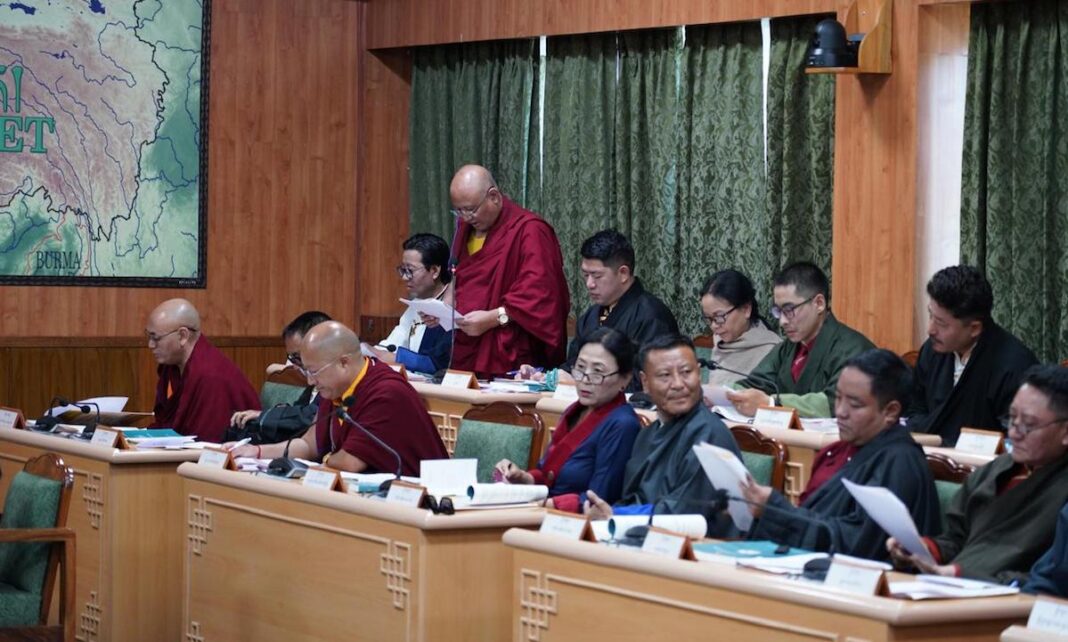
The resolution, the second Private Member’s Resolution presented during the ongoing second session of the 18th Tibetan Parliament in Exile, was tabled by Parliamentarian Lhakpa Tsering and supported by Parliamentarian Gyaltsen Choekye Gagya. It was subsequently put to a vote and adopted by the House.
Speaking on the resolution, MP Lhakpa Tsering said the three pillars of Tibetan democracy should lead by example by making greater use of the Tibetan language in their official work. He argued that language is not merely a means of communication but a fundamental vessel of a people’s identity, culture, and continuity.
He recalled having previously called for greater use of Tibetan during a parliamentary visit to Varanasi, and said sustained efforts were needed to cultivate the habit of speaking Tibetan in official settings. He stressed that the change should begin with public servants themselves before being extended more broadly to the Tibetan public.
Parliamentarian Rigzin Lhundup, who also spoke in support, described it as unfortunate that a parliamentary resolution was needed simply to encourage Tibetans to speak their own language. He said the use of Tibetan by officials when communicating with the public would not only make government institutions more accessible but also provide an important example for younger generations.
He further maintained that the preservation of Tibetan should not be viewed merely as a reaction to language policies imposed in occupied Tibet. Rather, he said, speaking Tibetan is integral to affirming Tibetan identity. He urged Tibetans to communicate, ask questions and conduct everyday interactions in Tibetan wherever possible, saying there was no reason to delay such efforts.
Parliamentarian Gowo Lobsang Phende similarly backed the resolution, while calling for greater attention to the distinction between speaking Tibetan and speaking pure Tibetan. He noted that although officials across the CTA’s three pillars generally use Tibetan, unnecessary English terms, and mixed expressions have increasingly entered official communication even when suitable Tibetan equivalents exist.
He said the CTA employs more than 500 people across its three pillars and argued that consistent use of pure Tibetan by those in public service could have a wider ripple effect throughout the exile community. Referring to restrictions on Tibetan language and script in occupied Tibet, he said the exile administration has an added responsibility to safeguard and strengthen the language where it retains the freedom to do so.
He also welcomed recent efforts by local Tibetan leadership in Dharamshala to encourage the use of Tibetan in official letters and statements. He called for such initiatives to be implemented consistently rather than remaining limited to formal announcements.
The resolution was ultimately adopted by the House, highlighting renewed efforts to strengthen the use of Tibetan language within the exile administration. It comes amid concerns over China’s implementation of the so-called “Ethnic Unity and Progress Law,” which Tibetan exile leaders have condemned as a legal framework aimed at accelerating the assimilation of Tibetans by eroding their distinct identity, language, culture, and way of life.

