

Tenzin Nyidon
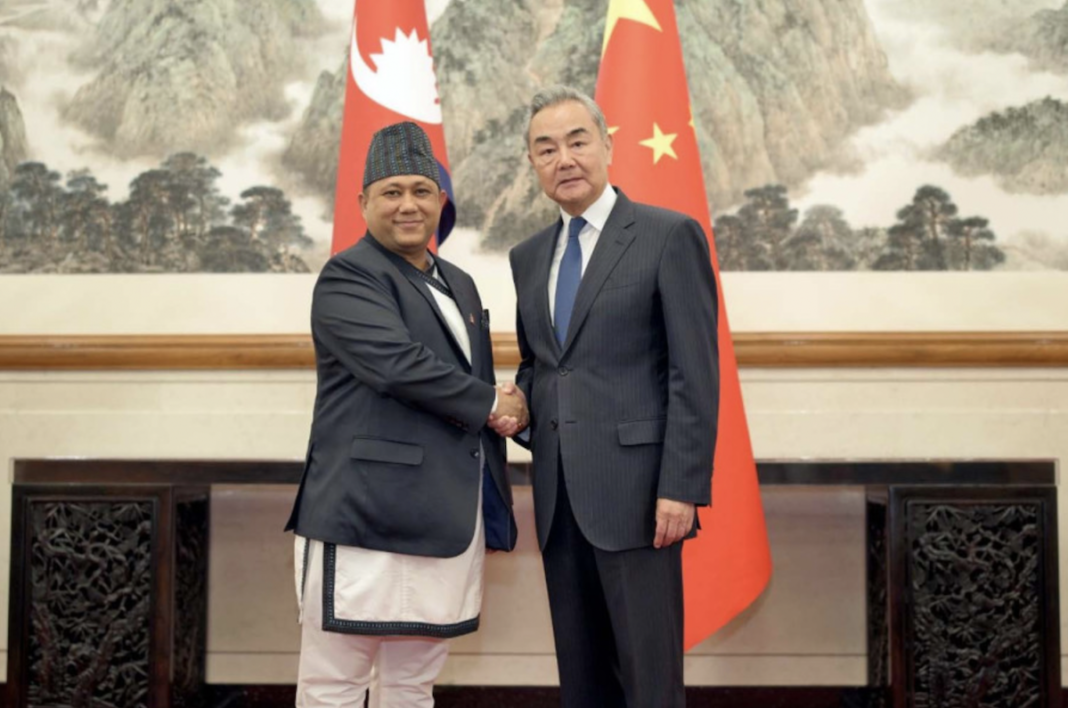
DHARAMSHALA, June 16: Nepal has reaffirmed its commitment to the “One China” policy and pledged not to allow its territory to be used for activities deemed harmful to China’s interests during high-level talks between Chinese Foreign Minister Wang Yi and his Nepali counterpart Shisir Khanal in Beijing on Monday.
The assurance came during Khanal’s four-day official visit to China, where the two sides discussed a broad range of bilateral issues, including connectivity projects, border management, trade, investment, and regional cooperation.
According to statements issued by both governments, Khanal reiterated Nepal’s longstanding position on China’s core concerns, stating that “the Taiwan and Tibet issues are China’s internal affairs.” He further affirmed that Nepal “firmly adheres to the One China policy, supports China’s complete reunification, and will never allow any force to use Nepali territory to harm China’s interests.”
China welcomed the commitment, with Wang Yi expressing appreciation for Nepal’s support on issues concerning Taiwan and Tibet. “China has always placed its relations with Nepal at the forefront of its neighbourhood diplomacy,” Wang said, describing China as a “trustworthy and reliable neighbour and partner” in Nepal’s development. China, in turn, pledged continued cooperation under the Belt and Road Initiative and support for Nepal’s development projects.
Nepal’s adherence to the “One China” policy—which explicitly designates Tibetan affairs as China’s internal matter—has severely constrained the rights and safety of Tibetans living in Nepal. Driven by Beijing’s economic and security pressures, the Nepali government has suppressed the Tibetan community’s civil, cultural, and political freedoms.
Under strict conditions prohibiting “anti-China” activities, Nepal routinely detains Tibetans who stage peaceful protests, particularly during high-level Chinese diplomatic visits or around sensitive anniversaries like the Dalai Lama’s birthday. The community faces heavy surveillance by security forces. Tibetans are largely prevented from celebrating traditional cultural festivals, including the Tibetan New Year, or openly displaying images of His Holiness the Dalai Lama.
During the talks, Wang appeared to allude to recent political developments in Nepal and growing Western engagement in the country, remarking that “distant relatives are not as good as close neighbours.” According to Nepali officials cited by the Kathmandu Post, Chinese officials raised concerns about Western influence in Nepal, particularly regarding United States-backed initiatives such as the Millennium Challenge Corporation (MCC) and the State Partnership Programme (SPP).
Chinese representatives reportedly argued that while such programmes may appear beneficial on the surface, they ultimately create strategic challenges for China. Beijing also expressed concern over potential US actions in Nepal that could affect Chinese interests.
In response, Khanal sought to reassure Chinese leaders that Kathmandu remains committed to maintaining balanced relations and is not shifting its foreign policy orientation toward Western countries. Nepal, he said, continues to pursue a non-aligned foreign policy while seeking constructive partnerships with all nations.
The two sides also discussed major infrastructure and connectivity projects under the Belt and Road Initiative (BRI). Khanal proposed the development of four economic corridors linking Nepal’s northern border with the central regions of the country, including plans related to the long-discussed trans-Himalayan railway project. He also sought additional air routes through western Nepal near the Hilsa border crossing in Humla district.
Separate discussions were held between Khanal and Liu Haixing, head of the International Department of the Communist Party of China. During the meeting, Nepal once again reaffirmed its commitment to the One China principle and pledged that its territory would not be used for activities against China.
The two sides also reviewed cooperation in sectors including energy, agriculture, technology transfer, tourism, digitalisation, petroleum and natural gas exploration, and cross-border connectivity. Both governments expressed commitment to accelerating the implementation of previously agreed projects and strengthening cooperation in regional and international forums.

