

Tenzin Nyidon
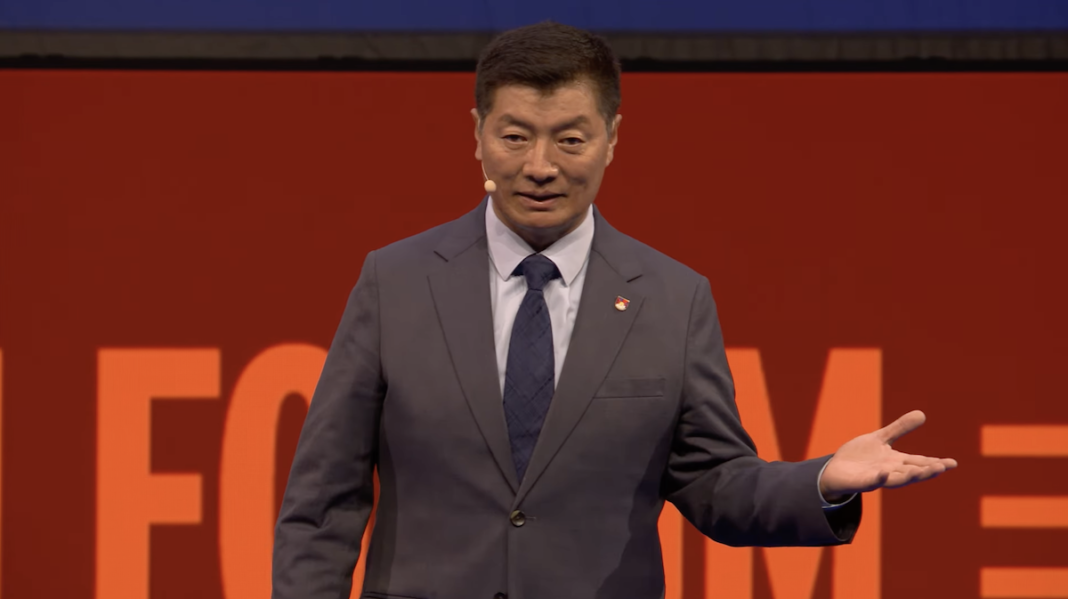
DHARAMSHALA, June 5: The former President of the Central Tibetan Administration (CTA) and Harvard Law School Senior Visiting Fellow, Dr. Lobsang Sangay, highlighted the Tibetan government-in-exile as a functioning democratic model for movements confronting authoritarian rule worldwide during his address at the 2026 Oslo Freedom Forum in Norway.
He was among several prominent speakers at the Oslo Freedom Forum, held from June 1 to 3 at the Oslo Konserthus in Norway. Organised annually by the Human Rights Foundation, the forum brought together activists, journalists, artists, technologists, and human rights defenders from around the world to discuss strategies for challenging authoritarian regimes and advancing democratic values.
Other notable speakers included Venezuelan opposition leader María Corina Machado, Hollywood actor Richard Gere, Nigerian journalist Steven Kefas, Crimean Tatar activist Lia Gazi, and Eritrean poet Yirgalem Fisseha.
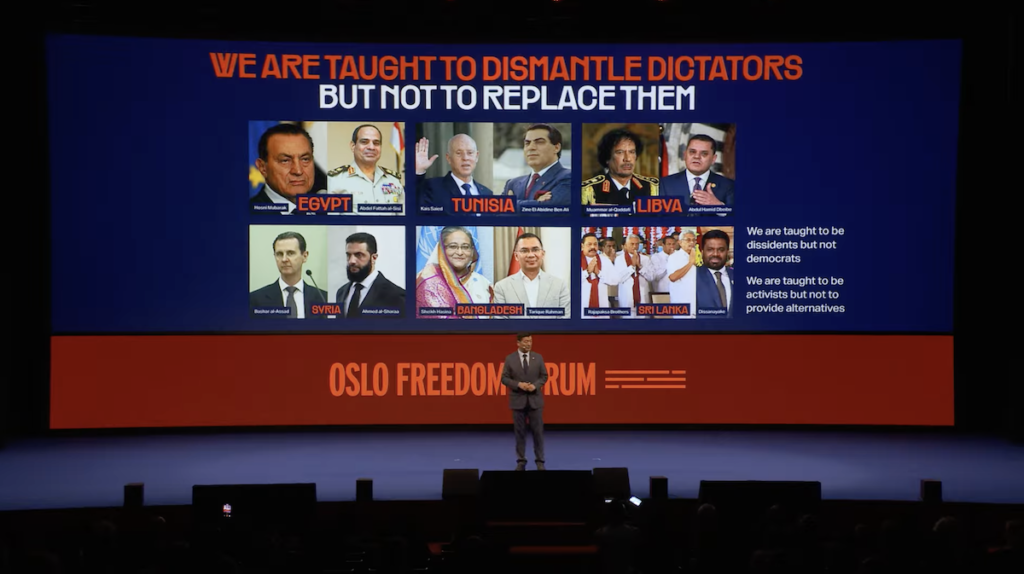
Speaking at the gathering under the theme “Dismantling Dictatorship,” Sangay argued that pro-democracy movements often succeed in removing autocrats but fail to establish viable democratic alternatives afterward.
“We are taught to dismantle dictatorships, not replace them,” Sangay said, pointing to examples from the Arab Spring and recent political upheavals in countries such as Sri Lanka and Bangladesh. While dictators and authoritarian leaders were removed, he noted, many activists and protest leaders struggled to transition from opposition movements into governing institutions.
Drawing from what he described as both his academic and practical experience leading a government-in-exile, Sangay urged activists to establish governments-in-exile and political parties while still outside their homelands.
“My recommendation to all of you in this room is to form a government in exile. Run the government in exile. Get experience running government in exile,” he said, arguing that such institutions allow opposition movements to demonstrate their capacity to govern and offer credible alternatives to existing regimes.
As an example, he pointed to the Tibetan government-in-exile, formally known as the Central Tibetan Administration (CTA), describing it as “the most dynamic, functioning, living democratic government in exile.”
“We run our own cabinet. We run our own parliament. We run our own judiciary. We run our own foreign ministry and our own schools and health services,” he said.
Acknowledging the political differences within the Tibetan exile community, the former Tibetan President said democratic institutions have helped maintain unity despite internal divisions. “There are divisions within the Tibetan community. There are factions within the Tibetan community. Absolutely. Yet we all agree there is one Tibetan government in exile. There is one parliament in exile,” he said.
Sangay argued that governments-in-exile have historically played significant roles in restoring democracy in their homelands, citing the Spanish and Polish governments-in-exile, as well as Baltic diplomatic missions, which helped sustain pressure against authoritarian rule. He also referenced the Philippine government-in-exile during World War II and political movements in Namibia, South Africa, Angola, and Venezuela that developed organisational capacity while operating outside their countries.
The Harvard Law School Senior Visiting Fellow concluded that authoritarian regimes often rely on a strategy of “divide and rule,” while democratic movements should instead “unite and fight” by building governing structures capable of demonstrating democratic governance in practice. “Don’t just dismantle dictatorship. Replace it. Prepare yourself. Train yourself to build something better. When the moment comes, be ready not only to oppose what is wrong, but to build what is right,” he said.

