

Tenzin Nyidon
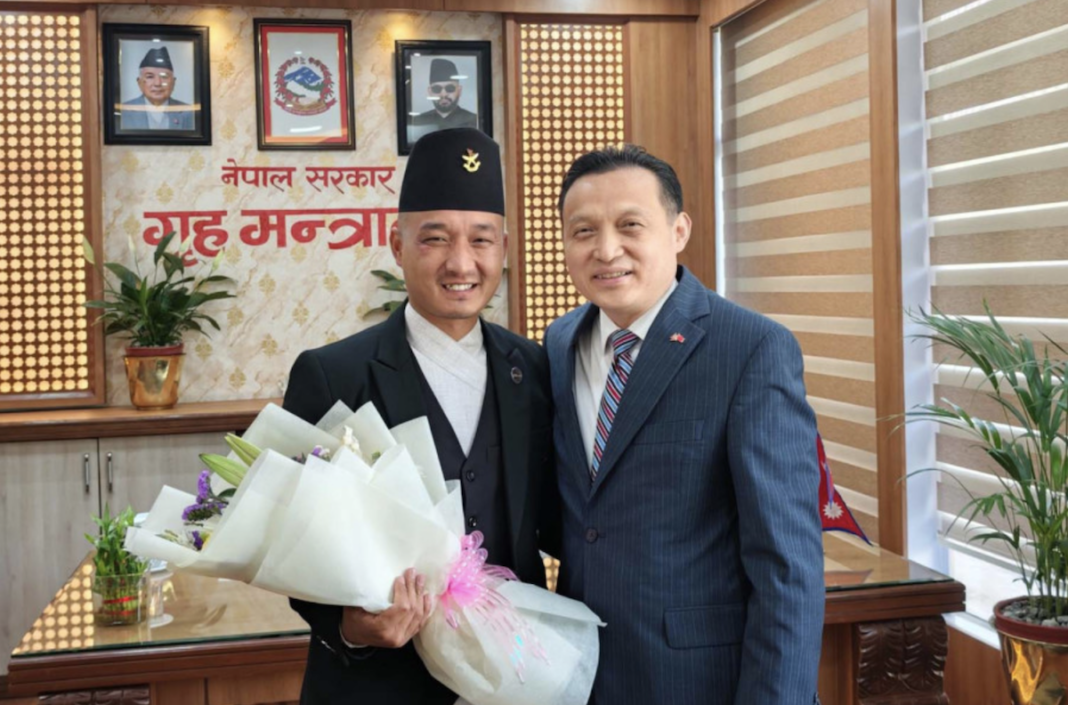
DHARAMSHALA, April 15: In a recent high-level meeting held on Monday, China intensified its diplomatic pressure on Nepal, urging Kathmandu to further restrict activities related to Tibet and Taiwan within its borders. The concerns were conveyed by Ambassador Zhang Maoming during his meeting with Nepal’s Home Minister, Sudan Gurung, where Beijing raised alarm over what it described as “separatist” activities and a perceived “westward tilt” in Nepal’s political orientation.
Ambassador Zhang explicitly warned the Nepali leadership against any participation in the upcoming swearing-in ceremony of the Central Tibetan Administration’s President Penpa Tsering, scheduled for May 27 in Dharamshala. “They might invite the government of Nepal to the oath-taking ceremony, so I would like to draw your attention to this matter,” the ambassador said.
China’s concerns have reportedly been compounded by recent developments, including a congratulatory message extended by the Tibetan political leader to Balendra Shah, as well as increased visibility of pro-Taiwan activities in the capital. One such incident involved the public display of the Taiwanese flag, which Beijing views as a direct challenge to its territorial claims.
Beijing also flagged concerns over the registration status of Tibetan refugees and recent visits by representatives of the Dalai Lama, which have allegedly irritated Chinese strategic circles.
Also present at the meeting, Home Ministry spokesperson Anand Kafle confirmed the substance of the discussions. “During the meeting, our home minister clearly stated that the Nepal government upholds the principle position on the Tibetan issue that it has been upholding for a long time, and will not allow its land to be used against China,” Kafle stated. “He also assured that the Nepal government is ready to contain such activities.”
Home Minister Gurung reiterated Nepal’s commitment to the ‘One-China’ policy, assuring that Kathmandu would maintain its established stance on both Tibet and Taiwan. He emphasized Nepal’s sovereign decision-making, stating that the country would not become “a pawn of any foreign power,” while also assuring that its territory would not be used against neighbouring states. “We are determined and committed to the country’s sovereignty and territory and will not be the pawn of any foreign power,” he told the ambassador.
Nepal’s Ministry of Home Affairs has historically exercised strict oversight on Tibetan refugee communities, particularly to prevent anti-China protests. This policy approach was reaffirmed during the latest round of talks.
Adding context to the evolving situation, Bishnu Pukar Shrestha observed that Beijing remains particularly sensitive to symbolic gestures, such as messages of goodwill from Tibetan leaders. He also noted that recent visits by representatives of the 14th Dalai Lama and the reception they received in Kathmandu have contributed to China’s growing unease. “They perceive a pattern of anti-China activities emerging in Nepal over the past few months,” Shrestha remarked.
During the meeting, the Chinese envoy also alluded to the possibility of “third-country” involvement in Nepal’s internal dynamics, suggesting attempts to strategically “encircle” China. Although no specific country was named, Gurung responded by reiterating Nepal’s neutral stance and commitment to maintaining balanced relations with all its neighbours. The meeting reflects Beijing’s increasing anxiety over Nepal’s diplomatic trajectory, particularly in the wake of last year’s Gen-Z protests.


“We are determined and committed to the country’s sovereignty and territory and will not be the pawn of any foreign power,” Sudan. But “During the meeting, our home minister clearly stated that the Nepal government upholds the principle position on the Tibetan issue that it has been upholding for a long time, and will not allow its land to be used against China,” Kafle stated. “He also assured that the Nepal government is ready to contain such activities.” So wth is it Sudan. LEts be honest, Nepal is a pawn and getting told what to do by China. Winnie The pooh with Tiger!!!! Bhoe Gyalo!!!!!!!
The Chinese communist regime claims, “it doesn’t interfere in other countries internal affairs”!!! Yet, here we are, it is brazenly interfering in Nepal’s internal affairs and virtually lecturing Home Minister Sushan Gurung to keep away from Tibetan and Taiwanese activists! How hypocritical is the Chinese communist regime? Despite being the most virulent interfering regime in every sphere from Tibet, Taiwan, Hong Kong, Dalai Lama to anything that irritates it, it constantly lectures other countries “not to interfere in so called Chinese internal affairs”! Despite the fact that it constantly calls other countries to “respect sovereignty”, it does not respect the sovereignity of other countries! It attempts to portray the US as not abiding international rules, yet, it is in fact the one who has been the biggest culprit in breaking international rules! The invasion of Tibet is an illegal act of breaking international law! Tibet posed no threat to China but out of sheer greed to plunder the natural resources of Tibet, it illegally invaded and subjected to military occupation ever since! It invaded India in 1962 despite India’s good will by helping its cause of being recognised by the world and gain admission in the United Nations! Nehru said: “There are not many instances in history where one country has gone out of her way to be friendly and co-operative with the Chinese Government and people, and plead their cause in the councils of the world, and then for the Chinese Government to return evil for good, and even go to the extent of committing aggression and invade our sacred land”. This is how the evil Chinese communists return evil for good. Pandit Jawaharlal Nehru died a broken hearted man two years after the Chinese aggression on India. Communist China invaded Vietnam in 1979 for which it got a drubbing from the Vietnamese! It has taken multiple disputed islands from Vietnam, Phillipines and recently illegally another small islet Antelope Reef! It illegally occupied whole of west Phillipines sea and built islands and militarised them. It has illegally occupied Aksai Hind which was part of Jammu and Kashmir. It is bullying Taiwan in order to invade and occupy it like Tibet. It is an international pariah and the most hated entity in the world. The new Nepali Government will be more nuanced than the previous pro-China Oli Government which was ruthless in suppressing the Tibetans in Nepal. People should remember that it wasn’t always like it has been for the last twenty years. Nepal was helpful to the Tibetans just like India in the late fifties and late sixties. It even allowed the Tibetan freedom fighters sanctuary in Mustang until 1972! The elder generation of Nepalis sympathised with the Tibet and Tibetans in the halls of Singh Durbar. However, after the demise of the monarchy and the advent of communism in Nepal everything changed owing to communist China’s influence and pressure! Nepalese communist insurgency was bankrolled by communist China. So, when they came to power, they did the bidding of the CCP. The Dalai Lama and the leaders of the Tibetan Government had no opportunity to send congratulatory messages to Nepali communist leaders owing to intense Chinese influence. When the pro-China communist regime of KP Sharma Oli was overthrown by the revolution of G-Z, The Dalai Lama and Tibetan elected SIKYONG sent congratulatory letters. This is done to all friendly country’s newly elected leaders since the Dalai Lama has more high profile than many elected leaders of the world! It seems this has incensed the Chinese communist regime and has been attempting to divert people’s attention from the failures and corruption of the pro-China Oli regime to some alleged CIA conspiracy by pro-Chinese Nepali communists! The corruption of the pro-China Oli regime was massive. Just to give a single example, the Chinese regime sold four aircraft’s to the Nepalese government through a mix of grants and loans. It was meant to up grade the Nepalese domestic fleet of airplanes. However, within five years, the plans have become un-usable and instead of flying they are grounded and have become birds nests! The Nepal airlines can neither sell them because of not finding any customer nor the Chinese are taking them back! So, meanwhile, it is an unnecessary drain of millions of rupees for maintenance! This is the kind of corruption that has made Nepalis fed up with the pro-China communists who were bribed and did the Chinese bidding rather than taking the interest of their country! The Chinese regime wants pro-China neighbours who will be sucking up to them and follow every dictate. However, Nepal demonstrated that the Chinese regimes knack for corruption ultimately ruins every nation that licks their boot. Pakistan and Sri Lanka were ruined by CCP’s loans and grants! That is why the new Nepali Government has said, it is not going to be a pawn of any country and will retain equidistance in its relations with neighbours. Tibetans in probability will feel more safe and secure now in Nepal than under the pro-China communist regime! That’s all we can hope for!