

Tenzin Nyidon
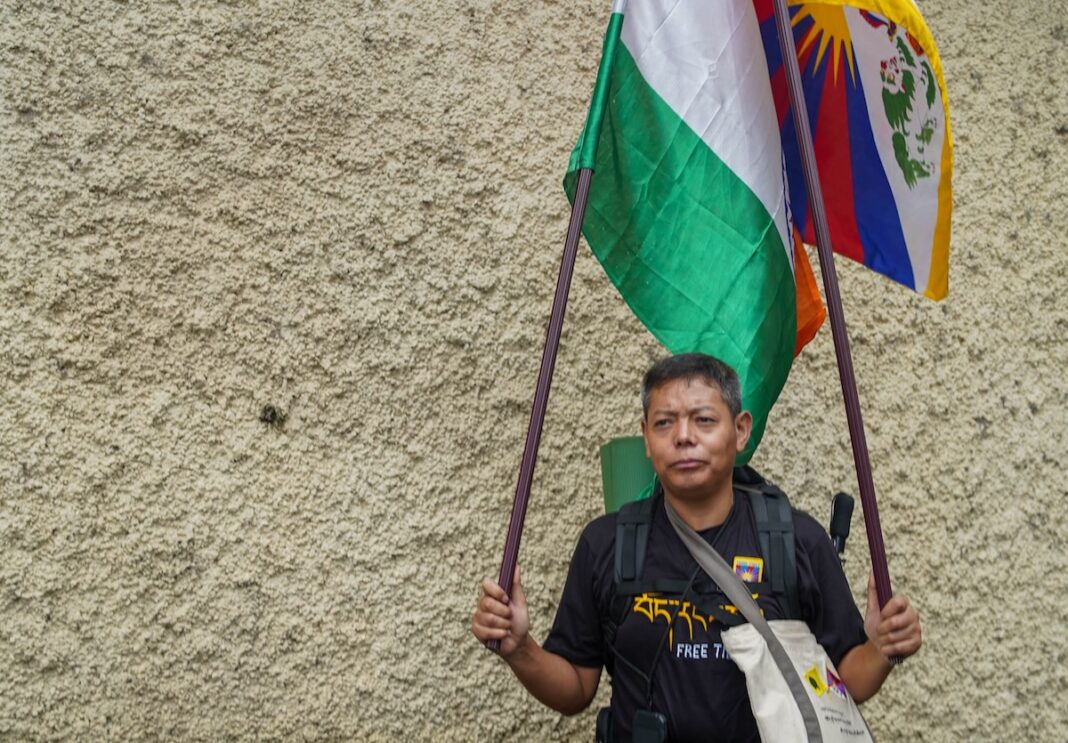
DHARAMSHALA, Aug. 21: With a black backpack on his shoulders and the Tibetan National flag carried alongside the Indian flag, Tibetan activist Lhodrak Tharchin set out on a lone Rangzen march or Azad Yatra from Dharamshala’s Police Ground to the Indian capital Delhi on Thursday.
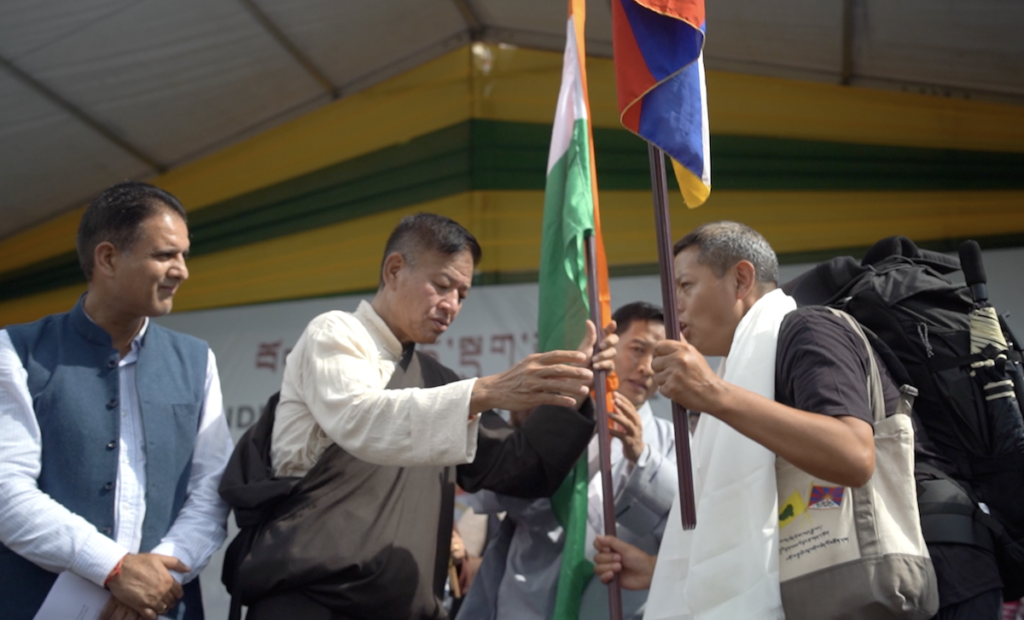
The march began immediately after a peace march commemorating the 49th day since the passing of late Tibetan independence activist Lobga Rangzen. The Central Tibetan Administration’s President, Penpa Tsering, flagged off the journey as thousands gathered at the Police Ground, raising slogans in support of Tibet’s independence.
For Tharchin, the journey is both a tribute and a continuation of a struggle. “This Rangzen Yatra is a tribute to Tibetan martyr Lobga Rangzen who self-immolated outside the United Nations headquarters in New York on July 2 to protest against China’s colonial rule in Tibet, and to all the martyrs who have sacrificed their precious lives for Tibetan freedom under Chinese occupation,” he told media representatives. But the journey, he stressed, is not intended to mark an ending. Rather, it is meant to ensure that the momentum generated during the 49-day mourning period does not fade.
Tharchin said Tibetans in different parts of the world have observed periods of mourning and organised numerous activities, demonstrations, and campaigns following Lobga Rangzen’s death. Yet, he warned, such movements can gradually become quieter once the mourning period concludes. “It is therefore very important that we continue these activities and maintain the movement,” he said.
His route will take him through Kangra, Ambala, Mohali, Panchkula, Chandigarh, Ambala, Karnal, and Sonipat before reaching Delhi, with the journey serving as a mobile campaign for greater awareness of the Tibetan cause. Along the way, Tharchin plans to meet local residents, speak about Tibet and distribute information and campaign materials. “The main objective is to meet as many people as possible and carry out as much advocacy and publicity for the Tibetan cause as I can,” he said.
At the heart of his campaign are three issues. First, Tharchin is calling on governments, international organisations and people across the world to recognise the Central Tibetan Administration (CTA) as the legitimate and true representative of the Tibetan people, and to recognise Tibet, in his view, as a historically independent nation living under Chinese occupation.
Second, he is seeking to draw attention to what he describes as the direct connection between Tibet’s political status and India’s national security. Tibet, he argues, historically served as a buffer between India and China, while China’s occupation and militarisation of the Tibetan plateau have transformed the region into a strategic arena with consequences for India. He points to Chinese territorial claims involving areas with historical and cultural connections to Tibet, including Ladakh and Arunachal Pradesh, and argues that the Tibet issue should therefore be understood not only as a question of Tibetan freedom but also as one affecting India’s security and development.
Third, the march seeks to highlight Tibet’s ecological significance. Tharchin is raising concerns about mining, large-scale dam construction, and river-diversion projects across the Tibetan plateau, arguing that the disruption of Tibet’s fragile environment has consequences that extend throughout the Himalayan region. He points to increasingly severe floods and other climate-related disasters as reminders of the wider ecological stakes.

