

Tenzin Nyidon
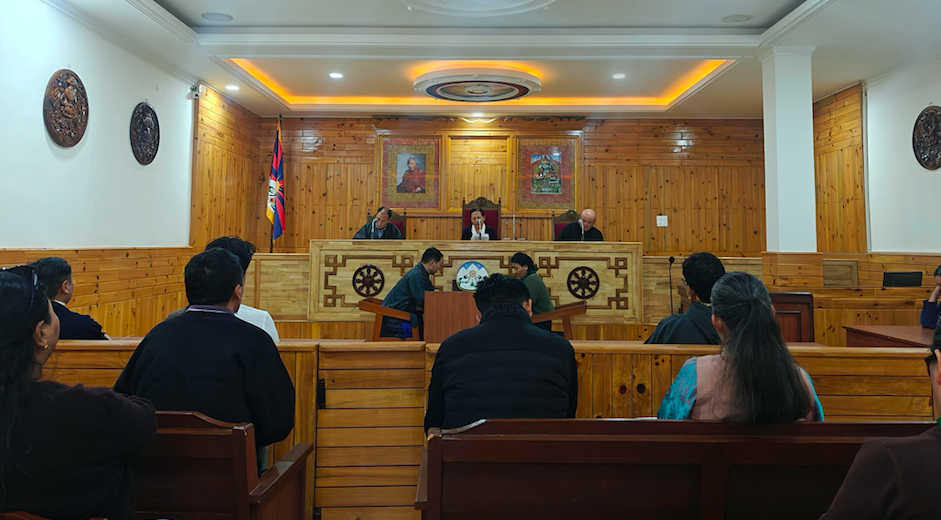
DHARAMSHALA, Oct. 21: A three-judge bench of the Tibetan Supreme Justice Commission (TSJC), the apex judicial body of the Central Tibetan Administration (CTA), on Wednesday issued its final judgment in Case No. 23, ruling that the plaintiff, Tenzin Khedup, had failed to establish his eligibility as a resident of Lugsam Tibetan Settlement in Bylakuppe, Karnataka, under the laws and regulations governing Tibetans in exile, rendering him ineligible to contest or vote in elections for representatives of Tibet’s three traditional provinces or religious traditions in India, Nepal and Bhutan.
The case centred on Khedup’s challenge to his exclusion from contesting the 2026 Tibetan General Election from the Dotoe constituency. Although a Canadian citizen, Khedup holds an Overseas Citizen of India (OCI) card, which permits him to reside in India indefinitely. He has lived at Lugsam Tibetan Settlement in Bylakuppe, Karnataka, for approximately three years, paid his Green Book contributions in Indian rupees, and registered to vote in the 2025–26 Tibetan General Election from Bylakuppe.
The case centred on interpreting residency provisions under the Charter of the Tibetans in Exile and the Election Rules and Regulations, particularly whether Khedup qualified as a resident of Bylakuppe despite holding Canadian citizenship.
During three hearings held on August 5, 13 and 19, Khedup and his legal counsel, Rigchen Wangyal, argued that the relevant provisions did not clearly define the term “residing.” They maintained that Khedup’s Canadian citizenship and the “CA” prefix on his Green Book did not, in themselves, establish that he permanently resided in Canada.

The respondent, Chief Election Commissioner Lobsang Yeshi, maintained that the relevant legal provisions must be read together. He argued that Tibetans residing outside India, Nepal and Bhutan were ineligible to contest or vote in elections for these representatives. The Election Commission further contended that “residing” referred to permanent residence rather than temporary physical presence. It cited Khedup’s Canadian citizenship and the “CA” prefix on his Green Book, noting that his records had not been updated to reflect residence in India.
In its final judgement, the TSJC held that residency must be interpreted within the broader framework of the Tibetan Charter in Exile and Election Rules and Regulations, rather than determined solely by the length of time a person has physically stayed in a particular place.
The Commission stressed that qualifying as a resident requires a legally recognised connection to the locality. It cited provisions governing the transfer of residence, which require an individual to have resided in the new locality for at least five years, relinquished entitlements associated with their previous settlement, and complied with the prescribed transfer procedures.
The Commission said it found Khedup had failed to demonstrate that these requirements had been fulfilled. It concluded that his approximately three-year stay in Bylakuppe was insufficient on its own to establish the legally recognised status required to qualify as a resident.
Consequently, the TSJC ruled that Khedrup was not eligible under the laws and regulations currently in force to contest or vote in elections for representatives of Tibet’s three traditional provinces or religious traditions.
In a separate section outlining its observations, the TSJC also raised concerns over the implementation of the regulations governing voluntary contributions from Tibetans in exile. The Commission noted that Khedup of Canadian citizen but appeared to have paid voluntary contributions at the lower rates applicable to India, Nepal and Bhutan.
It referred to Article 2 of the Voluntary Contribution of the Tibetans in Exile, which stipulates that people residing in another country, or staying there for more than one year, must contribute at the applicable rate for that country. The same provision also bars people from using relatives in another country to make contributions at a lower rate.
The Commission said the regulations did not appear to have been properly implemented in this instance and stressed that existing rules must be enforced. It further called for any necessary amendments to the relevant provisions to be formally submitted to the Tibetan Parliament in Exile.
The TSJC also urged the Central Election Commission to propose amendments to relevant rules and regulations in response to changing circumstances within the Tibetan exile community.
Speaking to media representatives following the judgement, Chief Election Commissioner Lobsang Yeshi said the TSJC had recommended reviewing existing laws and Election Rules and Regulations to address cases involving individuals who have permanently relocated to India from abroad. He added that, in line with the Commission’s guidance, relevant regulations may need to be amended to address such circumstances and prevent similar disputes in future elections. He said several proposals are being considered to improve the electoral process.
Yargyal, a senior legal officer who represented the plaintiff, told Phayul that the judgment could have wider implications for Tibetan voters beyond the case itself. He said Khedup’s voter registration in Bylakuppe had been deemed invalid because he had not fulfilled the requirements under Section 22 of the Election Rules and Regulations. Applying the same provisions, Yargyal argued, could also call into question the validity of voter registrations of Tibetans who moved from India, Nepal or Bhutan to foreign countries within the past four years and subsequently registered and exercised their voting rights in constituencies abroad.

