

Tenzin Nyidon
DHARAMSHALA, June 29: The President of the Central Tibetan Administration (CTA) Penpa Tsering said that his administration is closely monitoring China’s evolving legal and political framework, particularly the newly enacted “Law on Promoting Ethnic Unity and Progress,” while reiterating that any review of the Middle Way Approach would require careful deliberation rather than immediate policy shifts.
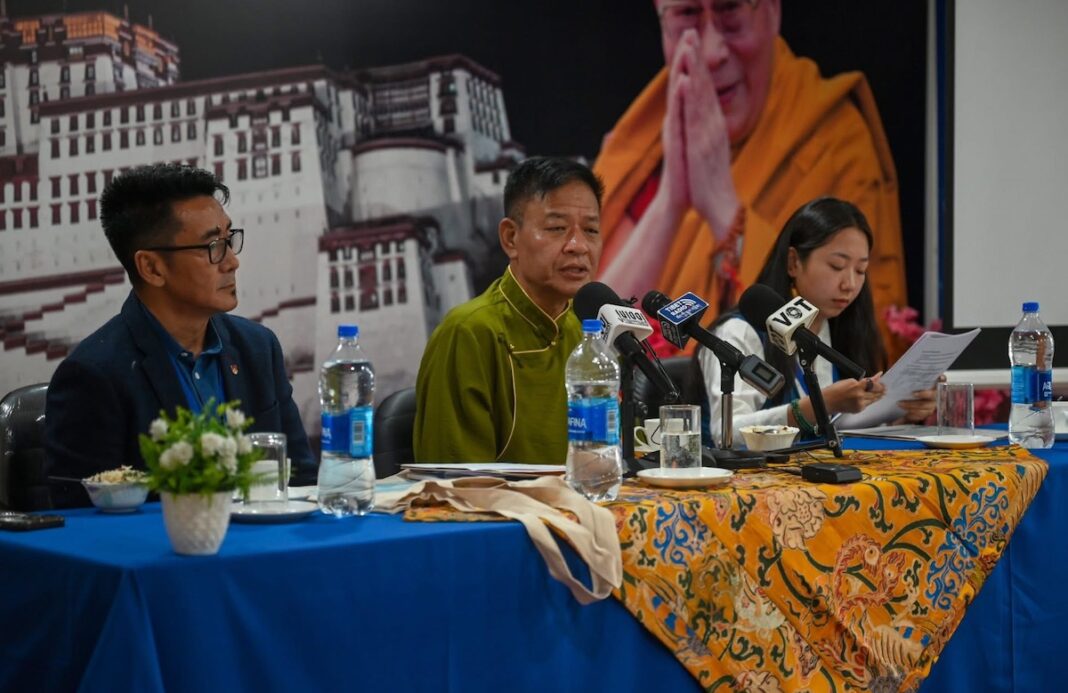
He made the remarks on Monday during a press conference held on the side-lines of a four-day international conference titled “Sino-Tibet Relations: Democracy, Dialogue, and the Middle Way Approach”, organised by the Global Tibetan People’s Middle Way Approach in Dharamshala from June 26 to 29.
Phayul questioned whether the evolving legal environment in China —particularly laws perceived as restricting minority linguistic, cultural, and religious freedoms—necessitated a fresh policy direction or even a counter policy.
The CTA President acknowledged growing concerns but ruled out any immediate policy overhaul. He noted that there are currently no active negotiations or meaningful back-channel engagements with Beijing that would necessitate an urgent shift in policy direction. Recalling earlier initiatives, including the 2008 Memorandum of Genuine Autonomy, he said these proposals were already framed within the scope of China’s own constitutional and regional autonomy provisions, though implementation has consistently diverged from stated principles.
“China is always a paradox,” he remarked, pointing to what he described as the gap between constitutional guarantees and their practical enforcement, arguing that legal frameworks in China are often shaped by political considerations rather than uniform application.
Addressing whether the Middle Way Approach should be reconsidered, the CTA President clarified that the policy remains a broad and flexible framework rather than a fixed political formula. He stressed that the administration is open to reassessing its strategies depending on evolving conditions, but emphasized that such reassessment cannot be rushed.
“The Middle Way is a larger concept,” he said, adding that it allows for evolving interpretations depending on political realities and possible future openings.
When pressed whether the CTA and his cabinet plans to formulate an alternative or counter-policy to China’s new ethnic unity law, Penpa Tsering rejected the idea of an immediate response. “A counter-policy cannot come in one or two days,” he said, stressing that any strategic response would require deep analysis, consultation, and observation of how the new law is implemented from July 1 onward. He added that the CTA would continue engaging with international governments, building awareness, and coordinating global advocacy efforts rather than rushing into policy announcements.
He further outlined a series of upcoming initiatives aimed at mobilising international attention, including collecting statements from global leaders, engaging with foreign ministries, and organising coordinated demonstrations across Tibetan communities worldwide. He emphasized that diplomatic pressure and global awareness campaigns would remain central to the CTA’s response strategy.
At the same time, he acknowledged the limits of international influence over Beijing, noting that global statements do not automatically translate into policy changes in China.
He cautioned against expectations of quick fixes or symbolic resolutions, stating that the situation requires sustained political engagement and strategic patience. “There is no magical solution,” he remarked, underscoring the complexity of dealing with China’s governance system, which he described as highly centralized and party-driven rather than institutionally accountable in the conventional sense.
He also urged Tibetan civil society and non-governmental actors to play a more active role in global advocacy efforts, noting that responsibility should not rest solely on the CTA.

