

Tenzin Nyidon
DHARAMSHALA, June 26: Speaker of the 18th Tibetan Parliament-in-Exile, Dolma Tsering Teykhang, said there is no reason to depart from the Tibetan government in exile, known officially as the Central Tibetan Administration’s longstanding official stance, Middle Way Policy, unless circumstances fundamentally change. Referring to China’s newly enacted “Law on Promoting Ethnic Unity and Progress,” which is set to take effect on July 1, she maintained that the new legislation does not warrant a shift in the CTA’s policy.
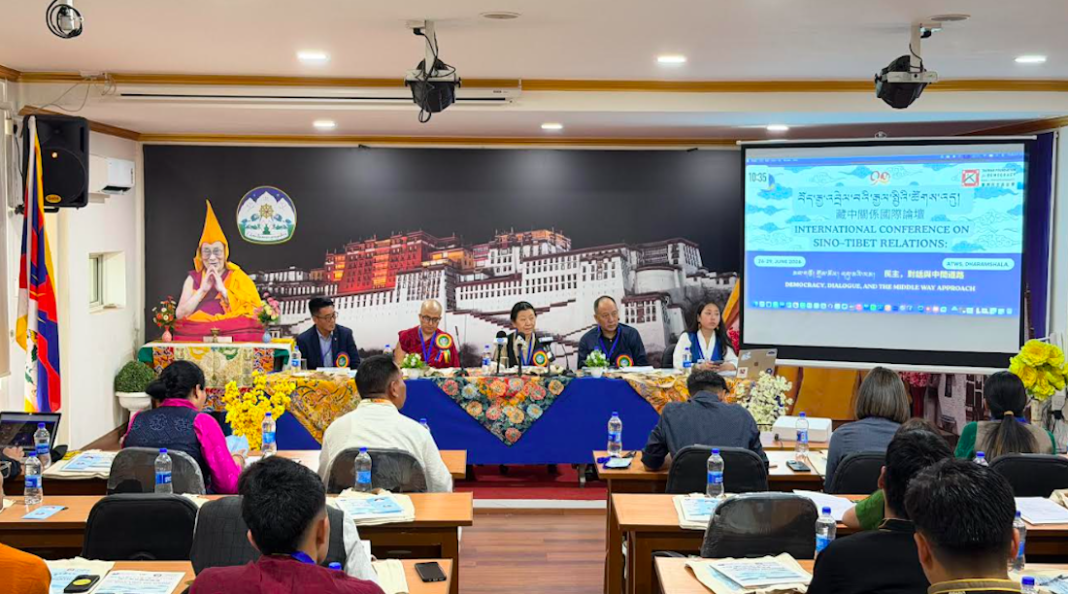
Speaking as the chief guest at the four-day international conference, “Sino-Tibet Relations: Democracy, Dialogue, and the Middle Way Approach,” organised by the Global Tibetan People’s Middle Way Approach and held from June 26 to 29 at the Administrative Training and Welfare Society in Dharamshala, Teykhang reflected on the challenges facing the Tibetan movement and reaffirmed the continued relevance of the CTA long-standing Middle Way Approach.
She said one reason for the movement’s current predicament was the failure to carry out its work effectively rather than shortcomings in the policy itself. Teykhang acknowledged that many people question what more can realistically be achieved through the Middle Way Approach as opportunities for dialogue with Beijing appear increasingly limited. However, she argued that these challenges do not warrant abandoning the current course, stating, “I do not think there is any reason to abandon the policy and path that we have followed until now.” Instead, she said Tibetans should reassess their strategies, make better use of available opportunities, and continue to strengthen their own institutions.
Addressing the stalled Sino-Tibetan dialogue, Teykhang said the responsibility for the stalled Sino-Tibetan dialogue lies with China, particularly under the leadership of Xi Jinping. She maintained that while Tibetans remain committed to the historical position that Tibet was an independent country, they have also demonstrated a willingness to coexist with China through the Middle Way Approach, including the submission of the Memorandum on Genuine Autonomy for the Tibetan People.
She said the Tibetan side had made extensive efforts to build trust with Beijing, particularly during the tenure of Prof. Samdhong Rinpoche, former Prime Minister of the cabinet of the CTA, even drawing criticism for making excessive concessions. Despite these efforts, she argued, China adopted an increasingly hardline and repressive stance, leaving the resumption of dialogue dependent on Beijing’s willingness to engage.
Responding to a question from the media about her confidence in preventing the implementation of China’s new law, Teykhang said this legal effort had been underway in Tibet since 2010 and stressed that pursuing accountability through international legal mechanisms requires time and sustained commitment.
She said any legal process would ultimately hold those responsible accountable, but emphasized that Tibetans inside Tibet are best placed to determine how to respond to repression based on their own circumstances and what they are able to endure. “We should not presume to tell Tibetans inside Tibet what they ought to do. In many ways, it is they who teach us, not the other way around,” she said, adding that those living under oppression often possess a unique resilience and understanding of how to navigate their circumstances.
Citing the Lhakar (White Wednesday) Movement as an example, Teykhang noted that the initiative originated inside Tibet rather than in exile, with Tibetans in exile later learning from those who launched it.
She said the primary responsibility of Tibetans in exile is to advocate for the Tibetan cause internationally, while acknowledging that the impact of those efforts is limited by the realities of exile. “How much we can ultimately accomplish, I cannot say with certainty. The extent of our ability is determined by the realities of our life in exile, and I cannot put a percentage or precise measure on it,” she said.
Addressing questions from the media on the continued relevance of the Middle Way Approach in light of China’s newly enacted “Law on Promoting Ethnic Unity and Progress”—which many Tibetans view as a measure designed to further erode Tibetan cultural, religious, and linguistic identity—Tenzin Shinyi, Vice President of the Global Tibetan People’s Middle Way Approach, said the conference was convened not to promote the Middle Way Approach as an unquestionable policy but to create a platform for dialogue and critical discussion.
She said the gathering brings together participants from diverse backgrounds to exchange perspectives, challenge prevailing assumptions, and engage in constructive discussions, with the aim of cultivating a deeper and more nuanced understanding of the Tibetan issue. “When we speak about the Middle Way Approach, our foremost priority is the protection of the Tibetan people’s identity, language, and culture,” she said, adding that environmental issues affecting Tibet would also form part of the conference discussions.
Describing the preservation of Tibetans as a distinct people as the central objective of the policy, Shinyi said the Middle Way Approach is fundamentally aimed at safeguarding Tibetan identity, language, and culture, all of which she said are facing unprecedented threats under Chinese rule.
“The Middle Way Approach itself was adopted through a democratic process. It was not imposed by the decision of a single individual,” she said. “Because democracy is so important, even if there is ever a need to change a policy, such a change must also come through democratic procedures. It cannot be decided unilaterally by one person, nor should any individual have the authority to alter policy on their own. I do not believe such a situation should arise.”
She added that should the Tibetan community collectively reach a consensus to revise its policy in the future, the decision must be made through democratic institutions and processes.

