

Tenzin Nyidon
DHARAMSHALA, June 27: The President of the Central Tibetan Administration (CTA), Penpa Tsering, on Friday launched a scathing critique of China’s newly enacted “Ethnic Unity and Progress Law,” describing it as a calculated attempt to legally institutionalize the assimilation of Tibetans and warning that it amounts to the “legalization of genocide” against the Tibetan people.
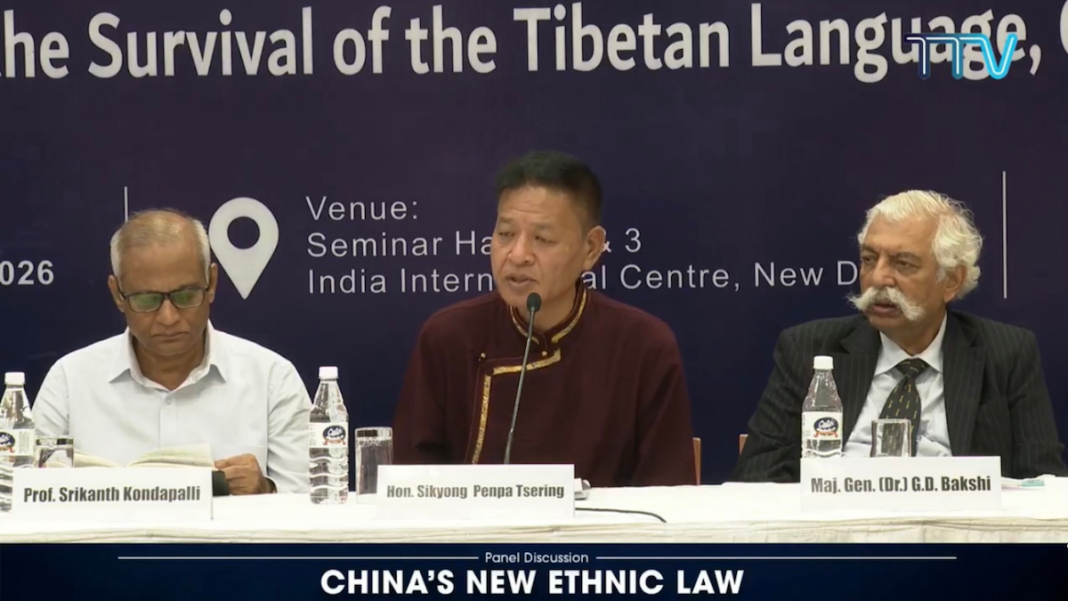
Delivering the keynote address at a panel discussion titled, “China’s New Ethnic Law: A Legal Assault on the Tibetan Language, Culture and Identity,” organised by the CTA’s official think tank, Tibet Policy Institute (TPI) at the India International Centre in New Delhi, the Tibetan political leader said the legislation marks the latest phase in Beijing’s long-standing campaign to erase Tibet’s distinct national identity under the guise of ethnic unity.
China’s Ethnic Unity and Progress Law, adopted by the National People’s Congress in March, is set to come into force on July 1. While Beijing presents it as legislation aimed at strengthening ethnic solidarity, President Tsering argued that the law instead codifies decades of policies designed to weaken Tibetan language, religion, culture and identity.
“To Tibetans, it represents the legal codification of a decades-long campaign aimed at transforming Tibetan identity, weakening Tibetan culture, restricting religious life and replacing a distinct civilization with a state-defined conception of national identity,” he said. “In essence, this amounts to China committing crimes against humanity and legalizing genocide in Tibet.”
President Tsering argued that the legislation undermines both international human rights standards and protections guaranteed under China’s own Constitution and the Law on Regional National Autonomy.
“Unity in this formulation does not celebrate diversity,” he said. “It seeks to replace diversity.”
The CTA President further warned that the legislation carries an extraterritorial dimension, citing Article 63, which he said extends the law’s reach beyond China’s borders and could potentially be used against foreign scholars, policymakers, and activists critical of Beijing’s ethnic policies.
“This law targets anyone criticizing China’s authoritarian regime and its assimilationist policies,” he said, cautioning that Beijing is increasingly portraying international criticism as interference in its internal affairs rather than legitimate concern over human rights abuses.
Reiterating the CTA’s commitment to the Middle Way Approach proposed by His Holiness the Dalai Lama, President Tsering said genuine autonomy within the framework of the Chinese Constitution—not separation—remains the only viable path towards resolving the Sino-Tibetan conflict.
“Unfortunately, the recently enacted Ethnic Unity Law takes China in precisely the opposite direction,” he said. “Rather than creating conditions for trust and reconciliation, it institutionalizes policies of assimilation under the guise of national unity. It replaces dialogue with compulsion and diversity with conformity.”
Announcing an international advocacy campaign ahead of the law’s implementation on July 1, the CTA President said the Tibetan administration would engage governments worldwide to raise awareness of the legislation and its implications.
“It is high time that the international community pays attention to what China is doing, not what China is saying,” he said. “What they are doing inside Tibet, and to the Uyghurs, Mongolians, Hong Kongers and Taiwanese, is not dialogue—it is coercion.”
Echoing similar concerns, Jayadeva Ranade, President of the Delhi-based Centre for China Analysis & Strategy, focused on the political context behind the legislation, arguing that Chinese President Xi Jinping’s “princeling” background has shaped his understanding of power within the Communist Party. Ranade said it is under Xi’s leadership that ethnic minorities have witnessed a steady erosion of their ability to preserve their distinct cultural identities, alongside a decline in their representation within the Communist Party leadership and the broader state apparatus.
TPI Senior researcher Dr. Tenzin Desal expounded on the genesis of the law and said that the necessity of the sinister law is symptomatic of China’s failed nation building initiatives over the decades.
Srikanth Kondapalli, Professor of Chinese Studies at Jawaharlal Nehru University, said that while the Constitution of the People’s Republic of China and various laws on regional ethnic autonomy contain provisions safeguarding the rights of ethnic minorities, their implementation has consistently fallen short of their stated objectives. He observed that the gap between constitutional guarantees and actual policy has left minority communities increasingly disillusioned, with many of Beijing’s promises remaining largely unfulfilled.


The thief will not keep the stolen good but will dispose it because it knows that sooner or later, he will be exposed! The CCP regime has stolen our country Tibet. It is fully aware that if Tibetans are not destroyed, it feels threatened of losing it like the thief who is highly anxious of its ill gotten treasure! The Chinese are one of the most racist people in the world! The Chinese have called all other people living on its periphery “barbarians” and built a wall to keep them away from themselves! Recently, a black doll by the name of Natasha was abused by every Chinese internet user by calling it names, disfiguring it, throwing it, stomping on it, spiting on it and tearing it apart. Owing to their extreme prejudice towards black people, they vented their racist rant and racist bigotry on the black doll. In the Nigerian capital of Abuja in 2023, the Chinese opened a huge shopping centre. However, when African people went to the shopping complex, they were denied entry, claiming, it was only for people of Chinese descent! This fuelled massive anger in Nigeria and the shopping complex was shut down by the Nigerian Government accusing the Chinese of racism in their own country! The Chinese have called African workers “monkeys” and Chinese social media is full of racism against black people. The so called “ethnic unity law” is a RACIST instrument against the Tibetans and Uighur people who they perceive as dark compared to themselves! It is the result of extremest Han chauvinistic attitude that is the result of Han supremacist ideology prevailing in communist China under the evil dictator Xi Jinping! Tibetans must learn that it is simply impossible to co-exist with communist China. Pandit Jawaharlal Nehru sincerely thought that India and China will be a bulwark against western imperialism since the Chinese pretended to be anti-imperialism and anti-colonial. It was a ruse. The Chinese are in fact much worse and dangerous than western imperialists and colonialists. They not only conquer the land and destroy it but they destroy the people who inhabit the land! The Manchus who once ruled China and many other nationalities which were forcibly occupied and incorporated into the Chinese “empire” have been obliterated! If Tibetans don’t fight for independence, there is no hope of survival under Chinese communist cult regime! In exile, every Tibetan family must ensure that their children speak Tibetan and also learn how to read and write Tibetan language. Tibetan writers, academics and intellectual to ordinary people must highlight the racist CCP instrument of genocide dressed in garb of “ethnic unity law” as nothing but CCP’s evil design to exterminate the Tibetan people as a distinct race with its unique language and cultural identity in order to claim Tibet for perpetuity! We cannot allow such an evil motive to succeed. We must take up arms to defend ourselves from total extinction. For this purpose, Tibetans should plan to train our people for military service as a means to defend ourselves from extinction that is the purported aim of the satanic Chinese communist occupiers of our country. We love peace. We preach peace but when we are threatened with extinction, don’t we have a right to defend ourselves? Is it not the right of every nation and people that they have a right to exist and if that is threatened, the right to defend is an inalienable right and we must not be complacent of the danger and should be prepared for any eventuality!