

Tenzin Nyidon
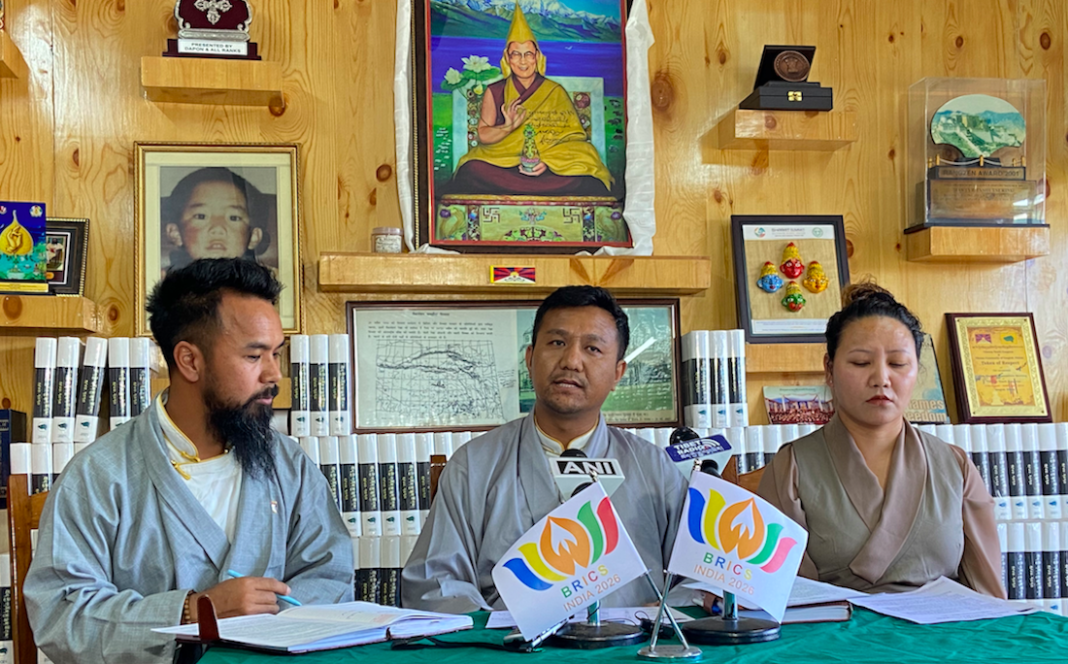
DHARAMSHALA, June 21: The Tibetan Youth Congress (TYC), the largest pro-independence Tibetan organization in exile, on Sunday strongly condemned the visit of Chinese Foreign Minister Wang Yi to India, asserting that Beijing cannot project itself as a responsible global power while continuing what it described as its “illegal occupation and colonial rule” over Tibet.
Wang is scheduled to attend the BRICS National Security Advisors Meeting in New Delhi on June 22–23, a high-level platform that brings together national security advisors from the 11-member bloc to discuss key regional and global security challenges.
In a statement issued ahead of the meeting, the TYC congratulated India on hosting the BRICS gathering and praised the country’s growing role on the global stage. “The Tibetan Youth Congress warmly congratulates the Republic of India on successfully hosting the BRICS Summit and applauds India’s emergence as a leading global power whose principled leadership and diplomatic engagement continue to play an increasingly significant role in addressing international challenges and shaping the global order,” the statement said.
The organization, however, voiced strong opposition to Wang’s visit, accusing the Chinese government of attempting to mask decades of repression in Tibet through diplomatic engagement and international cooperation.
“For more than seven decades, the Chinese Communist Party has subjected Tibet to military occupation, political repression, demographic engineering, cultural eradication, and systematic violations of fundamental human rights,” the statement alleged. The group further accused Beijing of intensifying policies aimed at assimilating Tibetans, suppressing expressions of Tibetan identity, and undermining Tibet’s religious, linguistic, and cultural heritage.
The TYC also expressed concern over China’s recently implemented “Ethnic Unity and Progressive Law,” set to come into force on July 1, 2026, describing it as a mechanism designed to accelerate the Sinicization of non-Chinese peoples. According to the organization, the legislation seeks to institutionalize assimilation policies affecting Tibetans, Uyghurs, Mongolians, and other minority communities under the guise of promoting national unity.
The statement reiterated the TYC’s position that Tibet remains one of the world’s longest unresolved issues of occupation and decolonization, arguing that China’s economic influence and diplomatic outreach cannot legitimize its rule over Tibet.
Linking the Tibet issue to regional geopolitics, the organization asserted that the ongoing Sino-Indian border dispute is fundamentally rooted in China’s occupation of Tibet. “Prior to the military invasion and occupation of Tibet from 1950–59, India and Tibet shared a long and peaceful border. The current tensions and disputes emerged only after the People’s Republic of China forcefully occupied Tibet and replaced Tibet as India’s northern neighbour,” the statement said.
The group maintained that efforts to resolve the border dispute without addressing Tibet would fail to tackle its underlying cause. “There can be no permanent, just, and sustainable resolution to the so-called India-China border dispute until the question of Tibet is resolved and the Tibetan people are able to exercise their right to determine their own political future in a free Tibet,” it stated.
The TYC further urged the Government of India, democratic nations, and the international community to hold China accountable for alleged human rights violations and policies of political and cultural repression in Tibet. It called on world leaders not to compromise principles of justice and human rights in pursuit of economic and strategic interests.
Reaffirming its demand for Tibetan independence, the organization appealed to governments and international institutions to support the Tibetan people’s right to self-determination and ensure that Tibet’s political future remains part of international diplomatic discourse.
“The Tibet issue is not merely a human rights issue; it is a matter of international peace, security, and decolonization,” the statement concluded. “The occupation of Tibet created the Sino-Indian border dispute, and only a free Tibet can provide the foundation for a durable and peaceful resolution.”

