

Tenzin Nyidon
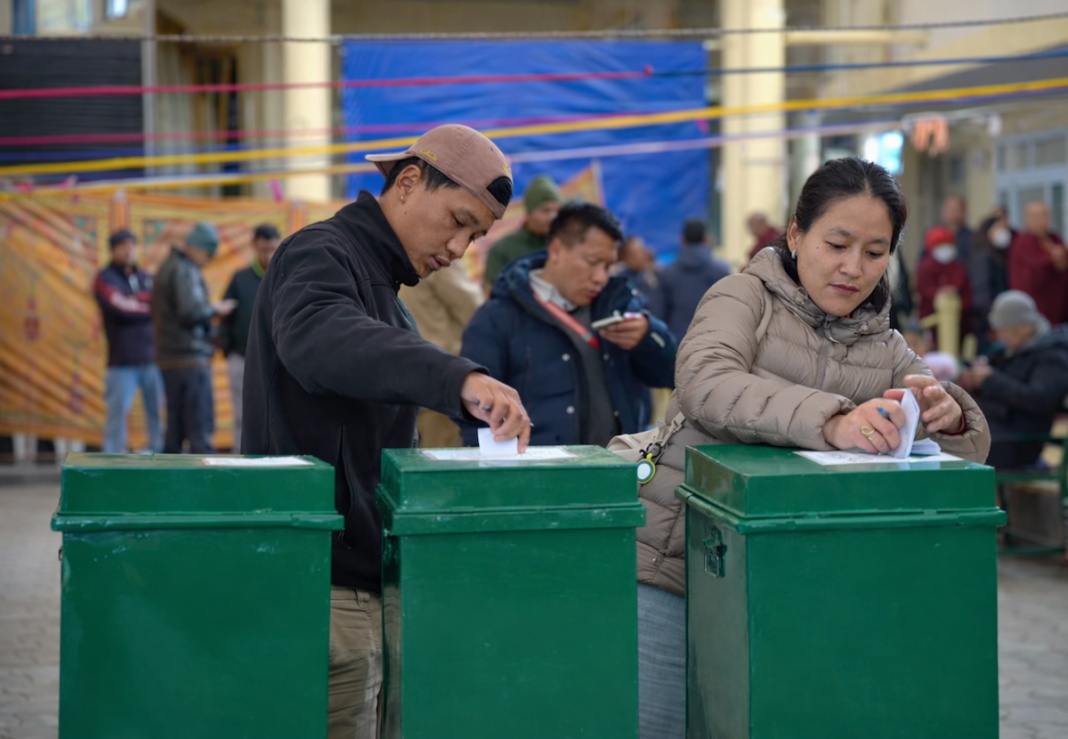
DHARAMSHALA, Feb. 4: China has condemned the ongoing 2026 General Election of the Central Tibetan Administration, dismissing it as a “farce” where Tibetans in exile across the world cast their ballots to choose their future political leadership.
In a written statement to Agence France-Presse (AFP), China’s foreign ministry rejected the legitimacy of the exile Tibetan government, officially known as the Central Tibetan Administration (CTA), asserting that it is “nothing but a separatist political group” and further describing it as “an illegal organisation that completely violates the Chinese constitution and laws.” Beijing has consistently opposed all political activities undertaken by the Tibetan exile community and has repeatedly denounced the CTA as unlawful and illegitimate.
The remarks came as exile Tibetans outside Tibet participated in the first phase of voting, known as the preliminary election, held on February 1. Tibetans living across 27 countries took part in the process, which is expected to see participation from more than 91,000 eligible voters worldwide. The preliminary polls are being overseen by 87 local election commissioners appointed by the Central Tibetan Election Commission.
Marking a notable development in the global Tibetan diaspora’s democratic process, Tibetans in South Korea voted for the first time in a Tibetan general election, reflecting the expanding geographic reach of exile Tibetan participation.
Despite the broad international participation, voting conditions vary significantly depending on the host country. In nations perceived to be under strong Chinese influence, such as Bhutan and Nepal, exile Tibetans are reported to face severe restrictions and intimidation, forcing them to vote in secrecy.
In Bhutan, exile Tibetans are reportedly not permitted to vote openly, with some sources claiming that voters must travel to border areas to cast their ballots. However, due to the highly secretive nature of the process, these accounts remain difficult to independently verify. In Nepal, where political sensitivities surrounding the Tibetan community remain acute, voting is likewise conducted under strict secrecy. According to sources, local election commissioners discreetly visited individual homes to facilitate the casting of ballots, a measure adopted to minimise visibility and potential repercussions. While sources indicated that voting in Nepal took place on January 11, confirmation of whether any voting occurred in Bhutan remains uncertain at this time.
The 2026 Tibetan General Election is being conducted in two phases. The first phase, or preliminary election, allows voters to shortlist candidates, while the second and final phase is scheduled for April 26, when the President and members of the 18th Tibetan Parliament-in-Exile will be elected.
In India, which hosts the largest Tibetan exile population, the voting process follows a detailed representative structure. Tibetan voters elect members of the Tibetan Parliament-in-Exile based on regional and religious affiliations. Lay voters are entitled to vote for 10 Members of Parliament according to their regional affiliation, while monks and nuns vote for 12 Members of Parliament, reflecting both regional and religious representation.
In addition, Tibetans also elect five Members of Parliament under regional representation from outside India: two from Europe, two from North America, one from Australasia and Asia (excluding India, Nepal And Bhutan).
The Tibetan General Election remains a cornerstone of the exile community’s democratic scope, standing in sharp contrast to China’s rejection of any political expression by Tibetans outside its control. Despite Beijing’s denunciations, exile Tibetans continue to assert their right to self-governance through a participatory electoral process carried out across continents to elect their leadership.


CCP, India is a free country, where every voice is listen. We Tibetans enjoy every democratic act here in India. CCP keep your mouth shut!
The CCP’s so called National people’s Congress (NPC)has more than 3000 attendees but no one has any say except one man -the great dictator Xi Jinping! THAT’S A FARCE!
When the leader is supposedly elected, there is no dissenting voice! The only ballot against the leader is his own ballot which happens only because it would be embarrassing if he voted for himself! THAT IS A FARCE!
The so called fight for corruption has toppled more than 7.2 million people of which many committed suicide has been the signature of a dictator that is only interested consolidating his personal power to ingratiate himself like Adolf Hitler, Stalin and Mad man Mao! THAT IS A FARCE!
Eliminating eleven personally selected and appointed PLA Generals by making spurious allegations of selling nuclear secrets to America is incredulous and an object of derision! THAT IS A FARCE!
The CCP has no mandate to rule China! It is not ruling China by the people’s mandate but by the guns of the PLA! THAT IS A FARCE!
Its legitimacy to rule China is on par with Afghan Taliban’s legitimacy to rule Afghanistan! THAT IS A FARCE!
On the other hand, The Tibetan Government in exile is the legitimate Government of the Tibetan people! It is the continuation of the independent Government of Tibet, that consisted of Tibetan kings and Lamas from the time of the great Tibetan empire! Today, in accordance with the times, the Dalai Lama has devolved power to the People’s elected leader in the spirit of democracy and universal suffrage! The leadership of the Exile Tibetan Government rules with the mandate of the Tibetans in exile through free and fair elections while in occupied Tibet, Tibetans are ruled by the guns of the Chinese communist occupiers!