

Tenzin Nyidon
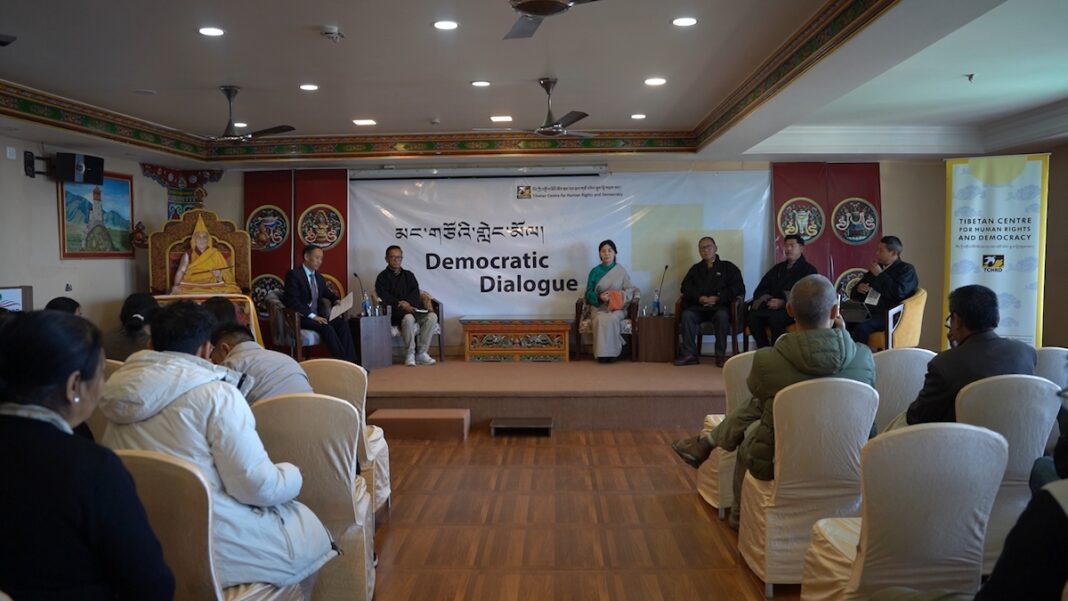
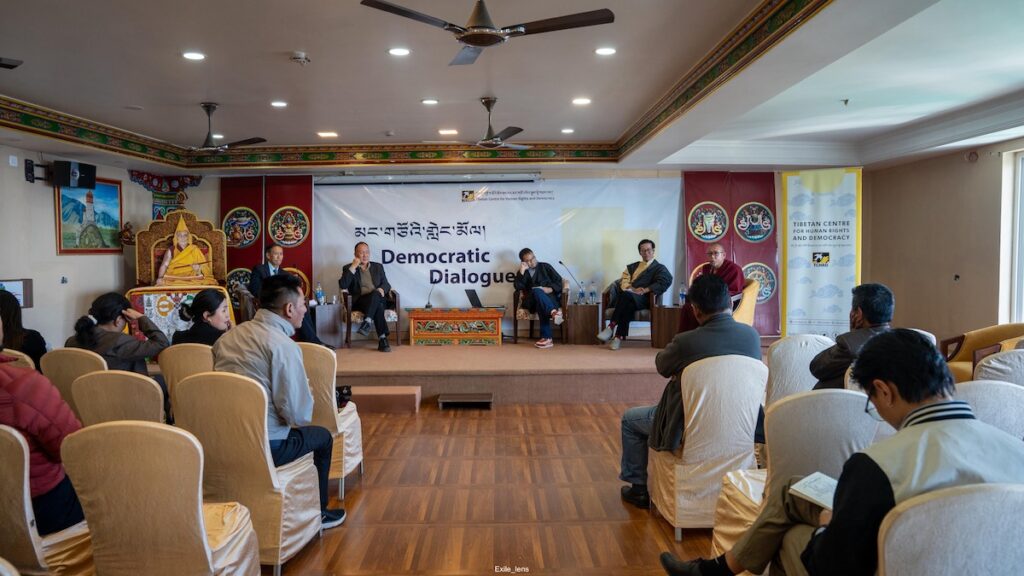
DHARAMSHALA, April 11: Rights and advocacy group Tibetan Centre for Human Rights and Democracy on Friday, ahead of the final phase of the Tibetan general election, organised a debate series titled ‘Democratic Dialogue’ in Dharamshala at Norbu House. The event brought together nine candidates contesting for seats in the upcoming 18th Tibetan Parliament-in-Exile elections, scheduled for April 26. The debate was structured into two sessions, with five candidates participating in the morning session and the remaining four engaging in the afternoon session.
The debate covered a wide range of key issues, including the candidates’ individual capabilities, their approaches to fulfilling parliamentary responsibilities, and strategies to strengthen democratic institutions. Participants also addressed the role of youth and the younger generation in advancing the Tibetan cause, fostering unity within the Tibetan community, and measures to counter transnational repression.
Phayul raised a question in reference to a resolution adopted during the recent budget session of the 17th Tibetan Parliament-in-Exile, which condemned China’s law on “Promoting Ethnic Unity and Progress.” The resolution had prompted concerns among some members of parliament that the legislation could further erode prospects for genuine autonomy.
In this context, the candidates were asked whether the Central Tibetan Administration should continue to uphold the Middle Way Policy. They were further invited to explain the reasons for supporting its continuation, or alternatively, to state whether they would seek to introduce a resolution in the House to amend the CTA’s official position, if elected, in order to advance the Tibetan cause in light of the current political realities in Tibet.
Responding to the question, Lhatse Dawa Tsering stated that differing views currently exist on whether the Middle Way Policy can effectively resolve the Tibetan issue. He emphasised that any meaningful resolution must ultimately involve engagement with China, noting that there are broadly only two possible approaches—conflict or dialogue.
He dismissed the possibility of armed conflict as neither viable nor practical when advocating for full independence, citing the vast disparity in strength and resources, which would render such an approach both unrealistic and harmful. While acknowledging that there may be limited immediate hope for progress under the current Chinese leadership, he drew attention to his own professional experience over the past decade. Through sustained engagement with Chinese citizens, he observed that a significant majority—around 70 percent of approximately 300,000 individuals reached—expressed support for the Middle Way Policy. Based on these interactions, he argued that it would be incorrect to assume a lack of hope or confidence in the policy.
He further asserted that the Middle Way approach is not only beneficial for resolving the Tibetan issue but could also offer advantages to China, including fostering internal unity, promoting spiritual and ethical values such as Buddhism, enhancing domestic stability, and improving China’s international standing. On the question of whether the Middle Way Policy requires revision, he maintained that any call for change must be accompanied by a clearly defined and more effective alternative. In the absence of such a viable option, he sees no compelling reason to alter the current policy.
Fellow MP contender Lharong addressed the issue in the context of China’s recently introduced law on “Promoting Ethnic Unity.” He stated that, rather than diminishing confidence, the law has reinforced his belief in the Middle Way Policy by highlighting its continued relevance.
He noted that while the law reflects China’s stated aim of building a unified nation, its implementation is fundamentally flawed, as it imposes uniformity at the expense of ethnic diversity. From the Tibetan perspective, he warned, the new law poses a serious threat to religion, culture, and language, with its enforcement indicating an attempt to erode these foundations at their core. This, he said, has heightened concerns about the increasingly precarious state of Tibetan identity.
Lharong emphasised that the Middle Way Policy, grounded in the framework of the Chinese constitution, seeks genuine autonomy that would safeguard Tibetan religion, culture, and language. He argued that alternative approaches do not currently offer stronger guarantees for protecting these essential aspects of Tibetan identity, and therefore saw no justification for a major policy shift at this time.
Other candidates stated that the Middle Way Policy provides an effective framework for safeguarding the core aspects of Tibetan identity. They further expressed the view that, at present, they do not see any alternative approach that could offer stronger or more reliable guarantees than the Middle Way Policy.
MP contender Sonam Tobgyal, responding to a question from an attendee during the second debate session on how to bring China back to the negotiating table with Tibetan representatives despite prolonged stalled dialogue and an evident power imbalance, said that it is also important to consider the question of full independence. Addressing the question of independence, he stated that while it remains a legitimate aspiration, historical experience shows that such struggles are often shaped by broader geopolitical conditions.
Smaller nations, he noted, have typically achieved independence when larger powers weakened or when favourable international circumstances emerged. Citing the example of India’s independence, he observed that several neighbouring countries also gained independence during the same period, largely due to the decline of British power—illustrating a broader pattern in political history.
He concluded by emphasising that political struggles are deeply tied to real-world conditions and societal dynamics. While the desire for freedom and independence is universal, achieving it requires not only aspiration but also the right conditions and opportunities.


The Tibetan Government’s policy known as “Middle Way” has been there for at least five decades! It was an idea that was spruiked by the late Bawa Phuntsok Wangyal during his hey day as a young Tibetan communist. This is clearly stated in his biography written by American professor Melvin Goldstein called “Tibetan Revolutionary”. It is on page 54 of the hard cover edition to be sure! The Dalai Lama adopted the idea way back in the early 1970s as a future policy for the Tibetan anti-colonial Freedom Movement. To give further proof of this; during an interview in 2023 with Samdhong Rinpoche on Radio Free Asia about U-May with Sonam Yangzom, Rinpoche said; “we stole it”!meaning from Phuntsok Wangyal). Then he said, “I am just joking, we adopted it”! Therefore, the origin of the “Middle way” was first proposed by Bhawa Phuntsok Wangyal! Tibetan leaders adopted the idea in exile after Tibet was occupied by communist China! Tibetans did not accept the notion of remaining with communist China! Professor Dawa Norbu writes: “It was no longer possible , they emphasised, (Exile authorities) to demand Bod rang brtsan (Tibetan independence), a political diet on which the refugees had been fed since 1959 but that under the Dalai Lama’s leadership and with his efforts, Rang skong ljong (genuine autonomy) is possible. This dialogue meant, as far as the refugees are concerned, the reduction of “independence” to “autonomy” which, according to Saklaini’s findings appeared to be UNACCEPTABLE TO MOST REFUGEES IN INDIA” Since, the majority of Tibetan exiles would not accept the autonomy proposal, the Tibetan authorities in Dharamsala resorted to blackmailing the population by claiming, it was the Dalai Lama’s “brain-child” in order to ramp it down the throat of the Tibetans! The Dalai Lama was very careful in crafting words like “in association” with China and not under China! Most Tibetans who came from Tibet will not accept the notion that Tibet is not owned by Tibetans. As Jewish writer Ze’ev Jabotinsky said, “Every native population in the world resists colonists as long as it has the slightest hope of being able to rid itself of the danger of being colonised. Every native population, civilised or not, regards its land as its national home, of which it is the sole master. This is equally true of the Arabs”. Tibetans will never give up on our national home, because we regard ourselves as the SOLE MASTER OF OUR HOME LAND! The Arab-Israeli conflict is precisely OWNERSHIP OF LAND! The Arabs feel Palestine is Arab land which was taken away by colonial powers for their vested interests. The Israelis on the other hand claim biblical connection to the land but the (unsurprisingly, the Chinese claim over Tibet is “from ancient times”. fact remains that they have been settled through the Balfour declaration of 1917! TIBET BELONGS TO TIBETANS! THIS IS A FACT! TIBET WAS A HOMOGENOUS COUNTRY LIKE JAPAN BEFORE THE CHINESE INVASION, OCCUPATION AND COLONISATION! CHINESE ARE INVADERS AND HAVE NO GENEALOGICAL ROOT IN TIBET! Therefore, Tibetans will never give up our homeland to be taken by the alien Chinese invader by force. It is the Dalai Lama’s insistence on non-violence that has kept the Tibetan anti-colonial freedom movement peaceful. Pursuing independence through peaceful means is worthy but we also have to see if it is paying dividends. The incredible resistance by the Palestinian people against overwhelming terror has galvanised the world attention in favour of the Palestinian independence. The Tibetan people’s struggle against Chinese illegal and brutal occupation of Tibet is exactly the same as the Palestinian people’s struggle against Israeli and American imperialism and colonialism ambitions! TIBETANS SHOULD EMULATE THE COURAGEOUS PALESTINIAN PEOPLE’S FIGHT FOR SELF-DETERMINATION INSTEAD OF SMOTHERING TIBETAN INDEPENDENCE ADVOCATES! As the recent Chinese law passed by the rubber stamp National People’s Congress demonstrated, THERE IS NO CHANCE THAT TIBETAN LANGUAGE, RELIGION, CULTURE AND IDENTITY CAN SURVIVE UNDER THE DEATH CULT OF CHINESE NATIONALIST SUPREMEST BIGOTRY! THE “ETHNIC UNITY LAW” IS AKIN TO THE LAW PASSED BY ISRAELI PARLIAMENT TO EXECUTE PALESTINIANS WHO ESPOUSE VIOLENCE AGAINST THE JEWS IN ISRAEL. THE CHINESE ETHNIC LAW STIPULATES THE TOTAL EXPUNGING OF TIBETAN LANGUAGE BY MAKING IT A CRIME TO EVEN COMPLAIN ABOUT SUCH ABUSE OF STATE POWER IN A OCCUPIED TERRITORY!