

Tenzin Nyidon
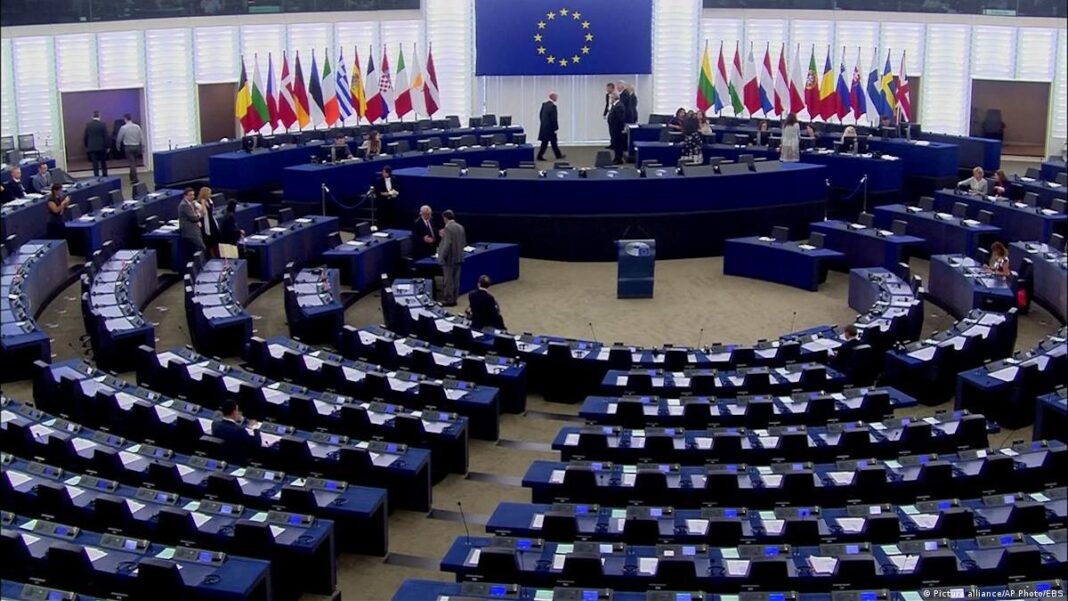
DHARAMSHALA, May 1: The European Parliament, in a resolution adopted on Thursday, strongly condemned China’s newly adopted law on “ethnic unity and progress,” warning that it will deepen the systematic suppression of ethnic identities and further strain relations between the European Union and Beijing, which have already been strained by ongoing human rights concerns.
The Parliament criticized the legislation passed by China’s top legislature, the National People’s Congress, on March 12, 2026. The law, formally titled the ‘Law on the Promotion of Ethnic Unity and Progress,’ is seen as a major shift in China’s governance of ethnic minorities, prioritizing ideological conformity and the expanded use of Mandarin across education, public life, and media.
The resolution emphasised that the protection of ethnic, cultural, religious, and linguistic identities is embedded in international law, referencing standards such as the United Nations Declaration on the Rights of Persons Belonging to National or Ethnic, Religious and Linguistic Minorities. Lawmakers expressed alarm that the new legislation departs significantly from China’s 1984 Regional Ethnic Autonomy Law, which previously provided a framework—albeit limited—for regional autonomy. Instead, the new law is said to institutionalize assimilation policies targeting groups including Tibetans, Uyghurs, Mongolians, Hui, and Manchus.
A particularly contentious aspect of the law is its extraterritorial scope. According to the resolution, individuals outside China could face prosecution if deemed to undermine the state’s concept of “ethnic unity.” The Parliament described this as a form of transnational repression and urged EU member states to suspend extradition treaties with China to protect individuals at risk.
The resolution called on the EU to take concrete steps in response. It urges the activation of the bloc’s Global Human Rights Sanctions Regime against Chinese officials and entities responsible for drafting and implementing the law. It also stresses that respect for human rights, democracy, and the rule of law must remain central to EU-China relations.
The Parliament reiterated its longstanding concerns over Beijing’s interference in Tibetan religious affairs, particularly regarding the recognition of spiritual leaders. It “strongly rejects” the Chinese authorities’ involvement in the succession of His Holiness the Dalai Lama, emphasizing that the process is a purely religious matter that must adhere to Tibetan Buddhist traditions.
In a notable section, the resolution calls for the immediate release of several political prisoners, including Tibetan religious figure Choktrul Dorje Ten Rinpoche, activist Palden Yeshi, and the 11th Panchen Lama. The Parliament also urged the Office of the United Nations High Commissioner for Human Rights to issue an updated report addressing the implications of the 2026 law.


Communist China’s so called “ethnic law” is a direct affront to the rights of the Tibetan people to use their language like any other nationality in every country. This is driven by racism just like Israeli law to murder Palestinians who attack Jews! The evil CCP feels very threatened by the Tibetans having their own civilisation and identity. This obviously questions Chinese claims over Tibet and their legitimacy in military occupation of Tibet for the last seven decades! They fear that if Tibetans retain their language, culture and identity, Tibet will want to be free from Chinese enslavement. They know, Tibetans are unhappy under Chinese occupation since 157 Tibetans have self-immolated in protest of Chinese occupation while calling for the return of the Dalai Lama! The call for the return of the Dalai Lama is a clarion call of rejection of Chinese occupation! The CCP therefore enacted this dastardly and racist “law” as a final solution to the question of Tibet. They are conjuring the Nazi ideology of Chinese Han supremacy over all other races! Just as the Nazis claimed to be superior to other races the CCP is doing the same! Just as the Nazis sought to liquidate all “inferior”races like the Jews and Gypsies in their pursuit of Nazi supremacy, the Chinese communist regime is on the same trodden path of the Nazis and think that the Han is “superior” to other nationalities and therefore, in order to meet the goal of Han chauvinism, all other conquered people such as the Tibetans must be liquidated! In this way, it will be a “pure” Han race like the Nazi dream of supremacy that would be the fulfilment of the so called “Chinese dream”. This they believe will entrench Tibet firmly under their control since Tibetans will disappear like water in the sand through cultural and linguistic genocide. TIBETANS MUST BE PREPARED TO DO ANYTHING AND EVERY THING TO THWART THE EVIL AMBITION OF THE CHINESE COMMUNIST REGIME! Thank you to every member of the European Parliament who spoke in support of Tibet and demanded the repeal of the genocidal “law” by the brutal killer regime of communist China!