

By Tsering Dhundup
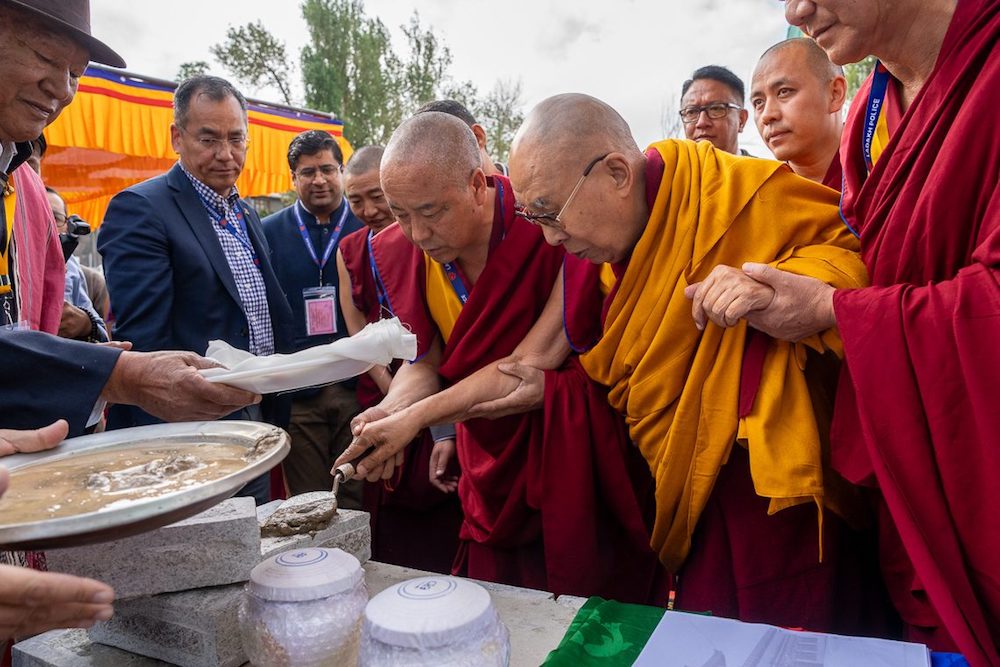
DHARAMSHALA, Aug 4: Tibetan spiritual leader His Holiness the Dalai Lama laid the foundation stone for the reconstruction of the historic Jokhang (Chowkhang) Vihara in Leh’s main market, marking a significant moment for Ladakh’s Buddhist community on Sunday.
The old temple, a cherished pilgrimage centre and home to a sacred statue of Buddha Shakyamuni crafted in Lhasa and transported to Leh in pieces, had been demolished after developing irreparable cracks caused by flooding and heavy rain.
In his address, His Holiness called the loss of the old structure “a blessing in disguise”, likening it to the Tibetan exile in India, which allowed the community to reconnect with the land where Buddhism originated. He urged that the new temple should not only be rebuilt as a place of worship but also serve as a “centre of learning” for Buddhist philosophy, logic, and debate.
“The crucial thing is that it provides others with the facilities to study the Buddha’s teaching just as I have been able to do since I was a child,” he said. “When you have completed the temple, you should ensure it becomes a centre where people can study logical and philosophical treatises and engage in dialectical debate.”
Following the foundation stone-laying, His Holiness travelled to Choglamsar to consecrate a new Dharma Centre built by the LGA. Addressing a packed hall, he emphasised the importance of rigorous study, debate, and spreading Buddhist teachings beyond the monastic community, encouraging monks, nuns, and laypeople to learn English for global outreach.
The Jokhang Vihara holds deep cultural and religious significance. Built in the late 1950s as a replica of Lhasa’s famed Jokhang Temple after China’s occupation of Tibet cut off Ladakhi pilgrims from visiting it, it houses a sacred statue of Buddha Shakyamuni. The original foundation stone was laid in 1957 by former India’s ambassador to Mongolia, late 19th Kushok Bakula Rinpoche, and the consecration in 1962 drew some 300 monks and 15,000 laypeople.
The statue, crafted in Lhasa and transported to Leh in pieces, was filled with relics and precious offerings before being enshrined. Over the decades, the temple has served as a unifying centre for all sects of Tibetan Buddhism in the Nalanda tradition.

