

Tenzin Nyidon
DHARAMSHALA, Aug. 26: China is reportedly removing traditional Tibetan literary and cultural works from revised Tibetan-language school textbooks, according to a report by the Dharamshala-based Tibetan Centre for Human Rights and Democracy (TCHRD), raising fresh concerns over the future of Tibetan-language and cultural education under Beijing’s evolving ethnic policy. The reported changes come shortly after China’s new Law on the “Promotion of Ethnic Unity and Progress” came into force on 1 July, 2026.
The law places education at the centre of efforts to cultivate what Chinese authorities describe as a “sense of community of the Chinese nation.” It requires schools and other educational institutions to use the national common language and script — Mandarin — as the basic language of education and teaching, while also requiring nationally unified textbooks and the integration of national-identity education throughout the educational process.
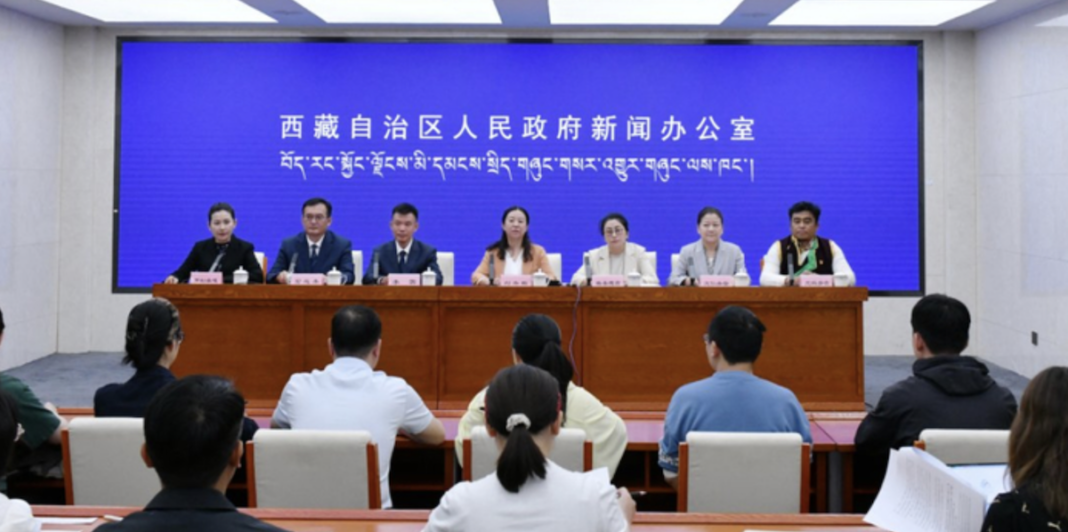
In Tibet, authorities are already rolling out educational measures that closely correspond with the law. At a press conference held by the Information Office of the People’s Government of the so-called Tibet Autonomous Region (TAR) on 12 August, Li Ji, deputy director of the TAR Education Department, said authorities would deepen implementation of the “Love China” Planting Seeds campaign. Courses on ethnic unity and progress, he said, would be introduced across kindergartens, primary, and secondary schools and higher educational institutions.
The campaign also includes expanded use of the national common language, new textbooks and stronger ideological and political education. According to information released by the TAR authorities, teaching materials promoting the Chinese national community are being developed for children at every stage of education. These include The Chinese Nation Is One Family for kindergartens, The Chinese Nation as One Big Family for primary schools, Great Unity of the Chinese Nation for secondary schools and Introduction to the Community of the Chinese Nation for universities.
Against this backdrop, a source close to TCHRD living inside Tibet told the rights group on 15 July that Chinese authorities were producing revised Tibetan-language textbooks for schools in parts of Qinghai, Sichuan, and Gansu. The source said traditional Tibetan literary and cultural works were being removed from the new editions. Among the works identified as removed were The Mirror of Poetry (སྙན་ངག་མེ་ལོང་), The Treatises of Water and Woods by Gungthang Kunchok Tenpai Dronmey, and Advice of an Experienced Old Man (ཉམས་མྱོང་རྒན་པོའི་འབེལ་གཏམ་).
The source further said the revised Tibetan-language textbook was produced in 2026 and was already being taught, while the previous textbook had been discontinued. According to the account, the new books contain little or no Tibetan cultural content, potentially limiting children’s exposure to their own literary And cultural heritage. The source also said children are required to attend kindergarten before entering elementary school and are subsequently taught primarily in Mandarin, reducing opportunities to use Tibetan even among children from Tibetan-speaking families.
The reported textbook changes form part of a wider campaign to embed the new law across Tibetan society. During a visit to the TAR last month, senior Chinese Communist Party official Wang Huning called for the full implementation of the law, greater efforts to forge a unified national identity, and the further promotion of the Sinicization of Tibetan Buddhism. Since March, TAR authorities said government offices and departments had organised 1,882 activities to publicise the law, reaching more than 258,000 people.
TCHRD researcher Dawa Tashi warned that Tibetan children must have meaningful access to education in their own language, history, literature, and culture, and that Tibetan parents and communities should have a meaningful role in decisions concerning the linguistic and cultural content of their children’s education. The reported convergence of Mandarin-language instruction, nationally standardised curricula, and the removal of traditional Tibetan works, TCHRD states, could further narrow the space for Tibetan language and cultural knowledge within formal education and accelerate its transmission loss among younger generations.

