

Tenzin Nyidon
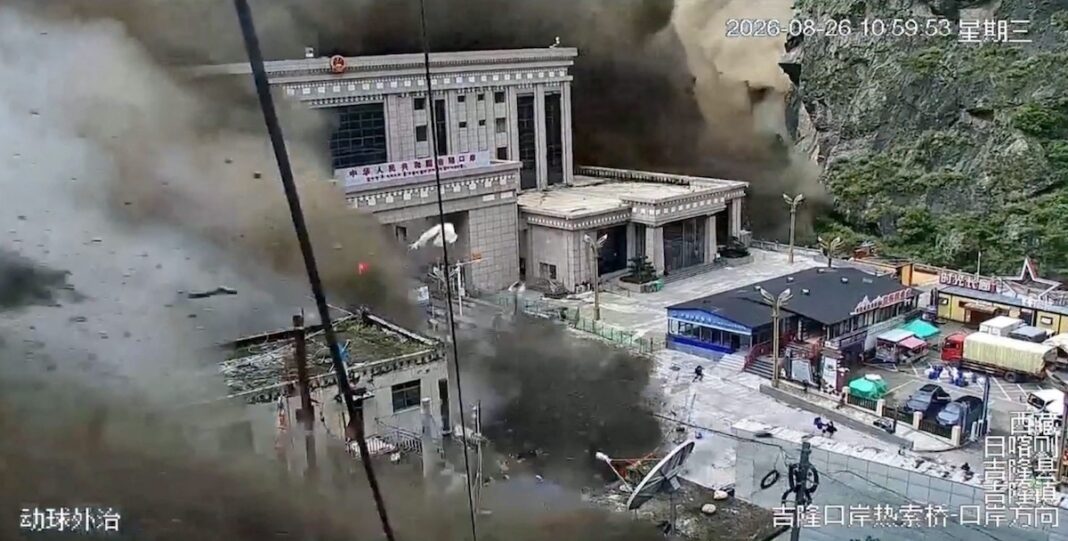
DHARAMSHALA, Aug. 31: Video footage capturing the terrifying moments when people fled a rapidly advancing wall of mud and debris at the Kyirong Port in occupied Tibet has reportedly been removed from Chinese social-media platforms, fuelling concerns over Beijing’s censorship of information surrounding the devastating Himalayan floods.
The footage, which circulated online following the disaster, reportedly shows people scrambling to escape moments before torrents of mud and floodwater engulfed parts of the Kyirong Port. Copies of some of the videos have continued to circulate outside China after the original posts were reportedly deleted.
Kyirong County, a strategically important trading gateway between occupied Tibet and Nepal, was among the worst-affected areas on the Tibetan side. The Kyirong Port, a major land crossing, suffered severe damage; roads, buildings, and infrastructure were inundated or swept away.
As of Monday, Chinese authorities have reported 16 deaths and 546 people missing in Kyirong County, according to reports citing official figures. By comparison, the death toll on the Nepalese side had risen to 903, with 4,247 people still missing. The stark disparity is particularly striking given that Kyirong was among the areas hardest hit by the catastrophic floods. The figures have intensified scrutiny of the disaster and raised questions about the true scale of casualties in occupied Tibet, where access for independent journalists and observers remains severely restricted.
Reports by Indian and international media outlets have stated in their reports that several videos documenting the disaster disappeared from Chinese social-media platforms. Some reports also allege that accounts posting information about casualties and the devastation were removed or restricted. Chinese authorities, however, have rejected allegations that they are suppressing information about the disaster. Authorities have also taken administrative action against people accused of spreading what they described as rumours concerning casualty figures and the scale of the disaster.
The reported removal of eyewitness footage is significant because access to Tibet for foreign journalists and independent observers remains highly restricted. In such circumstances, videos recorded by residents, workers, and travellers can provide rare visual evidence of events unfolding in the region. The disappearance of footage has therefore added another layer of controversy to an already catastrophic disaster, particularly as official casualty figures continue to evolve while hundreds remain unaccounted for.
Meanwhile, Chinese state media coverage of the disaster has largely centred on rescue and relief operations, repeatedly showcasing images of emergency personnel searching through debris, evacuating residents, and delivering supplies. While such footage documents the ongoing response, the emphasis on rescue efforts, rather than the full extent of the destruction and human toll, has been criticised as presenting a sanitised picture of the catastrophe and potentially obscuring the severity of the disaster on the Tibetan side.
The contrast between official coverage and eyewitness footage circulating outside China has further fuelled concerns about information control and the suppression of independent accounts. With hundreds of people still unaccounted for in Kyirong, observers say, the disappearance of videos and restrictions on information could make it increasingly difficult to establish the disaster’s full human cost.

