

Tenzin Nyidon
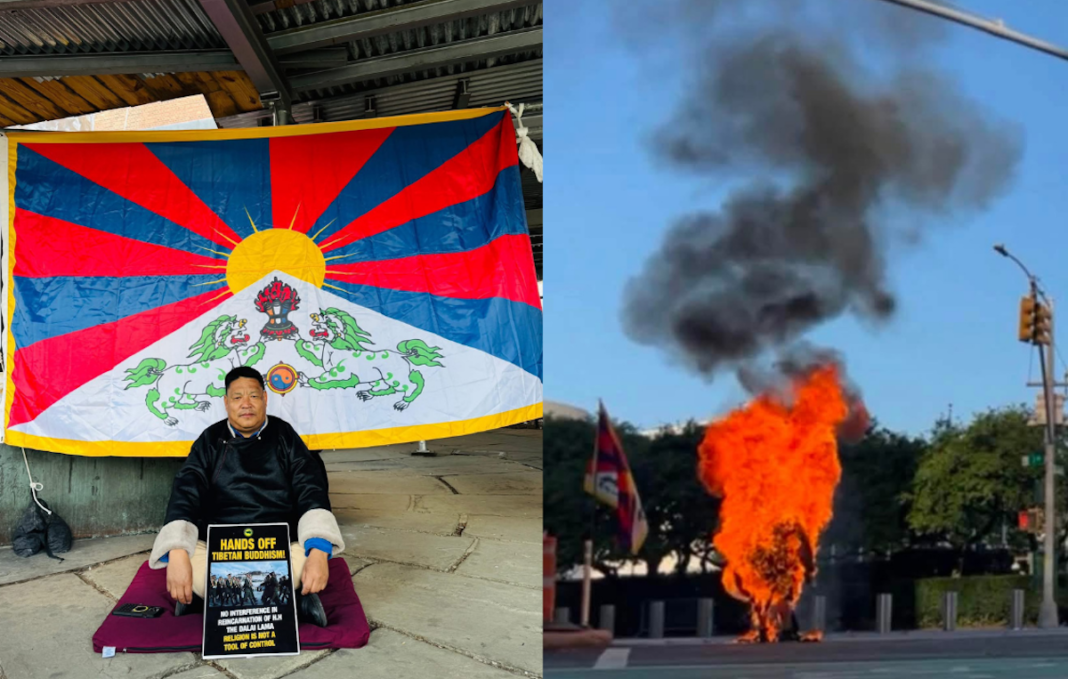
DHARAMSHALA, July 3: Veteran Tibetan independence activist Lobga Rangzen self-immolated in front of the United Nations Headquarters in New York on July 2 at around 5:49 pm. He sustained severe burn injuries and was immediately rushed to Bellevue Hospital for emergency treatment.
Reliable sources confirmed to Phayul that he succumbed to his injuries at approximately 7:04 pm the same evening. He was a Tibetan refugee who lived in New York and worked as a cab-driver. He also served as the President of Tibetan National Congress’s New York/New Jersey chapter.
His death comes a day after the implementation of China’s new so-called “Promoting Ethnic Unity and Progress Law,” a sweeping legislation that exile Tibetans describe as codification of genocide in Tibet.
In a video posted on his personal Facebook account prior to the act, Lobga Rangzen issued a detailed political statement addressing Tibetans in exile and expressing strong criticism of Chinese repressive policies in Tibet. He also called on Tibetans in exile to unite and work collectively for Tibetan independence and to remain united in the ongoing freedom struggle movement.
He alleged that the policies implemented by the Chinese government in Tibet were aimed at eroding Tibetan identity, culture, and language. He called on Tibetans in exile to increase their commitment and effort toward the Tibetan cause, stressing that meaningful outcomes, in his view, required sustained and concrete action.
He highlighted the role of His Holiness the Dalai Lama in establishing democratic governance in exile through the devolution of political authority and the creation of the Tibetan government in exile known officially as the Central Tibetan Administration (CTA). He described the system as a historic responsibility entrusted to Tibetans in exile to continue their national struggle while living in democratic conditions.
He also stated that Tibetans in exile represent those living under Chinese rule in Tibet, reflecting the Dalai Lama’s broader vision of exile leadership as a voice for those inside Tibet.
He further accused Chinese authorities of widespread political repression across all Tibetan regions, including restrictions on free speech and religious expression, and limitations on displaying images of the Tibetan spiritual leader. He said Tibetans were subjected to these conditions due to the absence of an independent homeland.
He appealed for unity among the Tibetan Parliament in Exile (TPiE), the Central Tibetan Administration (CTA), and the broader Tibetan community. He urged them to set aside internal disagreements and work collectively toward the political goal of Tibet’s future independence.
He also emphasized the importance of cultural continuity, urging Tibetans not to cancel or tone down upcoming celebrations of the Dalai Lama’s birthday. Instead, he encouraged continued observance of songs, dances, and cultural festivities as expressions of Tibetan identity and heritage.
In his statement, he clarified that his action was not driven by personal deprivation or survival, but was intended as a political act related to Tibet’s worsening situation. He urged Tibetans to preserve their identity, remain committed to their cultural roots, and continue what he described as the long-term struggle for Tibet.
Following the news of his death, groups of Tibetan demonstrators gathered near the United Nations Headquarters, holding candlelight vigils and calling for justice for Lobga Rangzen. Protesters also urged the United Nations to take immediate steps to investigate alleged human rights violations in occupied Tibet.


One of the most daring self-immolation by a Tibetan independence activist Lobga Rangzen was on display in front of the UN Headquarters Complex located in New York on 2nd July 2026! This was to protest the satanic Chinese communist cult’s attempt to ERASE TIBET’S LANGUAGE, CULTURE, HISTORY, RELIGION AND IDENTITY BY ENACTING A SO CALLED “ETHNIC UNITY LAW” WHICH LEGALISES GENOCIDE IN OCCUPIED TIBET! Tibetans cannot afford to lose their sacred culture, language, religion and identity yet find themselves hapless to do anything against the demonic CCP except burn their bodies in utter desperation and helplessness! While the act was laudable in its nature to dedicate one’s dear life for one’s own country and people, it was done with such calmness and pose that has both surprised and extremely saddened every Tibetan! It is hard to come to terms with someone who is alive and healthy one moment and then turn into ashes within few minutes! This is bewilderingly alarming and inconceivable to comprehend! Lobga Rangzen was a Tibetan nationalist of the highest order. He lived for Tibetan independence and died for Tibetan independence! SUCH PATRIOTS ARE AS RARE AS A DIAMOND, THE SIZE OF A BOULDER! Every Tibetan including those who oppose Tibetan independence could no longer pretend to look the other way in deference to the Dalai Lama! It brought tears to every Tibetan who are emotional and have empathy for their own kind. The sight of the fire that engulfed his body was unbearable to watch! It was impossible not to cry to see such a sight of another fellow Tibetan consumed by the mammoth flame as he stood there without flinching until he dropped to the ground! We have seen similar sight of a Tibetan nun doing the same thing in occupied Tibet without any movement while a Tibetan woman in the vicinity offered white scarf to her as the flames leapt consumed her body! Lobga Rangzen has greatly moved the Tibetan community in exile with his fiery display of sheer bravery and the message of unity he left behind besides exhorting to fight for the independence of Tibet! If the evil Chinese communist regime wanted to send a message of intimidation towards the Tibetans in exile by legalising transnational aggression, they got the opposite of what they intended. If they meant to obliterate the unique Tibetan language, culture and identity by enacting laws, it has only hardened the resolve of the Tibetan people to safe guard their precious heritage by any means! The courageous act of Tibetan independence Hero has galvanised the independence cause of the Tibetan movement which until now was suppressed to curry favour from the evil CCP regime. With such ferocious display of independence fervour, the Tibetan authorities will be hard pressed to deny the Tibetan independence wave and even if they make an attempt to curtail the growing intensity of the movement, it will only alienate themselves from the general public! This is another OWN GOAL by the boof-headed Chinese communist regime which is known for scoring own goals for most of its existence! They are dead against the independence of Tibet but through their RACIST, PARANOIA AND HAN CHAUVINISM, THEY ARE LIGHTING THE VERY FIRE OF TIBETAN INDEPENDENCE THAT THEY WANT TO DIFFUSE!