

Tenzin Nyidon
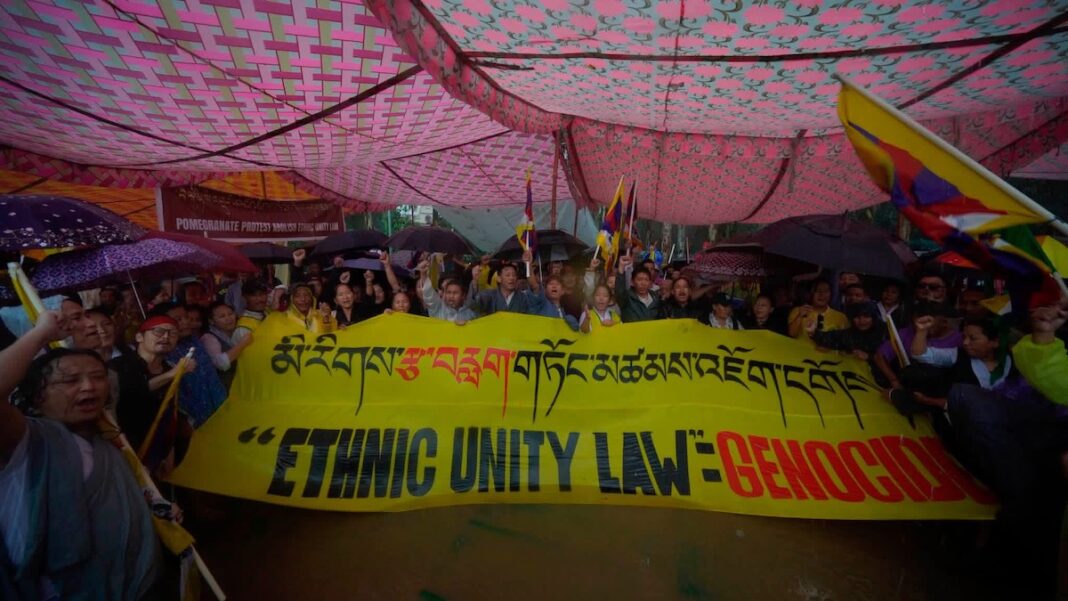
DHARAMSHALA, July 1: Exiled Tibetans in Dharamshala joined a worldwide ‘Global Day of Action’ on Wednesday to denounce the implementation of China’s new “Law on Promoting Ethnic Unity and Progress,” describing it as a state-backed legal framework designed to accelerate the assimilation of Tibetans and systematically dismantle their distinct identity, language, religion, and culture.
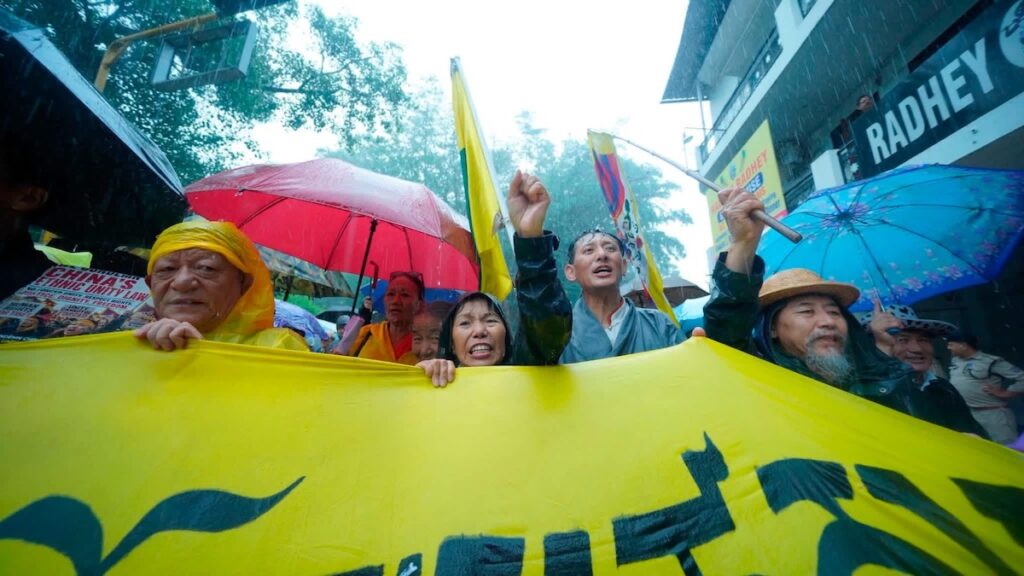
The demonstration was organised by a coalition of four major Tibetan non-governmental organisations—Students for a Free Tibet-India (SFT-India), the Tibetan Women’s Association (TWA), the National Democratic Party of Tibet (NDPT), and the Gu Chu Sum Movement Association of Tibet. Protesters marched from McLeod Ganj’s Main Square to the Martyrs’ Pillar in the Main Tibetan Temple, carrying placards and raising slogans against Beijing’s so-called “Ethnic Unity Law.”
In a joint statement, the four organisations described July 1, 2026, when the legislation officially came into force, as “a devastating turning point for the survival of Tibet.” “Behind its hollow title lies a brutal reality: as of today, the forced erasure of Tibetan identity, language, and culture is officially codified into state law,” the statement read.
The organisations stated that the law formalises long-standing assimilation policies already implemented across Tibet, particularly the mass placement of more than one million Tibetan children into state-run colonial boarding schools, where they are separated from their families and educated primarily in Mandarin.
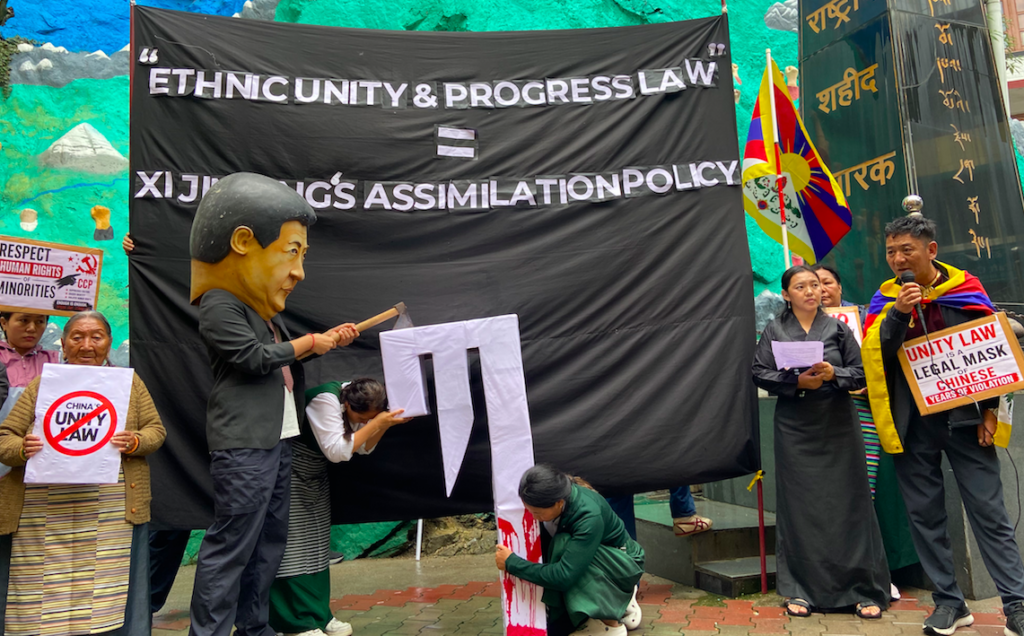
According to the statement, the legislation establishes a legal framework that prioritises assimilation into a single Han-centric national identity by expanding the use of Mandarin (Putōnghuà) in schools and public life, enforcing state-directed social integration, and broadening penalties for acts deemed to threaten “ethnic unity.” The groups alleged that these provisions could be used to criminalise peaceful expressions of Tibetan language, culture, traditions, and identity.
The coalition expressed particular concern over Article 20 of the legislation, which requires parents to educate their children to “love the Communist Party of China” while prohibiting the transmission of ideas considered harmful to national unity. The organisations argued that the provision extends state authority into family life by legalising state-directed housing integration, population transfers, and policies encouraging intermarriage, describing it as an unprecedented intrusion into private life aimed at dismantling cohesive Tibetan communities through ideological control and social surveillance.
“From today, speaking the Tibetan language, practising traditional customs, or expressing an independent identity can be legally prosecuted as a threat to ‘national unity,'” the statement warned.
Calling the law “a legally mandated shutdown of an entire civilisation,” the four organisations urged governments and international institutions to take immediate action. They called on world leaders to publicly reject the legislation and demand its repeal, citing concerns previously raised by United Nations human rights experts that the law contravenes international human rights obligations undertaken by China.
They also appealed for international pressure on Beijing to dismantle the colonial boarding school system, end the forced separation of Tibetan children from their families, and allow the UN High Commissioner for Human Rights and independent international monitors unrestricted access to Tibet to investigate conditions on the ground.
Meanwhile, the Tibetan Youth Congress (TYC), during its ongoing 55th Working Committee Meeting in Dehradun, staged a protest under the banner “POMEGRANATE PROTEST: Abolish the Ethnic Unity Law,” denouncing the implementation of the law, calling it one of the gravest threats to Tibetan identity in recent decades.
The protest deliberately invoked Beijing’s “pomegranate” metaphor, which portrays China’s ethnic groups as tightly bound together within a single national identity. Rejecting this narrative, the TYC asserted that Tibet’s distinct history, civilisation, language, religion, and cultural heritage cannot be subsumed into a Han-centric conception of the Chinese nation, arguing that genuine coexistence must be founded on respect for distinct identities rather than enforced assimilation.
In a separate statement, the TYC accused Beijing of institutionalising policies of political repression, cultural interference, economic domination, and coercive assimilation under the guise of promoting “ethnic unity.” It argued that the legislation advances a singular Han-centred national identity while undermining Tibet’s distinct civilisation, language, religion, and history.
The TYC further said that concerns expressed by the UN High Commissioner for Human Rights and various UN Special Rapporteurs demonstrate that the law violates internationally recognised human rights, including the rights to language, culture, religion, and self-determination.
The organisation called on the Government of India and democratic countries to unequivocally condemn China’s assimilation policies in Tibet, urged the UN Human Rights Council and its member states to take concrete multilateral action, demanded that Beijing abolish the law, and appealed to governments and human rights organisations worldwide to closely monitor its implementation and hold China accountable.
Describing the legislation as a “dangerous turning point,” the TYC warned that, if left unchallenged, it could irreversibly disrupt the intergenerational transmission of Tibetan language, religion, and culture, threatening the survival of the Tibetan nation.
“The Tibetan Youth Congress unequivocally condemns and rejects this genocide law,” the statement said, adding that Tibetans around the world remain united in defending their identity, dignity, culture, and their aspiration for a free and independent Tibet.
The coordinated demonstrations formed part of a Global Day of Action observed by Tibetans and supporters across multiple countries, aimed at drawing international attention to what campaigners and activists describe as the legal institutionalisation of China’s long-standing assimilation policies in Tibet.

