

Tsering Dhundup
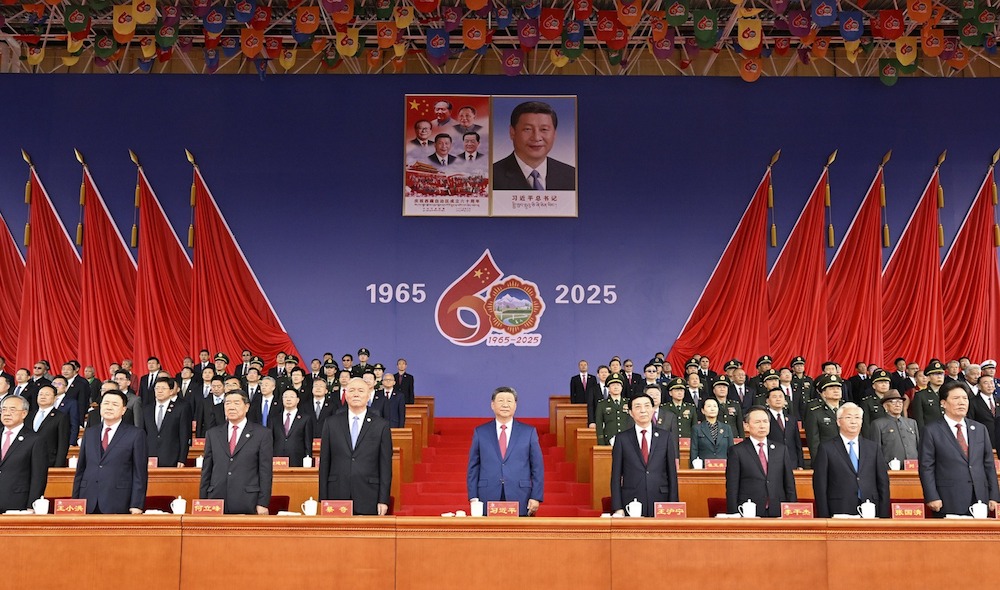
DHARAMSHALA, Sep. 1: Rights group Tibetan Centre for Human Rights and Democracy (TCHRD) has condemned Xi Jinping’s recent visit to Lhasa as a “choreographed spectacle of unity without autonomy”, accusing Beijing of using the 60th anniversary of the so-called Tibet Autonomous Region (TAR) to tighten control rather than honour promises of self-rule.
On August 20, Xi, who is also General Secretary of the Chinese Communist Party (CCP) and Chairman of the Central Military Commission, led a central government delegation to Lhasa, the residence of His Holiness the Dalai Lama. Chinese state media framed the visit as an unprecedented display of “care and affection” for Tibetans, while Xi presided over official work reports and reiterated long-standing priorities of “political stability”, “ethnic unity”, and “religious harmony”.
But according to TCHRD, the anniversary revealed the CCP’s complete abandonment of even the limited autonomy guaranteed by Chinese law. Unlike speeches at previous milestones, neither Xi nor senior leader Wang Huning made any mention of deepening regional autonomy. Instead, they emphasised assimilation into a single Zhonghua Minzu (Chinese nation), erasing the political, cultural, and linguistic rights nominally guaranteed under the Chinese Regional Ethnic Autonomy Law of 1984.
The imbalance of power is evident as Tibetan officials hold only three of the 13 top posts in the TAR People’s Government, with Han Chinese officials dominating not only the Party Committee and regional People’s Congress but also county-level administrations. “Tibetan officials serve largely symbolic roles while strategic decision-making remains firmly in the hands of Beijing’s appointees,” the report stated.
The well-known research also pointed to systemic Sinicisation campaigns. Tibetan-medium schools are being dismantled, with Mandarin imposed as the primary language of instruction—even in monasteries. Children are increasingly unable to speak with their grandparents, parents report, as Tibetan language use is punished in schools. Monasteries are forced to prioritise CCP propaganda, Dalai Lama images are banned, and religious texts are translated into Mandarin, eroding cultural identity.
Policies also extend to the social and economic fabric of Tibetan life. Intermarriage campaigns, forced labour transfers, and resource extraction projects are displacing communities, often without consultation or fair compensation. The group reported that Chinese authorities have responded to resistance with arrests and surveillance.
Citing an internal Chengdu cybersecurity document, TCHRD said Chinese authorities are preparing to suppress dissent around sensitive dates, including the Dalai Lama’s 90th birthday and the September 9 founding anniversary of the TAR. Officials have reportedly been instructed to block pro-Dalai Lama content, restrict religious gatherings, and prevent criticism of Beijing’s policies.
The Dharamshala based rights group concluded that the commemorations served less to honour Tibetan rights than to showcase state dominance and to justify ongoing repression under the rhetoric of “ethnic unity” and “national progress”.

