

Tenzin Nyidon
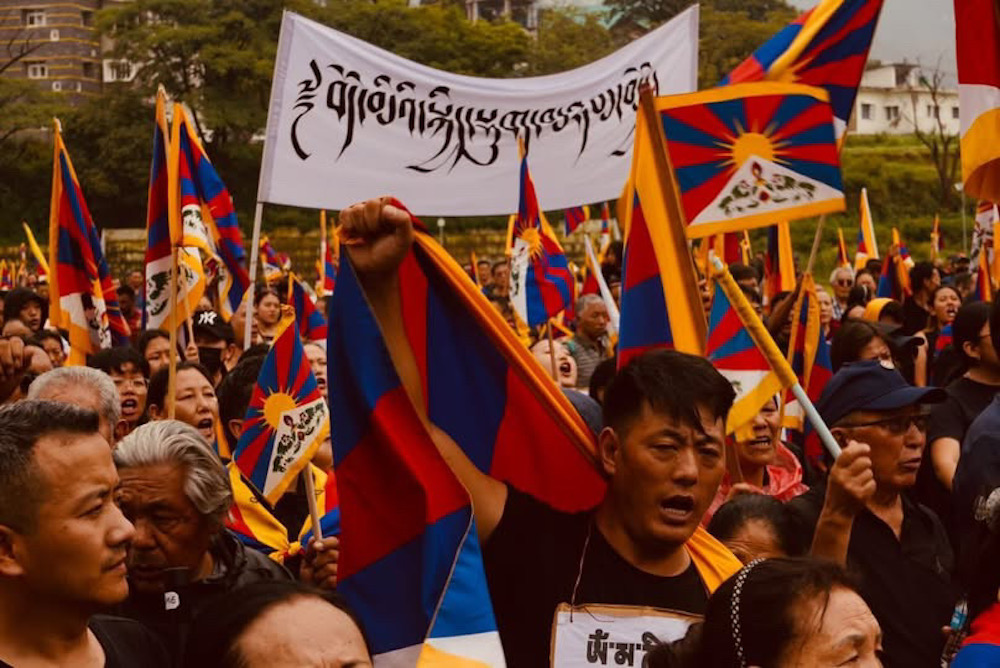
DHARAMSHALA, July 18: Thousands of Tibetans and supporters dressed in black marched through the streets in the capital of the Tibetan diaspora on Saturday in a coordinated mass protest condemning China’s recently enacted “Ethnic Unity and Progress Law” and paying tribute to the late Tibetan independence activist Lobga Rangzen, whose self-immolation earlier this month has reignited calls for international action on Tibet.
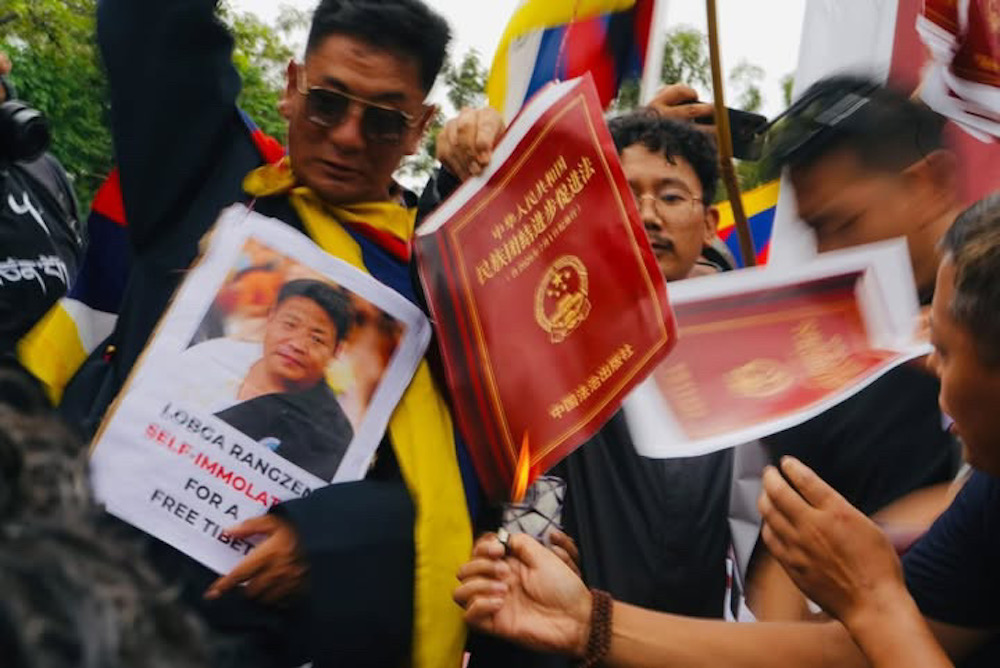
The demonstration, organised jointly by six major Dharamshala-based Tibetan non-governmental organisations, began at the Main Temple before proceeding through McLeod Ganj and culminated at the Kacheri Police Ground, where protesters publicly burned a copy of the Chinese Constitution as a symbolic rejection of Beijing’s regressive policies in Tibet.
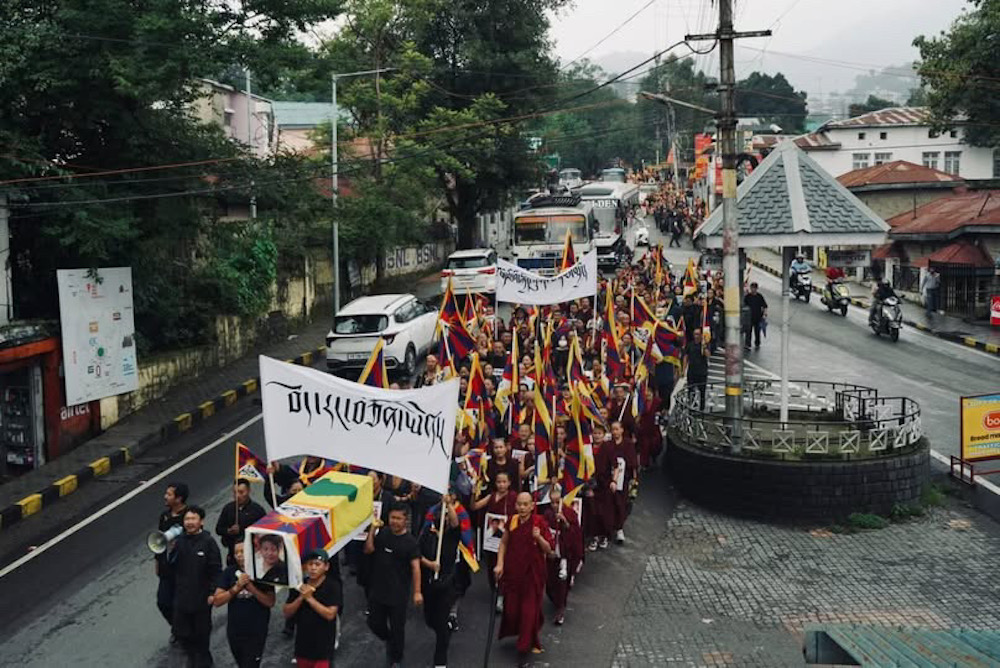
Carrying Tibetan national flags, placards, and portraits of Lobga Rangzen, demonstrators marched through the streets chanting slogans including “Lobga Rangzen died for a Free Tibet,” “Tibet is a nation, not a minority,” “China is guilty of genocide in Tibet,” “China out of Tibet now,” and “China lies, UN listens.” Through their slogans and banners, protesters denounced what organisers described as Beijing’s escalating campaign to erase Tibetan identity through legal, political, and cultural assimilation policies.
In a joint statement, the organisers strongly condemned the “Ethnic Unity and Progress Law,” a 65-article legislation adopted during China’s National People’s Congress in March and brought into force on July 1. They argued that, despite being presented as legislation promoting “ethnic unity,” the law institutionalises long-standing policies of forced assimilation and strengthens state control over Tibetans and other non-Chinese peoples.
According to the statement, the law seeks to systematically assimilate Tibetan language, religion, culture, customs, history, and education into a single Chinese national identity, thereby undermining the Tibetan people’s fundamental rights, dignity, and national identity.
Describing the legislation as “an illegal instrument of forced assimilation,” the organisations called for its immediate repeal and urged governments, international organisations, and human rights mechanisms to closely monitor its implementation, investigate its impact on Tibetans, and hold China accountable under international human rights standards.
The rally also served as a tribute to Lobga Rangzen, who set himself on fire outside the United Nations Headquarters in New York on July 2. Organisers said his final testament made clear that his action was driven not by personal despair but by profound concern over what he described as the systematic destruction of the Tibetan nation under Chinese rule.
They recalled that Lobga Rangzen warned of policies aimed at eradicating Tibetan identity and appealed to Tibetans worldwide to unite in pursuit of Tibet’s independence, stating that Tibetans had lost their fundamental rights because they had lost their country.
The statement noted that Lobga Rangzen had urged Tibetans not to cancel cultural performances or artistic expressions following his death, emphasising that such traditions remain vital to preserving Tibetan identity and inspiring younger generations. Rather than mourning his sacrifice, he called upon Tibetans to continue working towards the aspirations for which he gave his life, ending his final message with the words, “Victory to Tibet! Victory for Tibet’s Independence!”
The organisations urged the United Nations to formally respond to his sacrifice by addressing the human rights situation in Tibet and examining the circumstances that compelled his act of protest.
They further called on the Chinese government to be held accountable for policies they say have driven numerous Tibetans to self-immolation over the years.
Reiterating their political demands, the organisations asserted that Tibet was an independent nation prior to its illegal occupation by the People’s Republic of China and appealed to the international community to recognise Tibet’s historical status and support the Tibetan people’s right to freedom and independence.
The joint statement also criticised recent remarks by United Nations Secretary-General spokesperson Stéphane Dujarric, who referred to Tibetans as a “minority.” The organisations described the characterisation as historically inaccurate and politically misleading, arguing that it reinforces Chinese government narratives while diminishing Tibet’s distinct national identity.
Calling on the United Nations to uphold impartiality, they urged the international body to avoid language that, in their view, legitimises China’s rule over Tibet or contributes to the erosion of Tibetan identity.

