

Tsering Dhundup
In September 2011, as senior Tibetan Buddhist leaders convened in Dharamshala, a quiet but historic correction took place. The 11th Religious Conference of the four major traditions of Tibetan Buddhism and the Bon tradition formally affirmed the Jonang as an independent and complete school of Tibetan Buddhism. The recognition followed years of scholarship, deliberation, and encouragement from His Holiness the 14th Dalai Lama.
For decades, the Jonang had occupied an ambiguous space in the Tibetan religious landscape—historically documented yet institutionally marginalized. The 2011 conference sought to resolve that ambiguity. The decision acknowledged the Jonang’s distinct philosophical identity—particularly its zhentong, or “other-emptiness,” interpretation of ultimate reality—and its careful preservation of the Kalachakra lineage. The affirmation restored doctrinal clarity and institutional dignity to a lineage that had endured centuries of suppression and revival.
Spiritually and scholastically, the matter appeared settled.
Yet more than a decade later, that affirmation has not translated into democratic inclusion. The Jonang remain entirely excluded from the Tibetan Parliament-in-Exile and absent from mention in the Charter of Tibetans-in-Exile. In the political architecture of the exile system, the tradition does not formally exist.
This contradiction—full religious legitimacy, zero constitutional recognition—has become one of the most enduring structural tensions within the Tibetan democratic project.
Religious Legitimacy, Political Silence
The contrast between religious recognition and political exclusion has sharpened over time. Despite petitions, parliamentary proposals, protests, hunger strikes, and repeated resolutions, the Jonang community continues to be denied representation in the exile legislature.
The most consequential attempt to correct this imbalance came in September 2024. The executive branch of the Central Tibetan Administration (CTA), led by President Penpa Tsering, introduced a reform bill seeking to incorporate the Jonang into the parliamentary structure. The proposal aimed to amend the Charter to include the Jonang alongside the Nyingma, Kagyu, Sakya, Gelug, and Bon traditions, each of which is constitutionally guaranteed two seats in Parliament.
The move was widely regarded as the strongest institutional support the Jonang had ever received. For the first time, the initiative came not from protestors outside Parliament but from the executive within government.
The bill failed decisively. Only 21 Members of Parliament voted in favor—far short of the required 30 votes needed to amend the Charter.
For many observers, the defeat was not merely procedural. It symbolized a pattern of systemic exclusion that has endured for nearly three decades. Repeated efforts, across different administrations and political climates, have produced the same outcome: recognition without representation.
A Tradition Rooted in Tibetan History
The Jonang tradition’s historical presence in Tibet is extensively documented. Emerging between the 11th and 13th centuries across eastern and central Tibet, it reached prominence under the influential scholar Dolpopa Sherab Gyaltsen, whose philosophical articulation of zhentong would become the defining hallmark of the school.
Unlike other Tibetan traditions that emphasized rangtong (“self-emptiness”), Dolpopa’s interpretation argued that ultimate reality is empty of relative phenomena but not empty of its own enlightened qualities. The distinction generated centuries of debate within Tibetan scholastic circles and solidified the Jonang as a philosophically distinct lineage.
The school also became the primary custodian of the Kalachakra teachings, a highly complex tantric system with cosmological, meditative, and socio-political dimensions. This guardianship further entrenched its unique role in Tibetan Buddhism.
In the 17th century, during a period of political consolidation under Gelug dominance, Jonang monasteries were forcibly incorporated into the Gelug tradition. Texts were restricted, institutional autonomy dissolved, and the lineage largely absorbed into the prevailing religious order. For centuries, it was widely assumed that the Jonang tradition had disappeared.
That assumption proved incorrect. The tradition survived in remote regions of eastern Tibet—particularly in Ngaba, Zamthang, and Golok—where communities quietly preserved their teachings. Modern rediscovery of these communities in the 20th century reshaped scholarly understanding of Tibetan religious history.
Today, the Jonang monastery in Shimla documents more than sixty active monasteries across these regions, collectively supporting more than 10,000 monks. The tradition is not symbolic or historical—it is demographically present and institutionally active.
Religiously, its vitality is not in dispute. Politically, its absence remains codified.
The Dalai Lama’s Unequivocal Support
The foremost figure of Tibetan Buddhism, His Holiness the Dalai Lama has consistently advocated for the survival and recognition of the Jonang tradition. In 1997, he appointed the 9th Khalkha Jetsun Dampa as the head of the Jonang lineage, reinforcing its legitimacy within the exile religious framework. In 2011, he presided over the Religious Conference that unanimously recognized the Jonang as equal to the Nyingma, Kagyu, Sakya, Gelug, and Bon traditions.
His support has extended beyond formal declarations.
When visiting the Jonang monastery in Shimla on March 18, 2014, he encouraged monks to study texts from all traditions, describing such intellectual openness as the path to becoming “a complete monk.” His message underscored a broader vision of non-sectarianism that has shaped Tibetan religious life in exile.
He also publicly endorsed the Jonang community’s demand for political recognition:
“It is up to the parliament and I have already asked since many years. I think they have a right as it is one of the major traditions of Tibetan Buddhism.”
The statement was direct. Yet despite such guidance from the highest spiritual authority of the Tibetan people, the political system has remained unmoved.
The impasse is particularly significant as the exile community contemplates a future in which the Dalai Lama’s personal authority may no longer serve as the ultimate mediator in institutional disputes.
The Constitutional Barrier
At the heart of the impasse lies the Charter of Tibetans-in-Exile. Article 37 allocates parliamentary seats only to the Nyingma, Kagyu, Sakya, Gelug, and Bon schools, granting each two seats. Jonang is starkly absent from the list.
This omission is not symbolic—it is structural. Because the Charter defines religious representation explicitly, exclusion from its language prevents Jonang practitioners from voting for religious MPs, contesting those seats, or participating in parliamentary committees that rely on religious quotas.
Amending the Charter requires a two-thirds majority—30 votes in the current Parliament. The 2024 vote demonstrated how difficult that threshold is to reach.
Over twenty-seven years, this constitutional architecture has functioned as a durable barrier to inclusion. While religious conferences can confer recognition through consensus, parliamentary inclusion requires redistribution of representation. That redistribution has consistently encountered resistance.
Critics argue that the issue is not theological but political: altering religious seat allocation could shift regional influence and factional balance within Parliament. In such a context, status quo incentives become powerful deterrents to reform.
Decades of Appeals and Protest
The International Jonang Well-being Association has recorded more than fifty appeals raised before various parliamentary sessions. The persistence of these appeals reflects both institutional patience and growing frustration.
In 2015, community members launched a hunger strike and sit-in protest outside Parliament. The action was suspended only after intervention by then-President Lobsang Sangay, along with the Speaker and Deputy Speaker. The protest drew attention to the issue but did not produce structural reform.
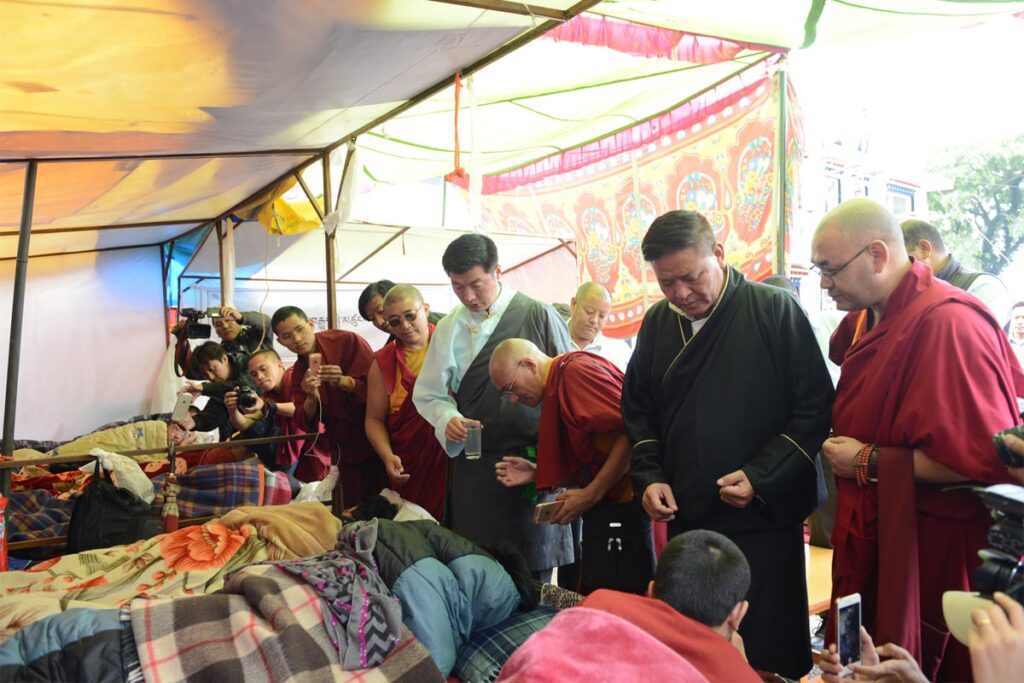
Petitions resurfaced during constitutional revision periods. Demonstrations were staged outside parliamentary sessions. Over time, some demands were partially met—such as inclusion in scholarly committees and curricular recognition in monastic institutions.
Yet the central demand—equal mention in the Charter and corresponding parliamentary representation—remains unresolved.
The 2024 Reform: Hope and Collapse
The Kashag’s 2024 proposal was framed as an attempt to resolve the issue definitively. Supporters cited historical precedent, noting that the Bon tradition had been formally incorporated into the political structure in 1976 and reaffirmed in 1991.
However, once parliamentary debate began, resistance surfaced.
Dotoe MP Phurpa Dorjee Gyaldong questioned the timing of reform, suggesting that broader discussions were underway about whether religious seats should continue to exist at all. Privately, several MPs acknowledged concerns that altering religious representation could recalibrate internal political balances.
Speaking with Phayul, Sikyong Penpa Tsering remarked candidly:
“Certain sections benefit from the present structure.”
“They don’t want any changes to that. They want status quo, which is also understandable from their personal interest or regional interest.”
His comments suggested that institutional inertia may be reinforced by political calculation.
He also warned that repeated failures to address the issue could damage the credibility of the Central Tibetan Administration, particularly as the exile community approaches a future in which institutional legitimacy must stand independent of individual moral authority.
Voices from the Jonang Community
The Jonang response combined disappointment with recognition of a familiar pattern. Khenpo Lhakyap, vice-president of the International Jonang Well-being Association, stated that the community could accept parliamentary outcomes if they were guided by genuine public interest.
“But if they are acting out of their own interest, then it’s not a good gesture.”
He likened the Tibetan Buddhist traditions to a pot of flowers in which “if one flower dies, it will affect the others,” suggesting that marginalization of one lineage weakens the collective whole.
MP Geshe Ngawa Gangri offered a sharper observation: “Even the Chinese government recognizes the Jonang tradition as equal to others.”
For a democratic exile government dedicated to preserving Tibetan identity, the comparison was striking.
Gyaltso, president of the International Jonang Well-being Association, articulated the community’s demand succinctly:
“The Jonangpas demand equal rights like other religious traditions—nothing more. This includes mention in the Charter of the Tibetans-in-Exile. We don’t particularly demand parliamentary representation, but it also falls under equal rights.”
He noted that constitutional omission produces practical consequences. Tibetan youth in India and abroad often lack awareness of the Jonang tradition. Internationally, the community encounters obstacles joining Buddhist associations in Taiwan and Nepal.
A recent incident deepened frustration. One month before the March parliamentary session this year, Jonang representatives submitted a petition urging inclusion of their proposal on the agenda. According to Gyaltso, the letter was not received by seven members of the Standing Committee, including the Speaker.
For the community, refusal even to receive a petition epitomized institutional resistance, even amounts to undemocratic approach.
A Contradiction at the Core
The impasse reveals a fundamental contradiction: the highest religious authorities recognize the Jonang as a major Tibetan Buddhist tradition; the democratic institutions in exile do not.
As members of the Tibetan diaspora increasingly scrutinize governance structures, questions are emerging about whether this inconsistency undermines Parliament’s moral authority and its claim to represent all Tibetans.
The issue now transcends one tradition. It concerns the coherence of the exile system itself.
After nearly thirty years, the Jonang’s absence from the Tibetan Parliament-in-Exile can no longer be regarded as an oversight. It is embedded within constitutional language and reinforced by political incentives resistant to recalibrate representation and decentralize power.
Whether this will shift depends not only on the Jonang community or the Kashag, but on whether Parliament is prepared to confront the entrenched interests that have preserved the status quo.
Until that moment arrives, the paradox remains.
Jonang is recognized in religious councils, affirmed by the Dalai Lama, and sustained by thousands of monks across Tibet and in exile. Yet within the democratic chamber that claims to represent all Tibetans, they remain—recognized, but unheard.


The conventional wisdom in Tibetan Buddhism is བོད་ཀྱི་ནང་པའི་ཆོས་ལུགས་ཆེན་པོ་བཞི་དང་ གཡུང་དྲུང་བོན་དང་བཅས་པ་ the four Buddhist schools of thought and BONPO. This is the historically accepted convention and that’s how most Tibetans see it. The Buddhist follower’s final goal is nirvana ཐར་པ་ because without it there is no genuine happiness in samsara འཁོར་བ་ All of Buddha’s teachings are aimed at achieving nirvana. He said, ང་ཡི་ཁྱེད་ལ་ཐར་པའི་ལམ་བསྟན་གྱི་ ཐར་པ་རང་ལ་རགས་ལས་ཤེས་པར་བགྱིས་ (I have shown you the path to nirvana. It’s up to you to achieve it). In order to achieve nirvana, one must realize emptiness སྟོང་པ་ཉིད་ Emptiness is the antidote in overcoming the afflictive emotions including their imprints! The notion of emptiness is a delicate subject. Each school of thought in India came to be divided owing to their disagreement on the notion of emptiness. The word emptiness is a poor translation in the English language but there is no other substitute either! What it means is that there is no inherent existence of any phenomena and that every phenomena is in fact nothing but a construct of the mind ཆོས་ཐམས་ཅད་རྟོགས་པའི་བཏགས་ཙམ་ཡིན་ The four schools in India have their own individual interpretation of mental projection or mental construct. The highest level of the emptiness was propounded by the Prasangika Madhyamika དབུ་མ་ཐལ་འགྱུར་བ་ This school was promulgated by Nagarjuna, ཀླུ་སྒྲུབ་ his disciple Arya Deva འཕགས་པ་ལྷ་ and Chandra Kirti ཟླ་བ་གྲགས་པ་ and is regarded as the understanding of the supreme nature of things དངོས་པོའི་གནས་ལུགས་མཐར་ཐུག་ which helps the practitioner to combat the delusions and eliminate them once and for all! Like their Indian counterparts where there came to be four divisions of school (Vaibhashika བྱེ་བྲག་སྨྲ་བ་) (Sautrantika མདོ་སྡེ་པ་)(Cittamatra སེམས་ཙམ་པ་)and (Madhyamaka དབུ་མ་པ་), there were differing interpretations of emptiness among the four Tibetan Buddhist schools in Tibet. However, all four major Tibetan Buddhist Schools unanimously agreed that Nagarjuna’s interpretation was the ultimate emptiness that was the antidote to eliminate mental defilements! The Jonang school found by Kunkhen Taranath differed and instead interpreted differently from that of Nagarjuna’s exposition. That is the main reason, the Jhonang school did not flourish as many scholars saw that their interpretation of གཞན་སྟོང་ deviated from the universally accepted Nagarjuna’s contention of every phenomena being devoid of independent self-existence རང་གི་ངོ་བོའི་སྟོང་པ་ In independent Tibet, great scholars engaged in heated debate over the nature of emptiness and they wrote treatises to rebut the contention of the other scholars. Even though Je Tsangkhapa is acknowledged as one of the most original progenitor of Nagarjuna’s school, he was challenged by Sakya Scholars such as Gowo Ramjampa Sonam Senge གོ་བོ་རབ་འབྱམས་པ་བསོད་ནམས་སེང་གེ་ and Sertok Panchen Shakya Chokdenpa སེར་མདོག་པཎ་ཆེན་ཤ་ཀྱ་མཆོག་ལྡན་པ་ Likewise there have been many other scholars who have taken issue with the contention of others. It seems, the Jhonang school’s interpretation was instrumental in its demise from most of Tibet except in far flung areas like Amdo Golok etc. While, it is reasonable to ask for representation, there is a fear that it will create a precedent for other religious denominations to make the same demand of having their own representatives in the parliament. There are Tibetan Muslims which has a sizeable population living in Kashmir and Nepal. There are Tibetan Christian’s and Hindus. If one school is given the right to represent their religious constituency, it paves the way for all others to do the same! That is why, only the historically prevalent and accepted schools are given representation and not others in order to avoid a precedent that will open the floodgates of religious representatives in the Tibetan parliament!