

Tenzin Nyidon
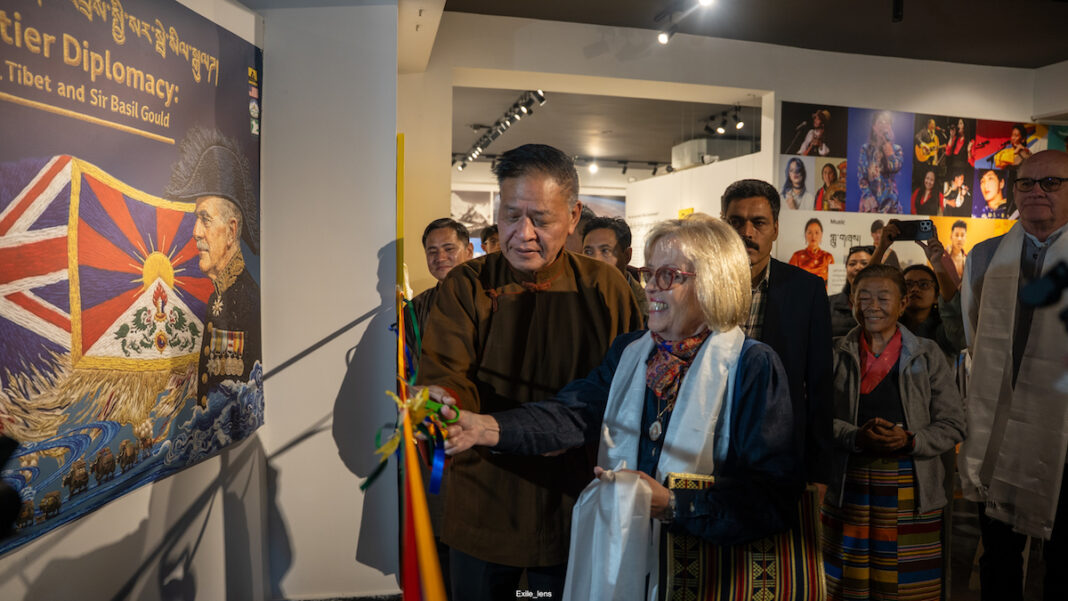
DHARAMSHALA, April 3: The exile Tibetan government, officially known as the Central Tibetan Administration’s Department of Information and International Relations (DIIR), inaugurated a four-month long temporary exhibition titled “Frontier Diplomacy: Britain, Tibet and Sir Basil Gould” on Friday at the Tibet Museum.
The event was attended by CTA President Penpa Tsering as the chief guest. He was joined by distinguished guests, Mrs. Frances C. Cutler, granddaughter of Sir Basil Gould, and her husband, Mr. Jonathan M. Cutler.
Sir Basil Gould served as the British Political Officer in Sikkim from 1935 to 1945, a key interlocutor between Tibet and British India, and earlier as the British Trade Agent in Gyantse, Tibet, from 1912 to 1913. He was also among the distinguished guests at His Holiness the 14th Dalai Lama’s enthronement ceremony in 1940. Last year, two rare historical documents from his personal collection were formally handed over to President Penpa Tsering in Office of Tibet, London. The handover took place amid growing concerns over the dispersal of Tibet-related historical artefacts, particularly following an auction held by Bonhams on June 4, 2025, which featured an extensive collection belonging to Sir Gould and renowned Indian artist Krishna Kanwal.
His archival records offer significant documentation of Tibet’s diplomatic and political status prior to the Chinese illegal invasion of Tibet. These materials are regarded as important historical evidence supporting Tibet’s de facto independence before 1950 and serve to counter official Chinese narratives regarding Tibet’s historical status.
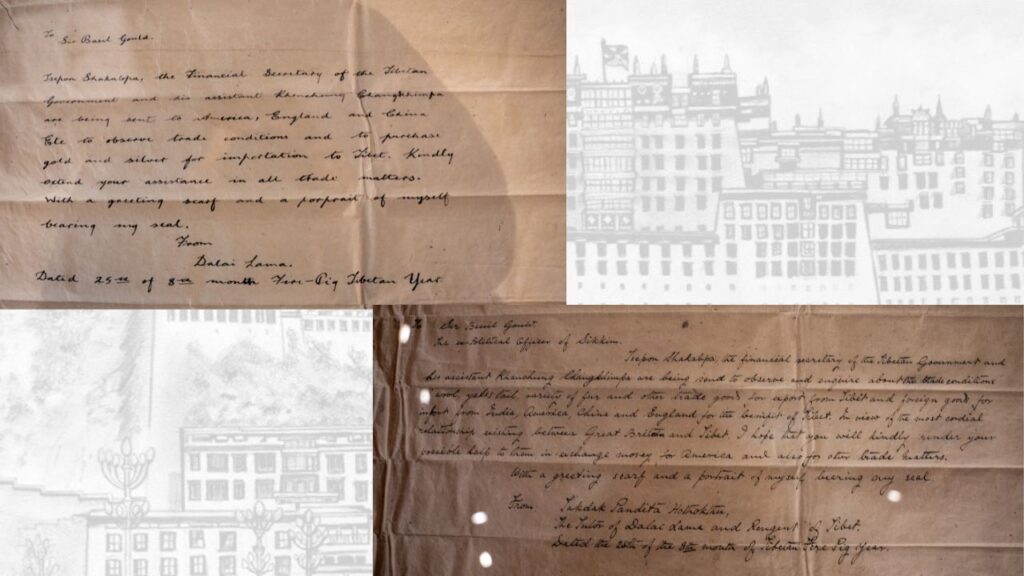
At the heart of the exhibition are two letters—a 1947 correspondence from the 14th Dalai Lama and the 3rd Taktra Rinpoche, Regent of Tibet, addressed to Sir Basil Gould during the historic Tibetan trade mission led by W. D. Shakabpa, then Finance Minister of Tibet. The letters emphasise Tibet’s independent conduct of foreign relations, demonstrating its direct diplomatic engagement with international representatives as a distinct political entity.
Addressing the gathering, the CTA President noted the importance of such archival materials in reinforcing Tibet’s historical narrative. He traced the longstanding relationship between Tibet and Britain, noting that formal interactions date back to 1774 with the visit of Scottish envoy George Bogle. He highlighted subsequent engagements involving British officials, explorers, and missionaries, emphasizing that these interactions form a crucial part of Tibet’s diplomatic history.
The Tibetan political leader also recalled the 1948 Tibetan trade delegation, which travelled to India, China, the United States, and the United Kingdom, marking a significant moment in Tibet’s international outreach. Reflecting on the historical trajectory, he noted the irony that Tibet lost its independence just two years after this diplomatic mission.
Emphasizing the strategic importance of historical awareness, he urged younger generations of Tibetans to engage deeply with their history. He noted that a strong understanding of Tibet’s past is essential for effective advocacy, particularly in countering increasing narratives about Tibet’s status. He further revealed ongoing efforts to engage scholars in the United Kingdom to document the historical relationship between Tibet and Britain, with the aim of influencing contemporary political understanding.
Speaking at the event, Frances C. Cutler offered a personal reflection on her grandfather’s legacy, drawing from his memoir “The Jewel in the Lotus.” She recounted how a chance circumstance led Gould to Tibet, where he began a lifelong association with the country and its people. During his tenure, Gould accompanied the 13th Dalai Lama on part of his return journey from exile in India and played a role in facilitating educational opportunities for Tibetan students in Britain.
Reflecting on the archival discovery, Cutler explained that the documents had remained untouched for over seven decades before being identified as historically significant by experts. She expressed pride in handing them over to the CTA, noting that they provide compelling evidence that both the United States and Great Britain regarded Tibet as an independent and sovereign state in 1947.
Speaking to Phayul, Cutler elaborated on her family’s decision to transfer the documents to the Tibetan administration. She stated that the move was guided by a recognition of their historical importance and their relevance to the Tibetan people. “These documents show that at that point, the world saw Tibet as a proper sovereign state and not part of China,” she said, adding that contributing them was both a responsibility and an honour.
Expressing emotional resonance upon seeing the documents displayed at the museum, she acknowledged the limited awareness among the British public regarding Tibet’s history and current realities. She described her family’s gesture as a modest contribution to the Tibetan cause, expressing hope that it would support Tibetans in their aspiration to reclaim their country.

