

Tenzin Nyidon
DHARAMSHALA, June 9: The Tibetan Supreme Justice Commission (TSJC), the highest judicial body of the Central Tibetan Administration (CTA), on Tuesday held a preliminary hearing on a writ petition filed by two Nepal-based monasteries—Senge Drak Ngedon Dechen Osel Ling Monastery and Senge Drak Sharbakhang Dhondupling Monastery—alleging that the Central Election Commission (CEC) unlawfully deprived their monastic residents of voting rights in the 2026 Tibetan general elections.
The petition concerns the exclusion of monks and nuns from the Choejor constituency in Nepal following the Election Commission’s decision to withdraw the final round of voting in the constituency.
Representing the petitioner, Sherab Sengey and Rigchen Wangyal, legal counsel with the Dharamshala-based Tibetan Legal Association (TLA), argued before Chief Justice Commissioner Yeshi Wangmo and Justice Commissioners Dawa Phunkyi and Labrang Phagpa Tsering that the matter pertains to the protection of fundamental rights and is distinct from the previously registered Case No. 22, which challenges the Commission’s decision to withdraw the final election in Choejor constituency.
During the hearing, Rigchen presented legal arguments, documentary evidence, and clarifications in support of the petition. He contended that the Election Commission’s April 23, 2026 announcement withdrawing the final election in Choejor effectively stripped monks and nuns from the two monasteries of their constitutional right to elect representatives. He argued that the move constituted a violation of Article 11 of Chapter Two of the Charter of Tibetans in Exile, which guarantees the right to vote.
A significant portion of the hearing focused on the eight findings cited by the Election Commission in its April 23 decision to withdraw the final election in Choejor and suspend voting rights in the constituency. The Commission had alleged widespread electoral irregularities during the preliminary election, including instances of individuals casting multiple ballots, large numbers of ballot papers bearing identical handwriting, ballots being distributed and collected outside the prescribed voting period, and allegations that election committee members personally transported, distributed, and collected ballot papers. The Commission also cited cases involving improperly completed ballots, ballot papers containing multiple handwriting styles, and a voter residing in the United States allegedly casting votes under a constituency category for which he was ineligible.
He challenged the legal and factual basis of these findings, arguing that the Commission’s conclusions were unsupported by credible evidence and could not justify the disenfranchisement of an entire constituency.
Rigchen specifically challenged the seventh finding regarding the U.S.-based voter, contending that the individual had registered his Green Book in Nepal and had previously participated in the 2021 Tibetan general elections there. He maintained that the voter’s established electoral record and constituency affiliation should have been taken into account, and questioned why the Commission instead treated the vote as a violation of electoral regulations.
The legal counsel also disputed the Commission’s assertion that efforts were made between May 1 and May 5, 2026, to facilitate voter participation in Choejor. Rigchen maintained that no on-site investigation or consultation had been conducted with local representatives, adding that evidence indicated neither the local truth-verification committee nor the settlement assembly had been contacted by election authorities.
Further, he noted that while the two monasteries are situated within the broader Choejor area, they were not among the six monasteries previously identified by the Election Commission as falling under the jurisdiction whose voting rights had been suspended. Despite this, monks and nuns from both institutions were prevented from casting their ballots.
Citing findings from an on-site investigation carried out by three TLA lawyers between May 17 and May 27, Rigchen said there were strong grounds to suspect that political influence and pressure may have played a role in the decision to deny voting rights to residents of the constituency.
He argued that the Commission’s actions violated not only the Charter of Tibetans in Exile and Tibetan electoral regulations but also fundamental principles of international law. Concluding his submission, Rigchen urged the Supreme Justice Commission to safeguard the petitioners’ fundamental rights and issue appropriate remedies to address the alleged violations.
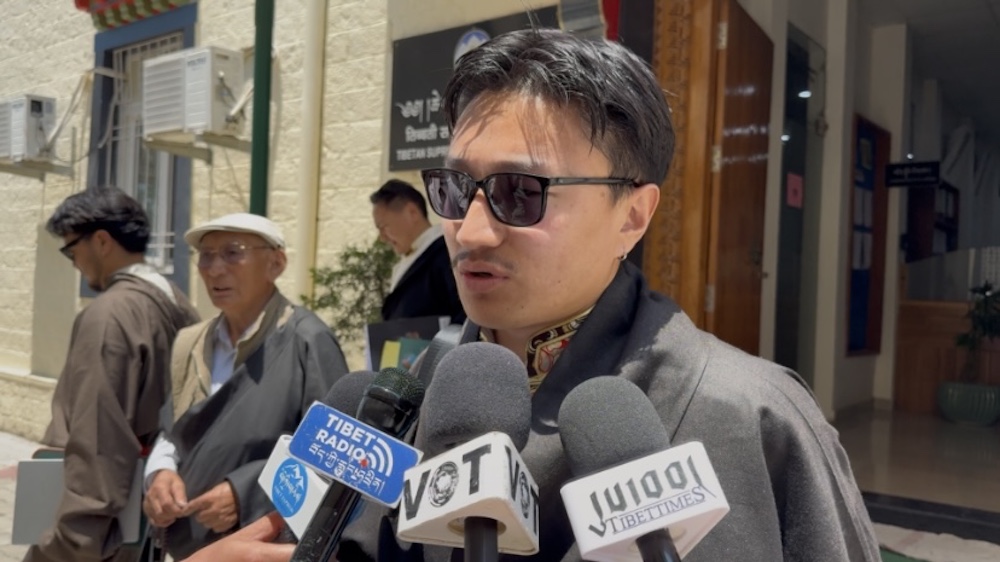
Following the hearing, Jampa Wangchuk, Legal Officer at the TLA, told media representatives that the proceeding was convened to clarify the distinction between Case No. 22 and the writ petition filed by the two monasteries. While Case No. 22 is being adjudicated as an ordinary legal dispute, the writ petition seeks judicial protection of fundamental rights under Article 69 of the Public Interest Litigation Procedure. According to him, the petition contends that the monasteries’ constitutional rights were violated.
He further argued that the preliminary election in Nepal had been conducted in an orderly and lawful manner, disputing the eight findings cited by the Election Commission. The validity of these eight allegations formed the central focus of the hearing, with the petitioners maintaining that the Commission’s conclusions were unfounded and had resulted in the infringement of the monasteries’ constitutional rights.
The TSJC did not issue any ruling on the merits of the petition during Tuesday’s hearing. The court has yet to determine whether the writ petition meets the legal requirements for registration and admission as a formal case. A decision on the petition’s admissibility is expected at a later date.

