

Tsering Dhundup
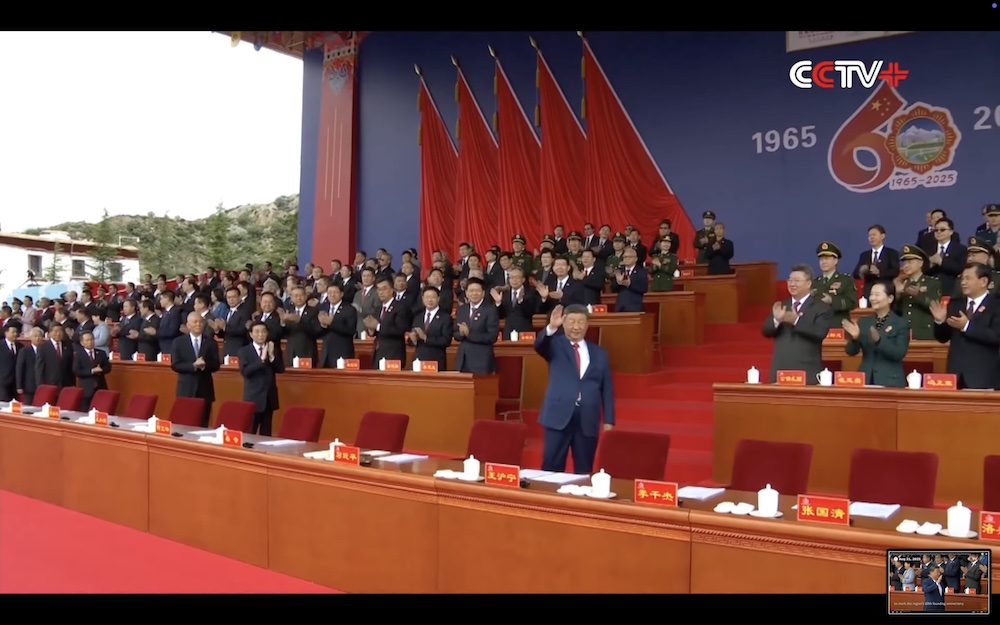
DHARAMSHALA, Aug. 21: China marked the 60th anniversary of the founding of the so-called Tibet Autonomous Region (TAR) with a large ceremony at Lhasa’s Potala Palace Square on Thursday, presided over by President Xi Jinping. The celebration took place directly in front of the Potala Palace, the historical seat of His Holiness the Dalai Lama, who has lived in exile since 1959.
Xi, who also serves as general secretary of the Communist Party of China (CPC) Central Committee and chairman of the Central Military Commission, was joined by senior party leaders Wang Huning and Cai Qi, along with some 20,000 officials and local attendees. Xi is the first Chinese president to attend the once-a-decade commemoration and the only one to visit Tibet twice, having last travelled there in 2021.
Beijing framed the event as a celebration of stability and development in Tibet under CPC leadership. Wang Huning declared Tibet had entered “its best period of development” under Xi’s rule since 2012, citing “tangible benefits to people of all ethnic groups.” He stressed Tibet’s role in national security and reiterated Beijing’s stance that “Tibet has always been an inseparable part of China’s sacred territory” and that “no external forces” would be allowed to interfere.
Xi, in his remarks during a meeting with local authorities on Wednesday, urged local authorities to prioritise stability, development, environmental protection, and border defence echoing Beijing’s long-standing emphasis on Tibet’s strategic significance. He also advocated for the “popularization of a national common language (Mandarin) and script”, – a policy widely seen as state-enforced cultural assimilation.
Yet exile Tibetan groups and human rights advocates strongly rejected the narrative. Tencho Gyatso, President of the International Campaign for Tibet (ICT), condemned the event as political theatre, saying, “Xi Jinping is in Tibet to project strength, stability, and legitimacy on the 60th anniversary of the creation of a Tibetan ‘Autonomous’ Region that denied Tibetans autonomy at its inception and is now even working to erase Tibet by replacing the name ‘Tibet’ with its Chinese term ‘Xizang’.”
She added that the high-level delegation “reflects China’s deep insecurity in Tibet and its need to perform leadership and assert authority.”
Central Tibetan Administration (CTA) spokesperson Tenzin Lekshey echoed the criticism on social media, writing, “Xi Jinping’s visit to Tibet should honour the Tibetan people’s rights – not showcase China’s oppressive control. True progress means freedom to preserve Tibet’s language, culture, identity, and environment.”
Despite Chinese state media such as Global Times and Xinhua reporting that Tibetans “warmly welcomed” Xi, the secrecy surrounding the event pointed to Beijing’s unease. According to reports, authorities only publicly announced the ceremony at 8 p.m. local time Wednesday, just 12 hours before it began. Sources inside Tibet reported heavy security deployments, with armed personnel saturating Lhasa’s streets. Former Tibetan political prisoners and individuals deemed “suspicious” were reportedly confined under house arrest.
Additionally, pilgrimage sites such as the Potala Palace and Jokhang Temple were closed to the public days ahead of the ceremony, with major streets around Potala sealed off.
Critics say such measures underscore the disconnect between Beijing’s official portrayal and the lived reality in Tibet, where Tibetans continue to face restrictions on movement, religious practice, and expression.
The so-called Tibet Autonomous Region was established in 1965 after China occupied Tibet as China’s fifth and final “autonomous region” after Inner Mongolia, Xinjiang, Guangxi, and Ningxia. While the designation was officially intended to grant what Beijing called ethnic minorities self-governance and religious freedom, exiled Tibetans and international rights groups contend that Beijing’s policies have instead entrenched political repression and cultural erasure, a charge China consistently rejects.

