

Tenzin Nyidon
DHARAMSHALA, Sept. 4: Chinese authorities have imposed stringent restrictions on movement into flood-hit Kyirong region in occupied Tibet, preventing Tibetans from other parts of the region from travelling to the disaster zone to provide relief and express solidarity with affected communities, according to an exile-based source who spoke to Phayul on condition of anonymity for safety reasons.
The source said the Chinese government has adopted an unusually restrictive approach to relief efforts in Kyirong, where severe flooding has affected areas along the Tibet-Nepal border. “Many Tibetans want to travel to Kyirong to help the affected people, but they are not being allowed to enter the area,” the source told Phayul, adding that the restrictions appear particularly stringent given the region’s proximity to Nepal.
According to a government notice issued following the floods, entry into the affected border area is restricted to officially designated relief personnel. Civilians and personal vehicles are prohibited from entering the disaster zone, while travel from Saga, Tingri and Nyalam Counties into Kyirong has been explicitly barred for civilians. Authorities have warned that those who violate the restrictions could face severe legal consequences.
The source contrasted the restrictions with the response to the devastating January 2025 Dingri earthquake, during which some Tibetan-led relief and assistance efforts were reportedly permitted. “This time, the restrictions are much stricter. During the 2025 Dingri earthquake, some Tibetans were able to provide assistance, but in Kyirong they are not allowing such efforts at all,” the source said. The source stated that the heightened controls may be linked to Kyirong’s strategic location on the Nepal border, where authorities are particularly sensitive to the movement of people and information.
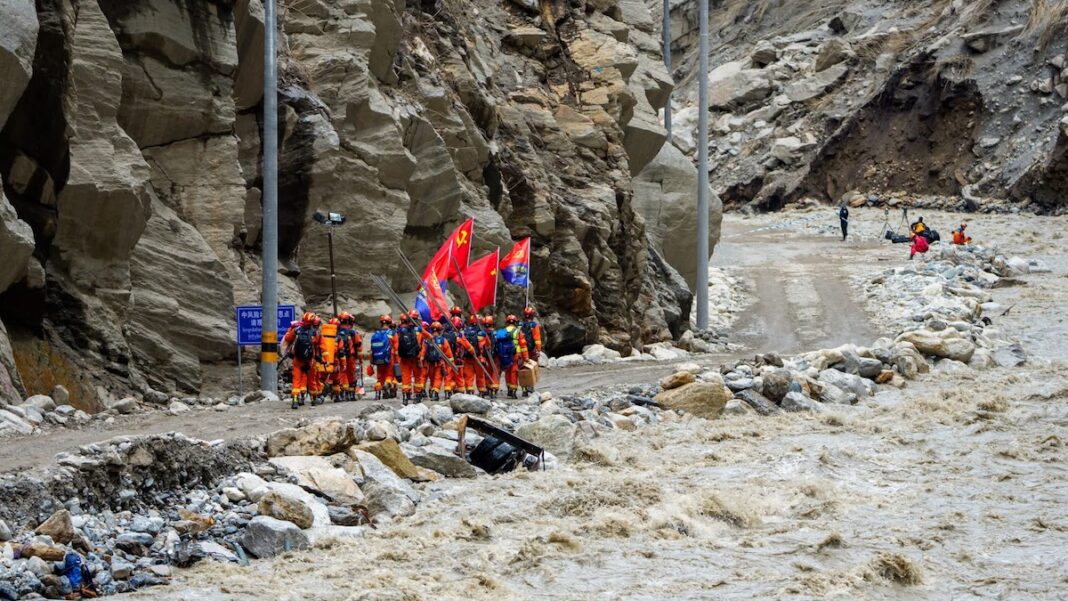
Meanwhile, Chinese state controlled propaganda mouthpiece have released carefully curated photographs and videos showing government-led rescue and relief operations in the affected areas. The imagery focuses on state-organised emergency responses and relief personnel, while independent access to the disaster zone remains heavily restricted.
In the aftermath of the catastrophic floods and mudslides that swept parts of the Tibet-Nepal border on August 26, Chinese authorities reported 31 deaths and 531 people missing in occupied Tibet as of September 4.
The figures, however, remain impossible to independently verify, as journalists, international humanitarian organisations, and other independent observers continue to be denied access to the disaster-affected areas. The absence of independent access has compounded concerns over the transparency of the official casualty figures and left substantial gaps in public knowledge about the scale of the devastation.
For families searching for missing relatives, the restrictions have created an acute information vacuum, prolonging an agonising wait for credible and timely confirmation of their loved ones’ fate and whereabouts. Chinese authorities said that, by noon on September 2, they had received 876 calls reporting people dead or missing—448 from within China and 428 from overseas. The volume of calls highlights the magnitude of the uncertainty surrounding the disaster and the growing demand from families for reliable information from authorities.

