

Tenzin Nyidon
DHARAMSHALA, Sept. 1: A joint press briefing in Dharamshala on Tuesday raised alarm over what activists and researchers described as an ‘information blackout’ surrounding the devastating flash floods in Kyirong in occupied Tibet, demanding that China release full and verifiable information on casualties, missing persons, displacement, destruction, and its emergency response.
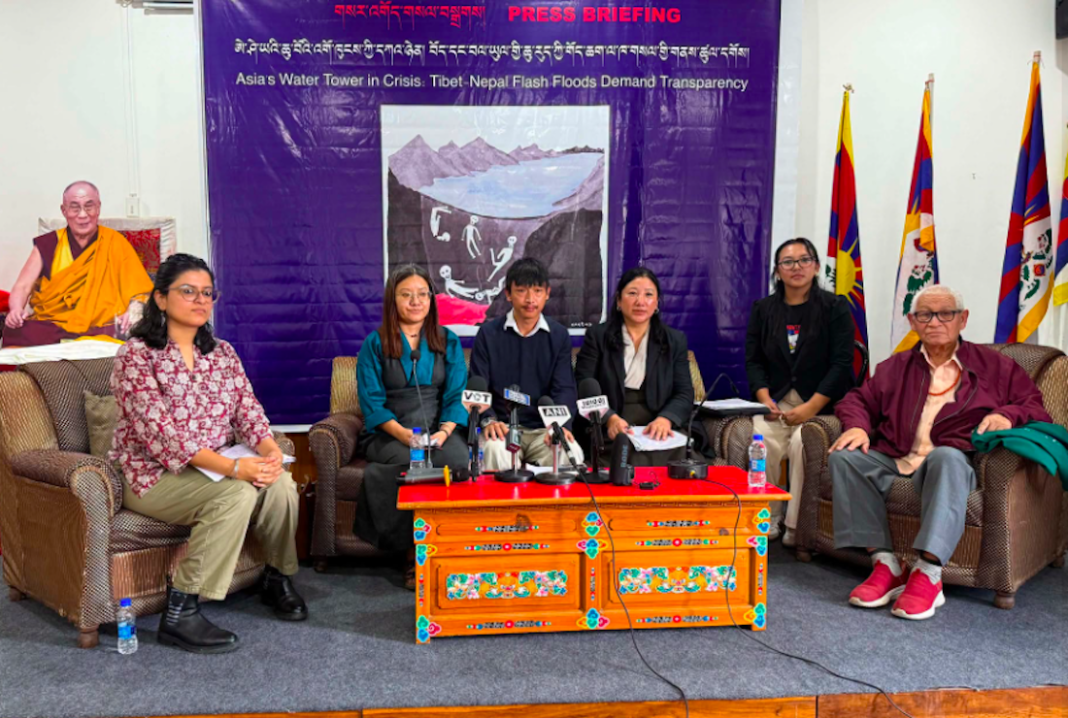
The briefing, titled “Asia’s Water Tower in Crisis: Tibet-Nepal Flash Floods Demand Transparency,” was organised by the International Tibet Network (ITN) and Students for a Free Tibet–India (SFT-India) at the Tibetan Settlement Office (TSO) hall in Dharamshala.
The briefing brought together researchers, activists, and a Tibetan monk from Kyirong, including Dhondup Wangmo, Research Fellow at the Environment and Development Desk of the Tibet Policy Institute (TPI), the Central Tibetan Administration’s think tank; Dr Lobsang Yangtso, Senior Environmental Researcher at ITN; Jampa Palden, a monk from Kyirong; and Tashi Dhondup, Campaigns Coordinator at SFT-India.
The speakers called on Beijing to provide complete, accurate, and timely information about the scale of the disaster, warning that withholding, manipulating, or selectively releasing information could endanger communities both within occupied Tibet and downstream in Nepal and India.
Jampa Palden, who is from Kyirong, shared accounts received from family members in the region, claiming that the entire Lhende area had been severely inundated and that three villages along the Lhende River had been completely washed away. According to his account, each of the three villages was home to at least 30–40 households. He added semi-nomadic Tibetan communities predominantly inhabit the area and is also an important trade corridor linking Tibet with Nepal.
Chinese state-controlled media have so far reported 16 deaths and 546 people missing. The discrepancy between limited official reporting and accounts emerging from outside Tibet was cited at the briefing as evidence of the urgent need for independent access and transparent reporting from the disaster zone.
Dr Lobsang Yangtso said that while the precise causes and trajectory of the recent glacial outburst have not yet been scientifically established, the disaster should prompt scrutiny of the rapid expansion of infrastructure across the environmentally fragile Himalayan region. She argued that extensive construction of roads, bridges, and hydropower projects in high-risk areas could compound the effects of climate-driven hazards, including glacial lake outburst floods, ice and snow avalanches, and other forms of cryospheric instability.
She also pointed to the accelerating effects of climate change on the Tibetan Plateau, describing Tibet as an exceptionally climate-sensitive region. According to figures cited at the briefing, the Tibetan Plateau and Himalayan region contain around 63,000 glaciers, 25,000 glacial lakes, 766 identified glacial-lake flood hazards, and 716 ice- and snow-avalanche hazards. “These risks,” she warned, could pose serious threats to communities in the future, particularly as warming alters the stability of glaciers and high-altitude landscapes.
She also drew attention to China’s ongoing construction of a proposed 60-gigawatt hydropower project in Medog County, Nyingtri Prefecture, Tibet, close to India’s Arunachal Pradesh border. She warned that large-scale infrastructure development in such an ecologically sensitive and climate-vulnerable landscape could have ramifications far beyond Tibet and across downstream areas, including India, Nepal, and Bangladesh.
The speaker therefore called for an international moratorium on mega-development projects in Tibet, arguing that large projects should not proceed until Tibetans can freely provide or withhold their consent without fear of detention, intimidation, or other forms of repression. She further urged Himalayan countries to consider an immediate moratorium on large hydropower projects until comprehensive climate, environmental and disaster-risk assessments are completed.
The briefing also scrutinised the role of multilateral development banks and international financial institutions in financing hydropower projects across the Himalayas. Lobsang Yagntso specifically raised concerns over international financing for the Trishuli River hydropower project in Nepal, arguing that financial institutions must be held accountable when projects proceed despite known glacier-related risks and insufficient environmental assessment.
She pointed to the vulnerability of hydropower infrastructure to sudden glacier-related disasters and questioned whether lenders have adequately incorporated increasingly volatile climate and geological conditions into their risk assessments. She argued that financial institutions should not treat Himalayan hydropower projects solely as development or investment opportunities while overlooking their potential consequences for workers, local communities, and downstream populations.
The briefing called for independent monitoring, real-time data sharing, and effective cross-border early-warning systems, including timely notification of dangerous glacier movements, glacial lake outbursts, sudden rises in river levels, and other foreseeable hazards.
The speakers called on China to grant unhindered access to affected Tibetan areas to international humanitarian organisations, independent journalists, disaster-response agencies, and human rights monitors. They also urged Beijing to ensure that Tibetans who document the disaster or communicate information about the humanitarian situation are not subjected to surveillance, detention, intimidation, prosecution, or other reprisals.
The briefing also appealed to international governments, media organisations, humanitarian agencies, and monitoring bodies to use Tibetan place names consistently in official statements, reporting, and documentation. The organisers argued that accurate Tibetan terminology is not merely a linguistic preference but a matter of factual accuracy, cultural respect, and recognition of Tibetan identity. They urged international actors to avoid uncritically adopting Chinese state terminology, including “Xizang,” particularly when reporting on humanitarian, environmental, and human rights issues.

