

Tenzin Nyidon
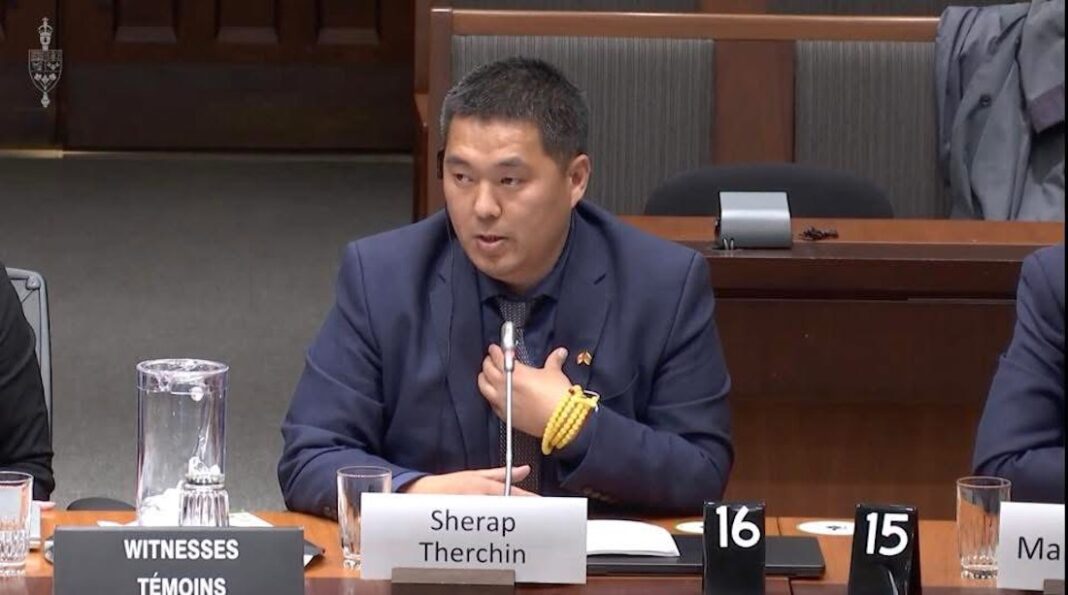
DHARAMSHALA, April 22: Sherap Therchin, the Executive Director of the Canada Tibet Committee (CTC), delivered a stark and personal testimony before Canada’s Subcommittee on International Human Rights, warning of the expanding reach of China’s transnational repression and its direct impact.
Appearing before the parliamentary body under the Standing Committee on Foreign Affairs and International Development (16:01:47 to 16:07:27), Sherap spoke during a hybrid session held in accordance with parliamentary procedure, alongside fellow witnesses including Maria Cheung, Grace Wollensak, Zaha Hassan, Marcos Kolga, Peter Mattis, and Zumretay Arkin.
Opening his remarks, the Tibetan activist revealed that he is among 20 Canadians sanctioned by the Chinese government on December 21, 2024—an action he described as both symbolic and deeply consequential. While calling the sanctions “a badge of honour” reflecting his commitment to human rights, he emphasized that they have brought “real and lasting consequences.” Branded by Chinese authorities as a threat to national security and sovereignty, he said, those targeted have become subjects of sustained harassment and intimidation.
He detailed the increasingly hostile environment he has faced since the sanctions were imposed. He reported frequent phishing attacks, malware infections targeting the CTC’s website, and a steady stream of threatening online messages from anonymous sources. To mitigate risks, he and his colleagues have adopted heightened digital security measures, including the use of VPNs—tools that, while necessary, have disrupted daily operations and serve as a constant reminder of the threats they face.
“These are not abstract concerns,” he told the committee, stressing that such pressures affect every aspect of life—from communication and work to personal safety and mental well-being.
The repercussions extend beyond the digital realm. He said international travel has become fraught with uncertainty, forcing sanctioned individuals to carefully consider destinations, interactions, and potential risks—particularly in countries with close ties to China. He also highlighted the psychological toll of worrying about family members in Tibet or other regions under Beijing’s influence, noting that sanctions can be “weaponized at any moment.” This persistent anxiety, he said, subtly undermines freedom of expression and, at times, even the courage to speak openly.
He acknowledged the Canadian government’s support, including consultations, safety workshops, and expressions of solidarity. However, he stressed that such measures cannot fully offset the impact of being targeted by what he described as “one of the world’s most powerful authoritarian regimes.” “Despite our best efforts to remain strong,” he said, “our lives have never been the same.”
Placing his experience within a wider context, he warned that his case is emblematic of a broader pattern of behavior by the People’s Republic of China. He cited findings from Canada’s Public Inquiry into Foreign Interference, which identified China as the most active state actor targeting the country’s democratic institutions.He also referenced Canada’s 2026 National Cyber Threat Assessment, which describes China as the most sophisticated and persistent cyber threat facing the country, engaging in espionage, intellectual property theft, and malign influence operations.
“This is not simply about disagreement with criticism,” he said. “It is about a state with a documented record of foreign interference, cyber aggression, transnational repression, and intimidation.”
While acknowledging the importance of trade and engagement with China, he urged Canada not to normalize arbitrary sanctions or detentions. He called for the establishment of “solid guardrails” in bilateral relations, including supply chain transparency, independent fact-finding access, and reciprocal travel rights.
He raised concerns over Canada’s visa-free travel arrangement with China, noting that some Tibetan-origin Canadians who attempted to visit Tibet or mainland China were denied entry and sent back without explanation. “Reciprocal access is essential,” he said, arguing that openness must be mutual if relations are to be fair and just.
He pointed to high-profile cases that illustrate the risks faced by Canadian nationals, including the detention of Michael Kovrig and Michael Spavor in China for nearly three years. He also referenced the 2014 detention of Kevin and Julia Garratt, as well as the long-term imprisonment of Huseyin Celil, a Canadian citizen of Uyghur origin held since 2006.
Concluding his testimony, Sherap delivered a stark warning: China’s repression is no longer confined within its borders. “It has gone transnational,” he said. “The threat is already here in Canada.”


Transnational repression is no longer a distant threat—it’s happening right now on Canadian soil. 🇨🇦🛡️ Sherap Therchin of the Canada Tibet Committee shared a chilling testimony about being sanctioned and harassed by Beijing, highlighting a pattern of cyberattacks, digital stalking, and threats against family members. 👨👩👧👦💻 From “debt traps” to sophisticated espionage, the message is clear: the reach of authoritarian influence is expanding, and activists are calling for much stronger “guardrails” to protect democratic freedoms and personal safety. 🛡️📢⚖️