

Tenzin Nyidon
DHARAMSHALA, Jan. 28: In a pivotal move, India’s National Centre for Seismology (NCS), the country’s primary agency for study on earthquakes under the Ministry of Earth Sciences, has reverted to using the term “Tibet” instead of “Xizang” in its earthquake reports and updates. The shift comes in the wake of a 7.1 magnitude earthquake that struck Tibet’s Dingri in Shigatse Prefecture. Previously, “Xizang” the Chinese propagandaappeared 58 times in NCS updates related to the earthquake.
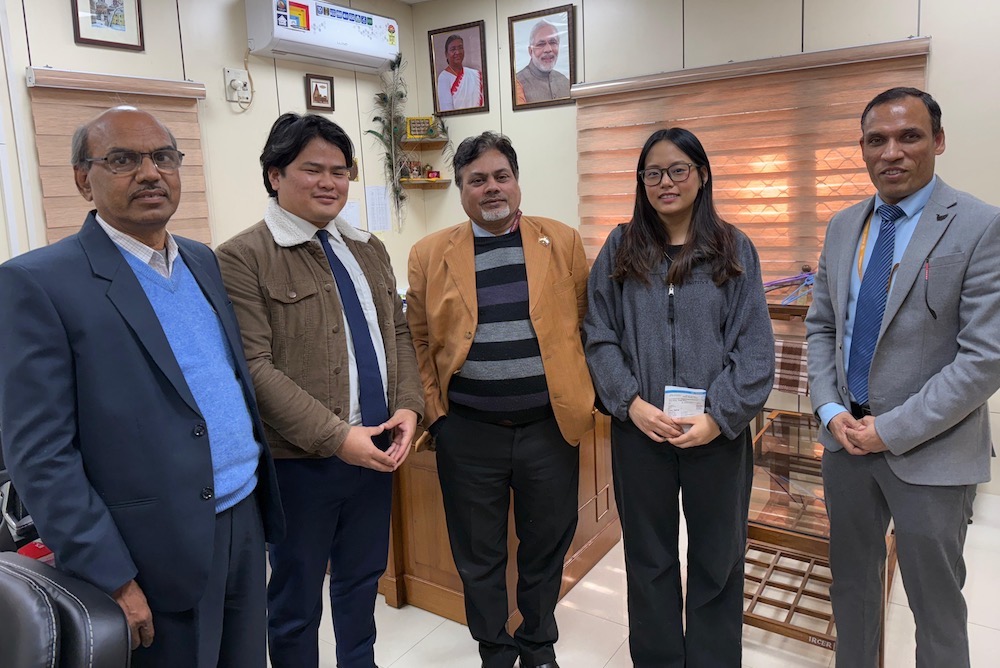
This change was made after concerted advocacy by the Voluntary Tibet Advocacy Group (V-TAG), a Tibetan advocacy group under the Central Tibetan Administration (CTA). On January 21, Tenzing Dhamdul and Tenzin Lhatso, researchers and members of V-TAG Delhi, met with NCS Director Dr. Om Prakash Mishra to address concerns regarding the terminology.
V-TAG Delhi welcomed the revision, hailing it as a reaffirmation of Tibet’s historical and cultural identity. “India has reverted to ‘Tibet’ because for India, it always has been Tibet and not Xizang. This was stated to us by the director of NCS Dr. O.P. Mishra when we approached him. We are glad to see that they have kept their word and implemented the necessary changes here,” Dhamdul told Phayul. “This is the beauty of Indian democracy in my opinion, where one can engage in such discussion and exchange thoughts freely.”
Dhamdul urged other nations to adopt accurate terminology, noting that many countries, including Switzerland, the Netherlands, the United States, and the United Kingdom, continue to use “Xizang” in seismic updates. “Countries around the world should take note of India’s modus operandi here. Because many have been using Xizang instead of Tibet knowingly or unknowingly without the larger implications,” he opined.
Reflecting on the impact of V-TAG’s advocacy efforts, Dhamdul added, “This time it was V-TAG Delhi, next time it would be another organisation but what matters is that Tibetans coming together and leading the advocacy efforts for Tibet. We are the representatives of our sisters and brothers in occupied Tibet and our small action here as Voluntary Tibetans brought a change, which every Tibetan and Tibet supporter can replicate and transcend further.”
He also expressed gratitude to everyone who supported the initiative, particularly acknowledging Tenzin Lhatso’s leadership. “There were many involved behind the scenes who made this possible. I deeply thank them all and especially Tenzin Lhatso la for leading this initiative in Delhi. We Tibetans led by His Holiness the Dalai Lama, senior leaders, our family, and our resilient community can do a lot if we come together and act upon it. I hope this small action by us will fuel the burning fire living in every Tibetan’s heart, showing us what we are capable of when it comes to advocating for Tibet and being the needed voice for our sisters and brothers in occupied Tibet globally.”


Thank you to the Indian seismological centre authorities for your understanding. As the Chief Minister of the Indian State of Arunachal Pradesh has said umpteen times, INDIA BORDERS TIBET AND NOT CHINA, the Indian authorities in New Delhi must understand the sentiments of the people bordering Tibet for centuries. Tibet is the source of their cultural heritage. All the Lamas that came from Tibet such as Shabdrung Ngawang Namgyal of Bhutan and Lama Lhatsun Namkha Jigme of Sikkim and the birth of Six Dalai Lama Tsangyang Gyatso in Tawang have been instrumental in the growth and nurturing of Himalayan Buddhist culture that has enriched the region from Ladakh, Lahul, Spiti, Buddhist nation of Bhutan to Indian State of Sikkim and Arunachal Pradesh. The whole of the Himalayan region imbibed Buddhism during the time of the Tibetan empire has left its indelible impression all across the Himalayas for centuries. The Dalai Lama has immense influence in this region because of their Buddhist faith. Therefore, in order to retain the peaceful nature of the Himalayan people, Tibet is vital for their survival. If Tibet dies, they will die too. Today, hundreds of students from Nepal, Bhutan, Sikkim and Ladakh study in the great Buddhist monasteries of Sera, Ganden, Drepung, Tashi Lhunpo, Namdroling Nyingma monastery, Sakya College in Rajpur and Kagyud Centres in the South. The four great Geluk monasteries boasts of thousands of students including westerners from different western countries. These include Americans, both black and white, Australians, New Zealanders, French, English, Spanish you name it, it’s a great conglomeration of nationalities. Many students from Ladakh and Arunachal study in the great monasteries of Sera, Ganden while many Ladhakis students study in Drepung monastery. Rinsong Rinpoche the late Gaden Throne Holder was a Ladakhi. As the border regions are of vital importance to India, India must support the Tibet movement as it has supported the African National Congress (ANC) in its fight against apartheid South Africa and Indonesia against Dutch colonialism. There is much more at stake for India in the liberation of Tibet than South Africa or Indonesia because India shares a border with occupied Tibet. There was no “India-China” border until the Chinese illegal occupation of Tibet in 1949/50. The Simla convention of 1913-14 is a testimony to this historical preponderance. When Tibet was free, the Indo-Tibet border was the most peaceful border for centuries. The Chinese communist even made a propaganda out of it by peddling “India and China are eternal friends” conveniently denying the existence of independent Tibet acting as a buffer between the two most populous nations. In Indian history, there is nothing about China except the visit of Chinese monk Hiuen Tsang during the time of King Harsha in AD 627-643 AD. and Fa-Hsien during 399 and 414 AD. These two monks made notes in their travels which shed light on the conditions in India at the time. That’s is all about China in Indian historical books taught in India in the 1960s and 1970s! Therefore, there was no interaction between China and India for centuries! On the other hand, Tibet and India were culturally the closest neighbour just like today’s Bhutan and India. As a result of this historical, cultural and lingual connection (Tibetans learnt Sanskrit to understand and read tantric mantras and their meaning) with India, Tibet looked to India as the Arya Bhumi (the holy land). Today, Buddhism is completely snuffed out in occupied Tibet but owing to India’s generosity and humanity spearheaded by Pandit Jawaharlal Nehru, Tibetans were given asylum including treating the Dalai Lama as a guest of India. As a result of the exile community’s effort led by the Dalai Lama to re-establish Tibet’s great Buddhist learning centres of the four Buddhist traditions and Bon, students from across the world, including Tibetan students from occupied Tibet, Indian, Bhutanese, Mongolians and Nepalese are all able to study Buddhism in these great Buddhist monasteries. It is paramount for India to support the Tibetan Freedom movement in order to preserve the peaceful Buddhist cultures across the Himalayas. If Buddhism dies out in the Himalayas, it will soon be taken over by other religious traditions and ideology that would be detrimental to the security and stability of India. For these reasons, India must also support the future reincarnation of the Dalai Lama who wields immense influence in occupied Tibet and all of the Himalayan region. Jai Tibet! Jai Hind!
ང་བོད་པར་སྐྱེས་པ་བསོད་ནམས་ཆེ།།
TIBET ALWAYS WAS AND ALWAYS WILL BE TIBET!