

Tenzin Nyidon
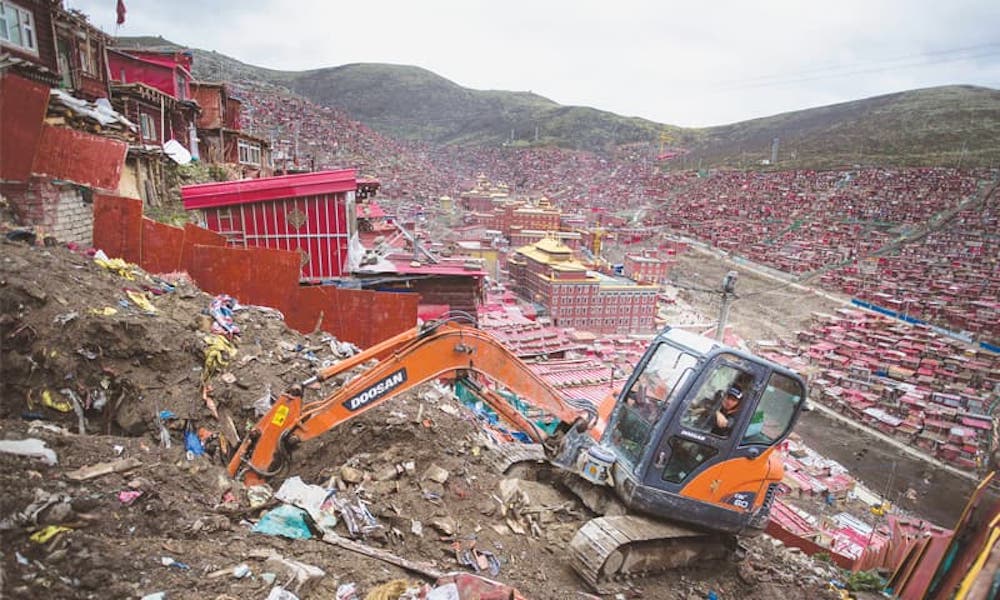
DHARAMSHALA, July 28: Chinese authorities have ordered monks and nuns whose residential quarters have been demolished at the renowned Larung Gar Buddhist Academy in Sertar County to leave the institute and return to their native monasteries, as Beijing presses ahead with its latest demolition campaign at one of the world’s largest centres of Tibetan Buddhist learning.
According to a report by the Dharamshala-based Tibetan outlet, Tibet Times, the order applies to all monastics whose residences have already been razed. Those from outside Serthar have been instructed to return either to their family homes or to monasteries in their native regions. At the same time, even monks and nuns originally from Serthar have reportedly been barred from remaining at Larung Gar and ordered to relocate to their local monasteries.
The latest measures follow a renewed demolition drive that began around July 13, 2026. Chinese authorities have justified the operation by claiming that the institute contains an excessive number of residential structures, creating safety concerns, and that the monastic population has grown beyond acceptable limits. Demolition crews have already torn down numerous residences, with the campaign continuing.
The current plan calls for the demolition of 1,060 monastic residences. Those whose quarters have been destroyed are no longer permitted to remain at Larung Gar and are being forcibly removed in successive groups.
Security restrictions across the academy have also been significantly tightened. Monks, nuns, and local residents are reportedly under heightened surveillance, while pilgrims and visitors from other areas are being prevented from entering the institute as authorities enforce stricter controls.
A source familiar with the developments told TT that Chinese authorities had initially planned to demolish the area surrounding Gyutrul Temple within the academy. However, monastery representatives reportedly appealed against the proposal, warning that such demolition would jeopardise the temple, the main assembly hall, and the circumambulation route. Following those representations, the authorities altered the plan and instead targeted the Joser residential quarters situated between the living areas of monks, nuns, and lay practitioners.
Larung Gar has been the target of repeated demolition campaigns over the past two decades. Chinese authorities carried out large-scale demolitions in 2001, 2016, and 2019, citing overcrowding and the absence of legally required construction permits. Those campaigns were also accompanied by stringent quotas on the resident monastic population and the forced removal of thousands of monks and nuns, particularly those who had travelled from other Tibetan regions to pursue Buddhist studies.
The 2019 demolition campaign also drew international attention after reports emerged that a nun, Tsering Dolma, died by suicide after leaving a final message describing how sustained state repression had driven her to despair.
Larung Gar, founded in 1980 by the late Khenpo Jigme Phuntsok, has long served as one of the most influential centres for the study of Tibetan Buddhism, attracting monks, nuns, and lay practitioners from across Tibet, China, and abroad. Human rights organisations and Tibetan groups have repeatedly criticised successive demolition campaigns and expulsions at the institute, arguing that they form part of broader efforts by the Chinese government to tighten control over Tibetan religious institutions and curtail independent monastic education.


The greatest enemy of the satanic CCP is religion and especially Tibetan Buddhism in the case of Tibet. The Chinese communist devils unleashed a barbaric campaign to destroy and vandalise every monastery and kill every monk and nun right from the word go of their invasion of Tibet! They were supposed to be carrying out the message of their evil communist ideology which holds religion as poison. In reality, religion in general and especially, Tibetan Buddhism is like medicine. It heals people! As they say, bad habits die hard, the evil CCP is on the same path of anti-religious campaign to rout out any traces of religion to this very day! During the madness of the so called cultural revolution, every monastery was pillaged and razed to the ground! It was a madness unparalleled in human history. Monks and nuns bore the brunt of this dastardly anti-religious campaign that almost wiped out Tibetan Buddhism. The Chinese see Tibetan Buddhism as a threat to their occupation of Tibet because the resistance is coming from the monastic community who are the vanguard of Tibetan Buddhism. The monks
/nuns of Tibet have been in the front of Tibetan resistance to Chinese occupation. Besides, the monks and Lamas are trusted by the majority of Tibetans who regard them as the saviour of Tibetan Buddhism. The Chinese on the other hand struck at the heart of Tibetan Buddhism. Despite such genocidal campaigns against Tibetan Buddhism, Tibetan Buddhism has survived. The evil communists have ruined their country by
sheer violence against people, their property and invaded Tibet to do the same. It continues to destroy holy sites and continue to colonise occupied Tibet through a mix of treachery and sabotage. It is erasing our language, custom. Religion history and identity. The stupidity of the Chinese communists is breath-taking. They have made so many blunders in population control which has now dwindled to such levels that it might not have enough workers to feed the elderly population. Tibet’s pristine waters and soil have been contaminated by poison owing to excessive Chinese mining! Tibets monasteries continue to be the main targets of the satanic regime to snuff out Tibetan resistance to Chinese occupation. They have enacted a law which criminalised Buddhism, Learning of Tibetan language and religious practises! In short the evil regime is obliterating our language, culture, religion and identity in order to perennially occupy Tibet! One hundred and seventy one (171) Tibetan hero’s have self-immolated in order to highlight the dire situation inside occupied Tibet! Tibetan Rangzen Hero Pawo LOGA has self-immolated in order to high-late the evil that is being visited in occupied Tibet by communist China! Surely, we cannot remain mute any more. LOGA Rangzen has showed the way. We must protect our most precious national treasure such as our language, religion and identity by exposing the evil regimes
nefarious act to the world! No more bootlicking! We must confront the regime head-on! The capitulation of our sovereignty in exchange for preserving our historical heritage has been thwarted by the evil regime. It has brought no dividend whatsoever and instead it only emboldened the enemy. NOW, IT IS CLEAR ONLY TOTAL INDEPENDENCE WILL ASSURE THE PROTECTION, PRESERVATION AND RETENTION OF OUR CULTURE, LANGUAGE AND RELIGION!