

Tenzin Nyidon
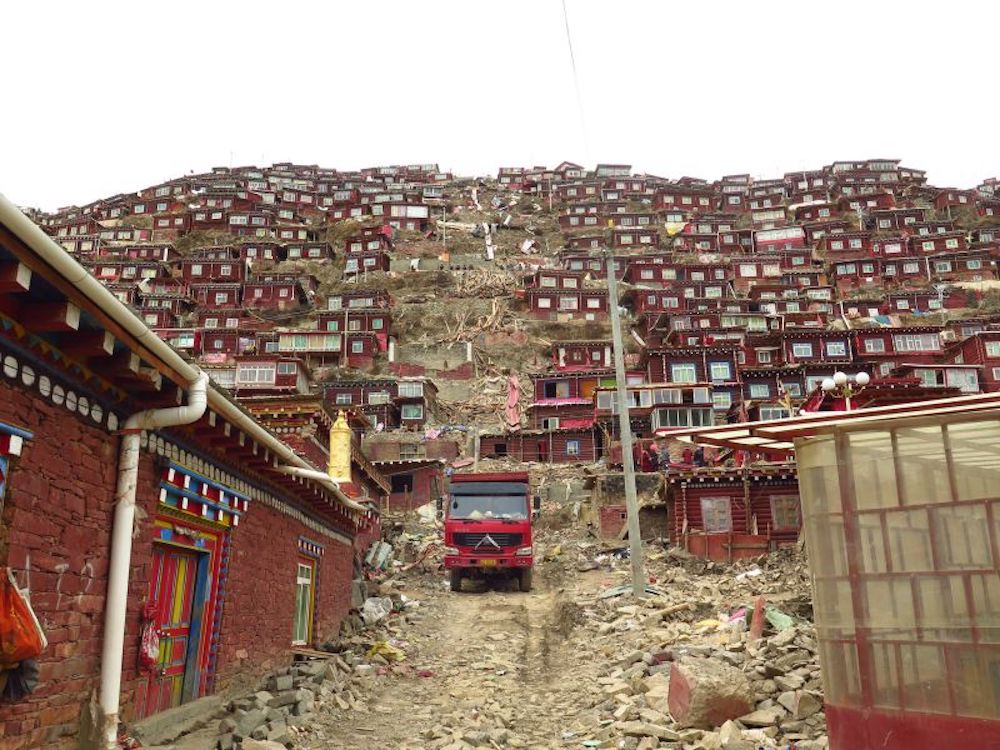
DHARAMSHALA, July 20: Chinese authorities have launched a new wave of demolitions at Larung Gar Buddhist Academy in eastern Tibet, with at least 1,060 residences of monks and nuns slated for destruction, marking the latest escalation in Beijing’s tightening control over one of the world’s largest centres of Tibetan Buddhist learning.
The demolitions, which began around July 13, are reportedly being carried out during the night in what observers believe is an effort to avoid public documentation and satellite monitoring, according to the Washington-based advocacy group, International Campaign for Tibet (ICT). As of July 15, six residences had already been demolished, citing a source familiar with the situation who requested anonymity due to fears of reprisals.
The rights group expressed concern that the latest campaign coincides with the implementation of China’s Ethnic Unity and Progress Law, which took effect on July 1. The legislation has been widely viewed as reinforcing Beijing’s policy of assimilating ethnic minorities, including Tibetans, into a unified Chinese national identity while discouraging resistance to state policies.
Although the precise justification for the demolitions remains unclear due to China’s tight restrictions on information from Tibet, ICT said the timing has raised concerns that the campaign forms part of a broader intensification of state controls over Tibetan religious institutions.
The source also noted that access to Larung Gar and the surrounding Serthar County remains heavily restricted. Earlier this year, a Chinese traveller visiting the area described the atmosphere in a vlog as being defined by “restrictions everywhere,” citing limitations on visitors’ movements, the duration of their stay, and even shuttle bus operating hours.
Founded in 1980 by the late Tibetan Buddhist master Khenpo Jigme Phuntsok, Larung Gar was established to revive Buddhist scholarship and meditation following the Cultural Revolution. Over the decades, it evolved into one of the most influential centres for the study of Tibetan Buddhism, language, and culture, attracting thousands of Tibetan and Han Chinese practitioners.
The academy, however, has faced repeated government crackdowns over the past two decades. Chinese authorities first launched large-scale demolitions in 2001, reducing the resident population by roughly half through the destruction of thousands of living quarters. After the academy gradually regained its numbers despite continuing restrictions, another major campaign in 2016 and 2017 resulted in the demolition of nearly 5,000 residences and the eviction of thousands of monks and nuns following a central government directive.
The measures drew international condemnation. In February 2017, six United Nations human rights experts warned that the actions at Larung Gar appeared to constitute “concerted attacks on tangible and intangible cultural heritage” and violated the cultural rights of both present and future generations.
Restrictions have continued to expand in recent years. Since 2019, Chinese authorities have progressively limited the enrolment and participation of Han Chinese Buddhists at the academy, and in 2021, reportedly introduced policies separating Chinese practitioners from Tibetan residents, further reshaping the institution’s composition and activities.

