

Tenzin Nyidon
DHARAMSHALA, Nov. 6: The exile Tibetan government officially known as the Central Tibetan Administration (CTA) President Penpa Tsering on Thursday called on the international community to strengthen its support for Tibet and take concrete political and diplomatic action against what he described as China’s coordinated efforts to undermine Tibet’s historical identity, religious freedom, and cultural heritage.
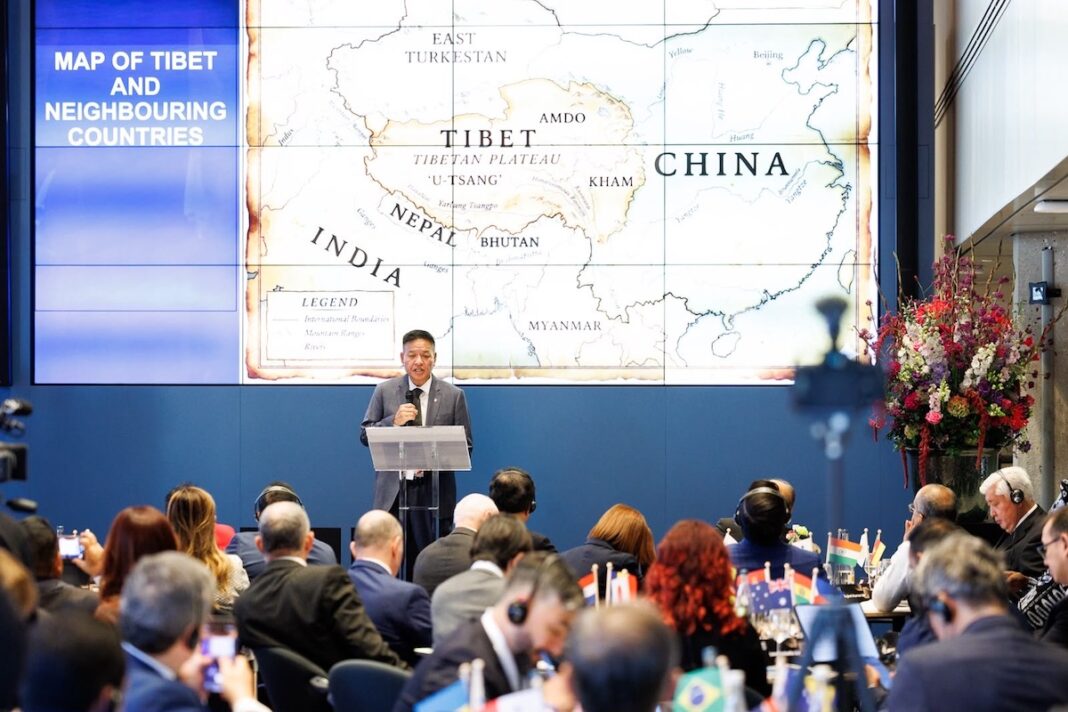
Speaking at the 6th annual summit of the Inter-Parliamentary Alliance on China (IPAC) in The Hague as a lightning speaker, the Tibetan political leader urged lawmakers worldwide to move beyond expressions of concern and translate their commitments into coordinated measures to counter the challenges posed by the Chinese government.
Calling for a more accurate understanding of Tibet’s historical and political status, the CTA President urged parliamentarians to examine Tibet’s history through objective historical and legal perspectives rather than relying on narratives promoted by Beijing. He cited two publications, Tibet Was Never Part of China Since Antiquity by Chinese Professor Hon-Shiang Lau and Tibet Brief 20-20 by Professor Michael van Walt van Praag, as important resources for lawmakers seeking a deeper understanding of Tibet’s historical and legal position.
He also cautioned that China’s global initiatives reflect ambitions that extend well beyond its borders, with far-reaching implications for international democracy, security, freedom, and the global order. He called on lawmakers to scrutinise the objectives and consequences of these initiatives and their impact on the international community.
Reaffirming the CTA’s commitment to the Middle Way Approach, he said the Tibetan administration continues to follow the vision and guidance of His Holiness the 14th Dalai Lama in pursuing a peaceful and mutually beneficial negotiated resolution to the Tibet-China conflict. He stressed that the pursuit of dialogue and reconciliation does not mean relinquishing Tibet’s historical and legal rights under international law.
He further urged governments to counter what he described as China’s historical misinformation through appropriate legislation, parliamentary resolutions and official declarations, pointing to the United States’ Resolve Tibet Act as an important example of legislative action.
The CTA President also raised concerns over Beijing’s increasing interference in Tibetan religious affairs, particularly its attempts to assert control over the reincarnation of Tibetan Buddhist spiritual leaders, including the future reincarnation of His Holiness the Dalai Lama.
He called on parliamentarians to oppose such interference and uphold the Tibetan people’s inherent right to determine the reincarnation of their spiritual leaders in accordance with Tibetan Buddhist religious traditions and the wishes of His Holiness. In this regard, he encouraged lawmakers to follow the positions taken by the United States and seven European countries — the United Kingdom, Germany, France, the Netherlands, Iceland, Lithuania and Estonia — in defending the religious freedom of Tibetan Buddhists and opposing Chinese government interference in the reincarnation process.
Turning to the deteriorating situation inside Tibet, he warned that China’s forced assimilation policies pose an existential threat to Tibet’s distinct language, religion, culture, and identity, describing the policies as amounting to cultural genocide. He called for concrete international measures to protect Tibet’s cultural heritage and the fundamental rights of the Tibetan people.
He also highlighted the environmental importance of the Tibetan Plateau, warning that China’s large-scale infrastructure and hydropower projects carry serious consequences extending beyond Tibet to neighbouring countries and the wider world.
Concluding his address, he called for sustained international solidarity with Tibet and specifically urged Members of the European Parliament to work towards appointing an EU Special Representative for Tibet to strengthen and coordinate the European Union’s engagement on the issue. He emphasised that international support for Tibet must go beyond statements of solidarity and be demonstrated through meaningful political, legislative and diplomatic action.
The summit brought together 52 parliamentarians from 30 countries across six continents to discuss coordinated responses to the growing challenges posed by the People’s Republic of China (PRC). The CTA President was accompanied by Representative Rigzin Genkhang of the Office of Tibet in Brussels during his address, delivered as part of his ongoing official visit to the Netherlands.

