

Tenzin Nyidon
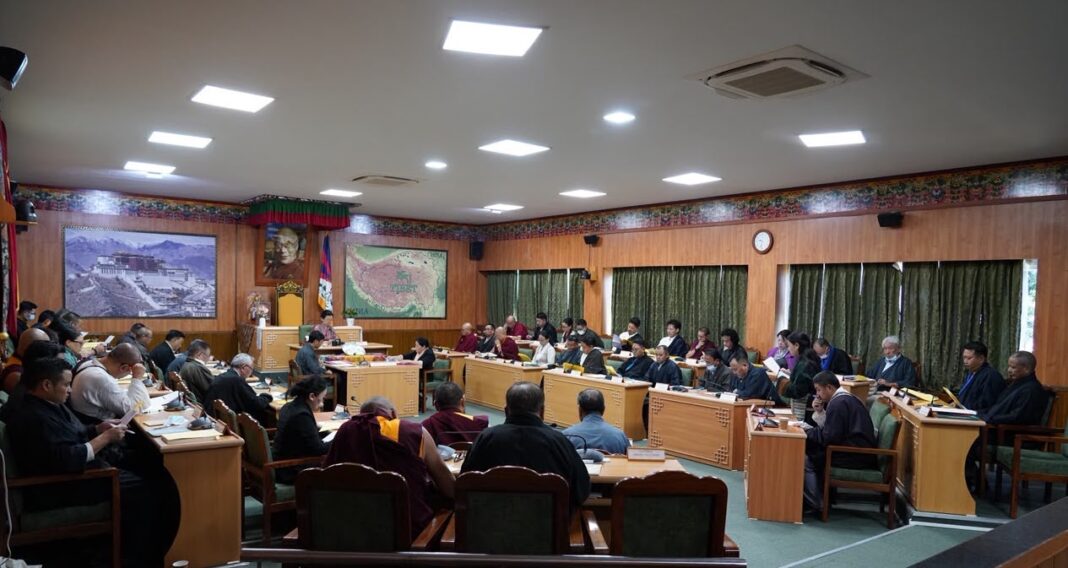
DHARAMSHALA, Sept. 21: A six-point solidarity motion on the critical situation inside Tibet triggered an extensive and at times heated debate in the Tibetan Parliament-in-Exile on Monday, with lawmakers divided over the wording as well as Central Tibetan Administration’s core positional implication due to a provision calling for continued efforts toward “Tibet’s freedom and independence”.
The motion was tabled by Parliamentarian Gyaltsen Choekye Gagya and supported by Parliamentarian Gonpo Dhundup on the fifth day of the ongoing session of the Tibetan Parliament-in-Exile. The House ultimately adopted the resolution expressing solidarity with Tibetans inside Tibet, without the fifth point of the resolution which failed to secure the required majority, receiving 17 votes in favour and 24 against.
The most contentious deliberation centred on the wording of the fifth point of the resolution, which called on Tibetans living in free countries to intensify efforts to raise international awareness of the Tibet issue, engage governments, and maintain unity while continuing efforts for “Tibet’s freedom and independence.”
The Central Tibetan Administration (CTA) President Penpa Tsering raised a point of order, arguing that although the motion was presented as an official expression of solidarity and condolences, the wording of the fifth point of the resolution had implications for the CTA’s established policy position. He maintained that if the provision amounted to a substantive change in the CTA’s policy, the matter would have to be addressed under Article 56 of the Charter of Tibetans in Exile, which provides a mechanism for dealing with important policy matters concerning the fundamental interests of Tibet or the Tibetan people.
Some parliamentarians proposed replacing the phrase “to continue efforts for Tibet’s freedom and independence” with wording along the lines of “to clarify the ultimate truth of the Tibet issue,” in keeping with terminology currently in use in the Charter. Others argued that language referring to the “struggle for the Tibet issue” should be retained.
Several members also questioned whether the adoption of the contested wording could create ambiguity over the CTA’s policy in the future. They sought clarification from Speaker Dolma Tsering Teykhang on whether her assertion that the motion would not alter the CTA’s policy position would be formally recorded.
The Speaker subsequently maintained that the motion had been introduced in accordance with parliamentary rules and procedures. She said the matter had been discussed within the Standing Committee and that the resolution, as presented, would not constitute a change in the CTA’s policy.
While some parliamentarians supported the motion in its entirety and stressed the importance of respecting the Middle Way Approach, others argued that calls for a review or reconsideration of policy were compatible with democratic processes. Some lawmakers also called for greater clarity over what pursuing Tibetan independence would entail in practical terms, including the strategies and mechanisms that would be required to translate the objective into concrete political action.
The debate also brought renewed attention to the political significance of the late Tibetan independence activist Lobga Rangzen’s self-immolation. Several parliamentarians said his death had resonated particularly strongly among Tibetan youth and argued that his sacrifice should not be allowed to fade without further action on the Tibet issue.
The Tibetan Parliament-in-Exile adopted five of the six points of a resolution expressing solidarity with Tibetans inside Tibet, calling for the protection of their human rights, religious, and cultural identity, and urging the Chinese government to address the Sino-Tibetan conflict through dialogue.
The resolution condemned decades of what it describes as repression of Tibetans’ religious and national identity and paid tribute to those who have protested Chinese government policies, including Tibetan self-immolators. It specifically honoured Tibetan independence activist Lobga Rangzen, who died after self-immolating outside the United Nations Headquarters in New York on July 2, and expressed condolences to his family.
It called on the United Nations’ leaders to raise the Tibetan issue with Chinese authorities, while seeking the release of arbitrarily detained Tibetans—including the 11th Panchen Lama—and urged an end to restrictions on Tibetan language, religion, and culture, as well as policies affecting Tibet’s environment.
The resolution supported resolving the Sino-Tibetan conflict through dialogue, while rejecting China’s so-called “Ethnic Unity and Progress Law.” It also expressed gratitude to India and acknowledged governments, parliaments, organisations, and individuals worldwide for their continued support of the Tibetan cause.

