

Tenzin Nyidon
DHARAMSHALA, May 22: The foremost Tibetan spiritual leader, His Holiness the Dalai Lama, on Thursday reiterated his hope of one day being able to return to Tibet, while addressing devotees during an audience at his residence in Dharamshala.
The audience was held following a long-life prayer offering made to the nonagenarian leader on Wednesday by members of Dokham Chushi Gangdruk and the Himalayan Buddhist Cultural Association. More than 400 devotees and well-wishers attended the audience.
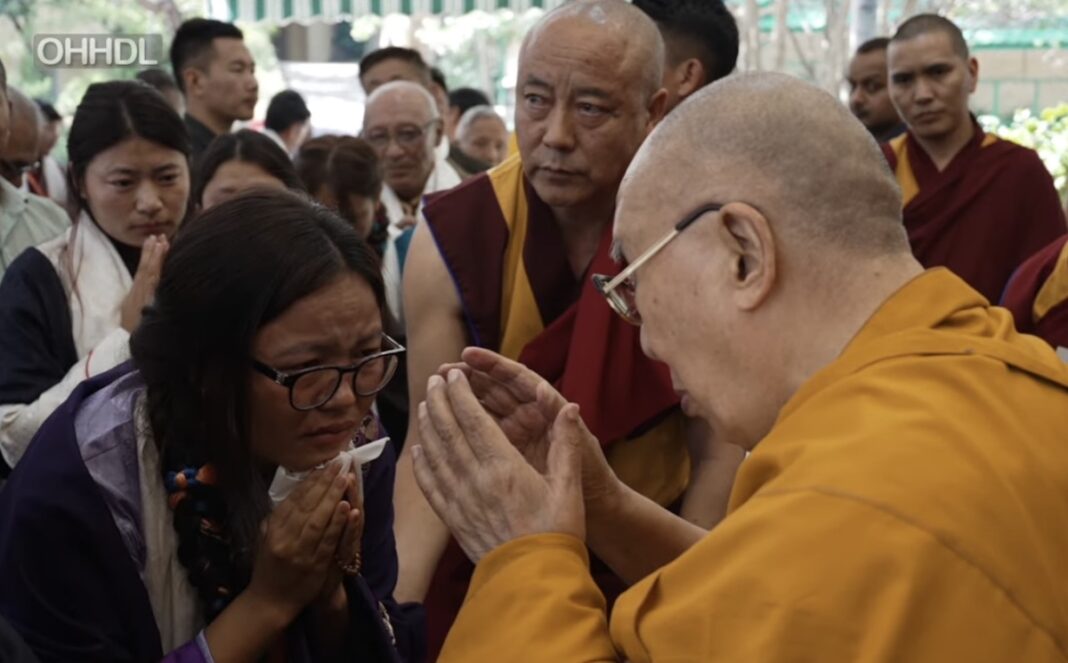
During the audience, a Tibetan devotee was seen appealing to His Holiness to pray that she may one day reunite with her family members in Tibet. Responding to the request, he remarked that he also hoped to be able to visit Tibet again someday.
His Holiness further said that the morale and spirit of Tibetans living inside Tibet remain remarkably strong despite decades of political repression and hardship. He urged Tibetans both inside Tibet and in exile to continue strengthening unity, mutual trust, and collective resolve.
Emphasizing the importance of solidarity among Tibetans across geographical boundaries, His Holiness advised that Tibetans should not regard themselves as separated from “Gyalwa Tenzin Gyatso,” referring to himself by his ordained name. He encouraged Tibetans in Tibet and in exile to nurture a shared sense of purpose and emotional closeness.
The Nobel Laureate has on several occasions in the past expressed hope of returning to Tibet, linking that hope to the possibility of greater openness and political reform in China. In several past remarks, he suggested that if conditions permitted, he would like to visit Tibet, including on pilgrimage, but not necessarily remain there permanently.
He has also previously expressed his desire to undertake a pilgrimage to Mount Wutai in China, one of Buddhism’s holiest mountains, associated with Manjushri, the Bodhisattva of Wisdom. The wish to visit Wutai Shan has generally been framed by His Holiness as a religious pilgrimage rather than a political return to Tibet.
Over the years, he has also referred to India, particularly Dharamshala, as his home after more than six decades in exile. He has consistently maintained both his deep emotional connection to Tibet and profound gratitude to India for hosting the Tibetan people and preserving the Tibetan Buddhist tradition in exile.

