

Tenzin Nyidon
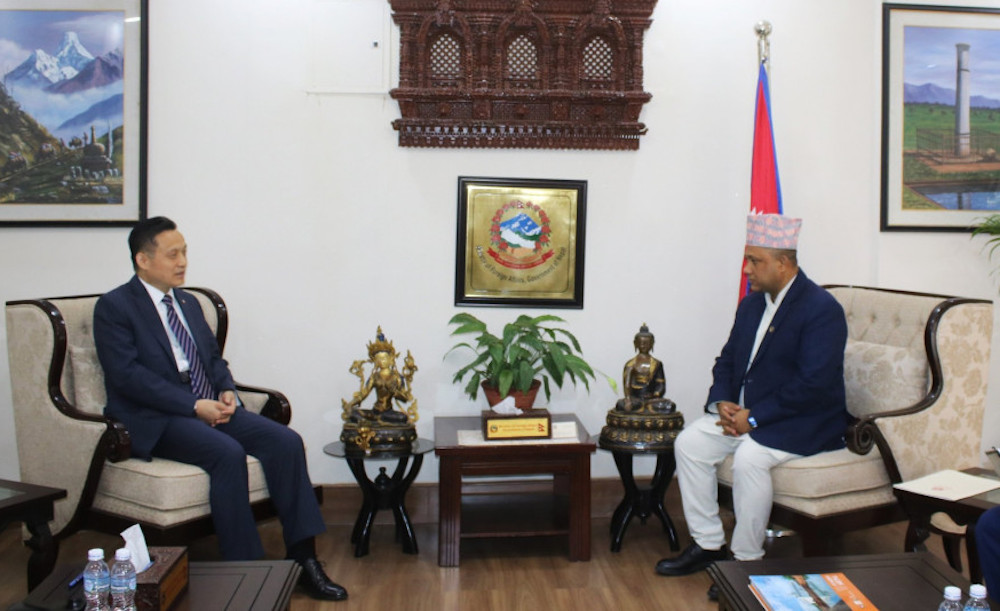
DHARAMSHALA, April 8: Nepal’s newly appointed Foreign Minister Shisir Khanal on Tuesday assured Chinese Ambassador Zhang Maoming that Kathmandu’s position toward Beijing would remain unchanged honouring ‘One China’ policy under the new administration led by Prime Minister Balendra Shah. The assurance came during the envoy’s visit to Nepal’s Ministry of Foreign Affairs.
During the meeting, Ambassador Zhang conveyed messages from Chinese leaders and sought clarity on the new government’s foreign policy direction, particularly its stance toward China and the status of previously signed bilateral agreements. According to reports, discussions also touched on key strategic and economic interests shared by both countries.
“We will continue to uphold our principled position enshrined in the constitution regarding foreign policy. Our stance and standards would remain the same. As always, we will support the one-China principle and will not allow our territory to be used against any country, including China,” Foreign Minister Khanal reaffirmed, highlighting the priorities of the new administration.
Earlier, delegations from the Communist Party of China visited Kathmandu following the RSP’s electoral victory to gain a better understanding of the new government’s foreign policy orientation. These engagements came amid speculation regarding potential shifts in Nepal’s diplomatic stance.
With Beijing keen to safeguard its strategic interests, investments, and prior agreements, multiple delegations were dispatched to engage with Nepal’s new leadership and ensure continuity in bilateral relations.
Ambassador Zhang, in turn, assured full support and cooperation from Beijing and welcomed Nepal’s reaffirmation of its longstanding foreign policy commitments. Both sides also discussed the resumption of stalled bilateral mechanisms, including the Bilateral Consultative Mechanism (BCM) at the foreign secretary level, likely to take place in the coming months.
Additionally, talks covered enhancing connectivity projects, boosting trade and tourism, and expanding investment opportunities. The Chinese envoy also raised the prospect of advancing joint projects under the Belt and Road Initiative (BRI) framework and extended an invitation to Foreign Minister Khanal to visit China at a mutually convenient time.
The development follows congratulatory messages sent by Chinese Premier Li Qiang, Foreign Minister Wang Yi, the Communist Party of China, and China’s Foreign Ministry to Prime Minister Shah, Foreign Minister Khanal, and the Rastriya Swatantra Party (RSP), expressing Beijing’s readiness to work closely with Nepal’s new leadership.
In Beijing, Chinese Foreign Ministry spokesperson Lin Jian reiterated China’s longstanding support for Nepal’s sovereignty, territorial integrity, and development during a press briefing on March 28. He further emphasized China’s willingness to deepen bilateral cooperation and advance the strategic partnership defined by “everlasting friendship for development and prosperity.”
Nepal’s renewed commitment to the ‘One-China’ policy under Foreign Minister Shisir Khanal mirrors similar assurances made by previous administrations, including that of former Prime Minister Khadga Prasad Sharma Oli, who was widely seen as pro-Beijing.
However, the deepening ties between Kathmandu and Beijing have raised growing concerns over the treatment of Tibetan refugees in Nepal, with rights groups pointing to increasing restrictions in recent years.
A 2023 report titled Languishing in Limbo: Tibetan Refugees in Nepal, published by the Tibetan Centre for Human Rights and Democracy and the Asian Dignity Initiative, documented a significant deterioration in refugee rights. The report noted that Nepal’s economic dependence on China, particularly following its participation in the Belt and Road Initiative (BRI) in 2017, has led to stricter enforcement of policies aligned with the ‘One-China’ principle. These include halting the issuance of Refugee Cards, restricting cultural and religious activities, and banning public celebrations such as the birthday of His Holiness the 14th Dalai Lama.

