

Tenzin Nyidon
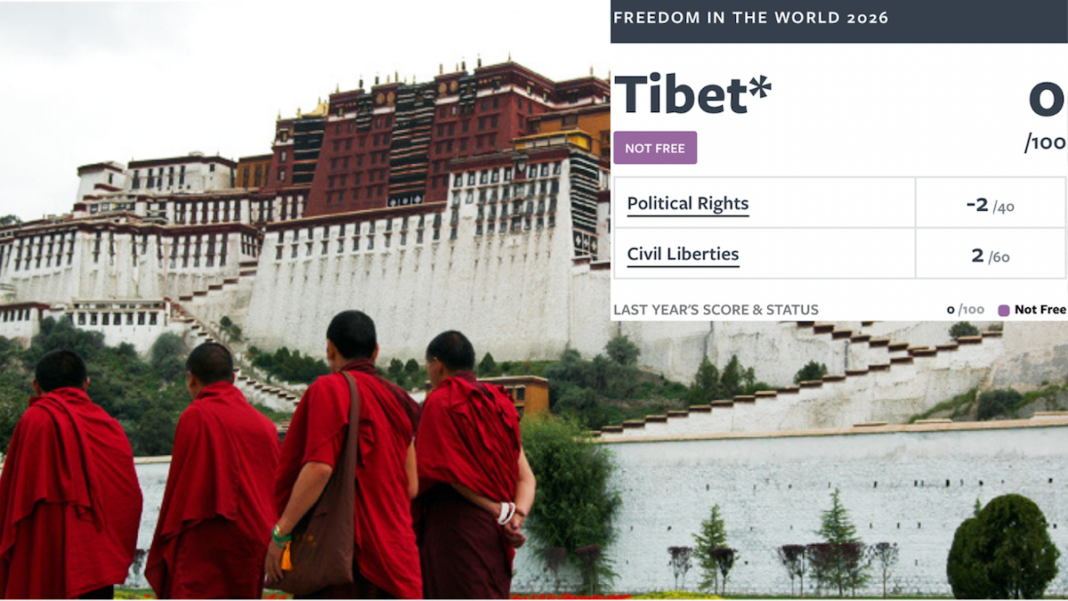
DHARAMSHALA, March 24: Tibet has once again received the lowest possible score in the Freedom in the World 2026 report released by Freedom House, marking the third consecutive year the region has ranked at the very bottom of global freedom indices. The report assigned Tibet an overall score of 0 out of 100, with a political rights score of –2 out of 40 and a civil liberties score of 2 out of 60.
Among the key developments highlighted is the introduction of a draft Law on Promoting Ethnic Unity and Progress in September 2025. If enacted, the legislation is likely to deepen assimilation policies and further weaken protections for minority languages, culture, and religion, according to the report.
The report also emphasised the continued tightening of state control over religious affairs. Chinese authorities have persisted in asserting exclusive authority over the recognition of the next Dalai Lama. However, the 14th Dalai Lama rejected this claim in July, reiterating that only legitimate Tibetan Buddhist authorities established under his trust have the authority to identify his successor.
A central factor behind Tibet’s negative political rights score is the effective exclusion of Tibetans from meaningful political participation. The report noted that real decision-making power rests with the Chinese Communist Party (CCP), with key leadership roles dominated by party appointees such as Wang Junzheng, while Tibetan officials largely occupy symbolic positions.
Electoral processes at all levels remain tightly controlled, with candidates vetted by the CCP and no space for opposition parties or independent political activity. The report further highlighted that expressions of loyalty to the Central Tibetan Administration (CTA), the exile government based in Dharamshala, are criminalized, further constraining political pluralism.
Regarding civil liberties, the report attributed Tibet’s extremely low score to sweeping restrictions imposed across all sectors. Media outlets remain under strict state control, and individuals risk arrest for sharing information deemed politically sensitive. The use of the Tibetan language is restricted on several digital platforms, and communication with foreign media is treated as a criminal offence.
Religious freedom also remained severely curtailed, with monasteries subjected to extensive surveillance and state oversight. Tibetan Buddhists are often required to denounce the Dalai Lama and pledge allegiance to the CCP. The report also cites the death in custody of Tibetan religious leader Tulku Hungkar Dorje in 2025, noting that the circumstances surrounding his death remain unclear.
The report further observed that academic freedom is virtually nonexistent. Schools enforce Mandarin as the primary medium of instruction while promoting political indoctrination. At the same time, a pervasive surveillance system, including facial recognition technology and widespread monitoring, limits even private expression.
“Residents of both Han Chinese and Tibetan ethnicity are denied fundamental rights, but the authorities are especially rigorous in suppressing any signs of dissent among Tibetans, including manifestations of Tibetan religious beliefs and cultural identity,” the report stated. It added that state policies encouraging migration from other parts of China, along with the forced relocation of Tibetans, have gradually reduced the proportion of ethnic Tibetans in their own homeland.

